
Several Rivian owners reported this week that the Highway Assist feature on their R1 vehicles stopped working on highways where they had used it for months.
Drivers of both first- and second-generation R1 vehicles posted the complaints across social media platforms Reddit and X.
The reports were first noticed by Rivian owner and enthusiast Chris Hilbert, who wrote on X that he was “seeing lots of reports of a reduction in coverage on Gen 1 Highway Assist,” tagging Rivian and Chief Software Officer Wassym Bensaid.
As of press time, Rivian has not issued a public statement on the reports.
Owner Reports
Reddit user ‘Benthebuilder23’, identified as an R1S owner, said Highway Assist stopped working after a hard reset.
A dashboard photo shared with the post showed the alert “Highway Assist unavailable. Connectivity is off in Privacy settings,” displayed while driving on Interstate 49.
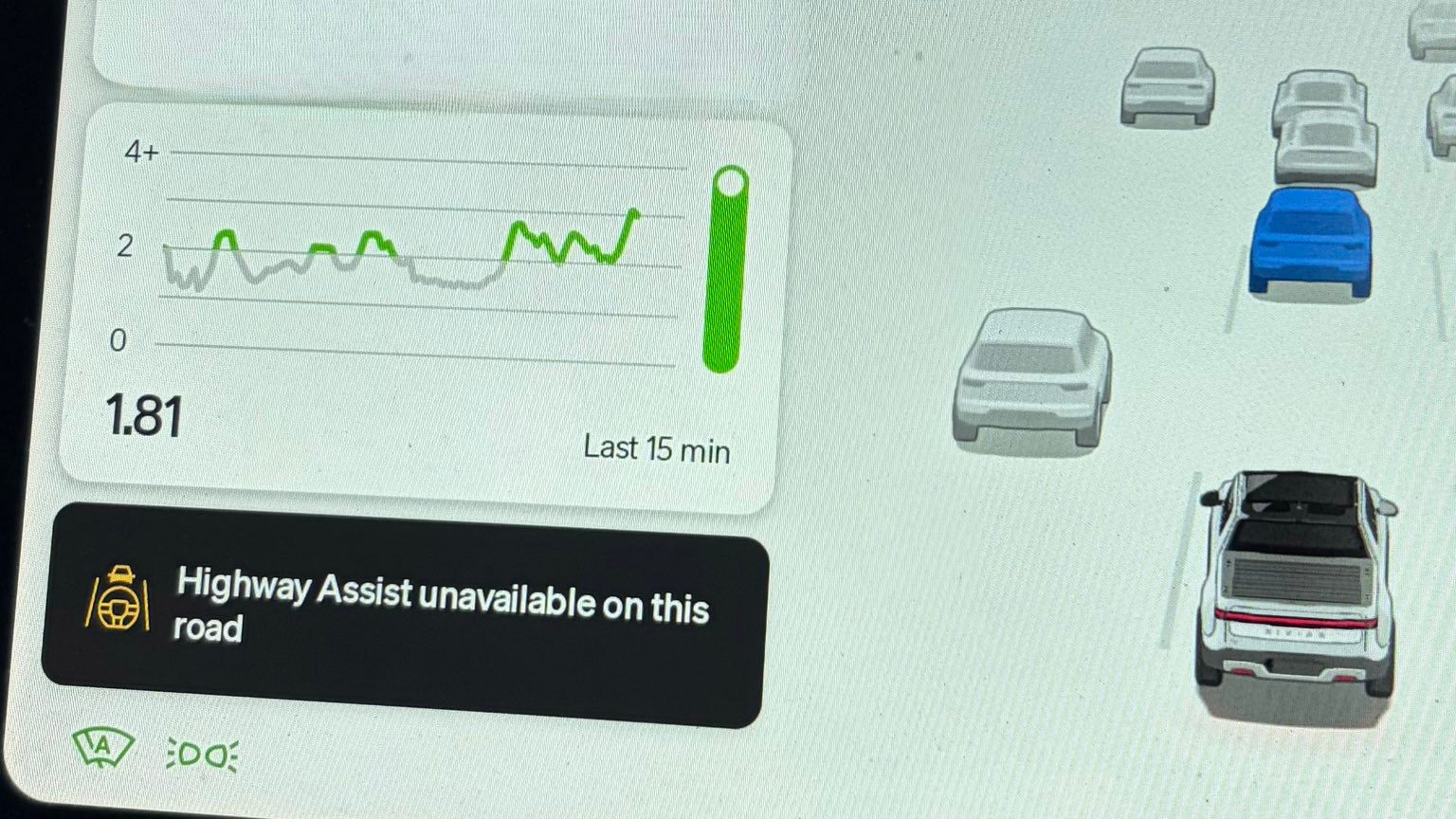
On X, owner ‘Mikekantorski’ revealed his Rivian had “decided the road I use highway assist on everyday is no longer available,” alongside an on-screen message reading “Highway Assist unavailable on this road.”
Drivers on both generations described the same behavior across the comment section and separate posts.
X user ‘_ashipp’ said his Gen 1 vehicle no longer allowed the feature on a highway he had used it on many times before, while user ‘ChristianSelig’ noted he has a “on Gen 2 and lost basically all our major highways here too.”
User ‘jeffreyblum’ said Highway Assist had become unavailable mid-drive on a Gen 2 vehicle, dating the change to the latest software update.
X user ‘MScyph,’ replying to a separate post, said he upgraded to Autonomy+ for a drive from Southern California to Oregon and lost Universal Hands-Free about 100 miles into Interstate 5, after a prompt to take control of the vehicle.
Rivian enthusiast and blogger ‘RivianTrackr’ tied the outage to a privacy-settings problem affecting Highway Assist and Lane Change on Command on the Autonomy+ tier.
Rivian has not confirmed the reports, named a cause, or said whether a fix is in progress.
Privacy Settings
Highway Assist depends on data-sharing permissions in the vehicle’s Data and Privacy menu.
Rivian‘s release notes for software version 2022.47 stated that Highway Assist would not be available if owners limited the sharing of precise location data.
The company’s data privacy notice lists precise location among the data shared for navigation, Highway Assist, the mobile app and analytics, and warns that turning it off can limit or disable those functions.
Rivian also notes that disabling all vehicle connectivity restricts features including navigation and lane-keeping assistance.
A support page makes the same point, stating that turning off precise location for driver assistance stops the features from working.
The dashboard error shared by one owner — “Connectivity is off in Privacy settings” — points to that same layer.
So do the reports of owners re-approving location tracking after software updates and resets.
Rivian‘s documentation does not explain what would flip those permissions without the owner’s input.
Software Trigger
A brand enthusiast and blogger ‘RivianRoamer’ attributed the problem to the 2026.15 software update a few hours later.
The account said the issue was “tied to the 2026.15 software, not your hardware,” and that affected vehicles had started reporting frozen location around the same time. By its account, owners may see missing location and speed on drive and charge sessions, location that looks stuck in the Rivian app, and Universal Hands-Free failing to enable where it previously worked.
‘RivianRoamer’ said it had word that Rivian was aware of the problem and working on a fix, though the company has not confirmed that publicly. The account outlined a manual workaround in three steps.
A soft restart comes first, holding the left and right steering-wheel buttons together for about 10 seconds until the center display reboots.
After the reboot, owners should accept any prompt on the center display to enable precise location. Owners can then toggle Hide Location off and on under the Location menu in the Rivian app to resync sharing.
Autonomy Platform
Rivian splits its driver-assistance offering by vehicle generation.
Gen 1 R1 models, built for model years 2022 through 2024, use Driver+, which bundles Highway Assist, Adaptive Cruise Control and Lane Change Assist.
Gen 2 R1 vehicles ship with the Rivian Autonomy Platform, an in-house system the company built after cutting ties with its earlier hardware and software.
The Gen 2 platform runs on 11 exterior cameras, five radars, 12 ultrasonic sensors and a driver-facing camera for attention monitoring.
Rivian‘s Gen 2 autonomy computer delivers 250 trillion operations per second, which the company says is roughly 10 times more powerful than the Gen 1 system.
The company classifies the platform as SAE Level 2, leaving the driver responsible for the vehicle at all times.
Autonomy+ is the paid upper tier, priced at $49.99 a month or $2,500 as a one-time purchase in the United States.
Lane Change on Command, which executes highway lane changes when the driver signals, sits within that tier, alongside Universal Hands-Free and Enhanced Highway Assist.
Rivian began charging for the suite in April after extending a 60-day free trial three times.
The software sits between Tesla‘s Autopilot and its more advanced Full Self-Driving (Supervised) in capability.
Autonomy Push
Rivian has expanded its assisted-driving footprint sharply over the past year.
At its ‘Autonomy & AI Day’ on December 11, the company set out a roadmap toward hands-off and eyes-off driving.
A software update soon after expanded Universal Hands-Free coverage from about 135,000 miles to more than 3.5 million miles of marked roads across the U.S. and Canada.
Universal Hands-Free works on roads with clearly marked lanes, though it does not stop or slow for traffic lights or stop signs.
Chief Executive Officer RJ Scaringe has laid out a phased plan: hands-free highway driving, then hands-free on more roads, then address-to-address driving.
Rivian has said it drove a vehicle autonomously for two hours in testing, and has signaled an eyes-off capability for controlled conditions in 2026.
The company develops the platform and its camera hardware in-house, training models on sensor data rather than coding fixed rules.
Rivian has also filed a patent outlining a fail-safe braking architecture for autonomous operation.
Earlier Highway Assist Problems
Highway Assist has drawn scrutiny before.
In September 2025, the National Highway Traffic Safety Administration said Rivian was recalling 24,214 R1S and R1T vehicles from model year 2025 over a defect that could cause Highway Assist to misidentify lead vehicles.
Regulators flagged the defect after an incident in which a 2025 R1S misclassified a low-speed vehicle.
Rivian fixed the problem through over-the-air update 2025.18.30, which it said reached more than 99% of affected vehicles.
Transport Canada issued a parallel recall covering the same models.
An earlier customer-satisfaction campaign, dated August 2023, covered some 2022 R1T vehicles built with a driver-assistance module that could not receive updated HD map information — a gap Rivian said could degrade Highway Assist performance over time.
Rivian resolved that case with a firmware update.
Unlike both prior cases, the current reports point to a settings problem rather than a hardware fault or a misclassification defect, and span both vehicle generations.