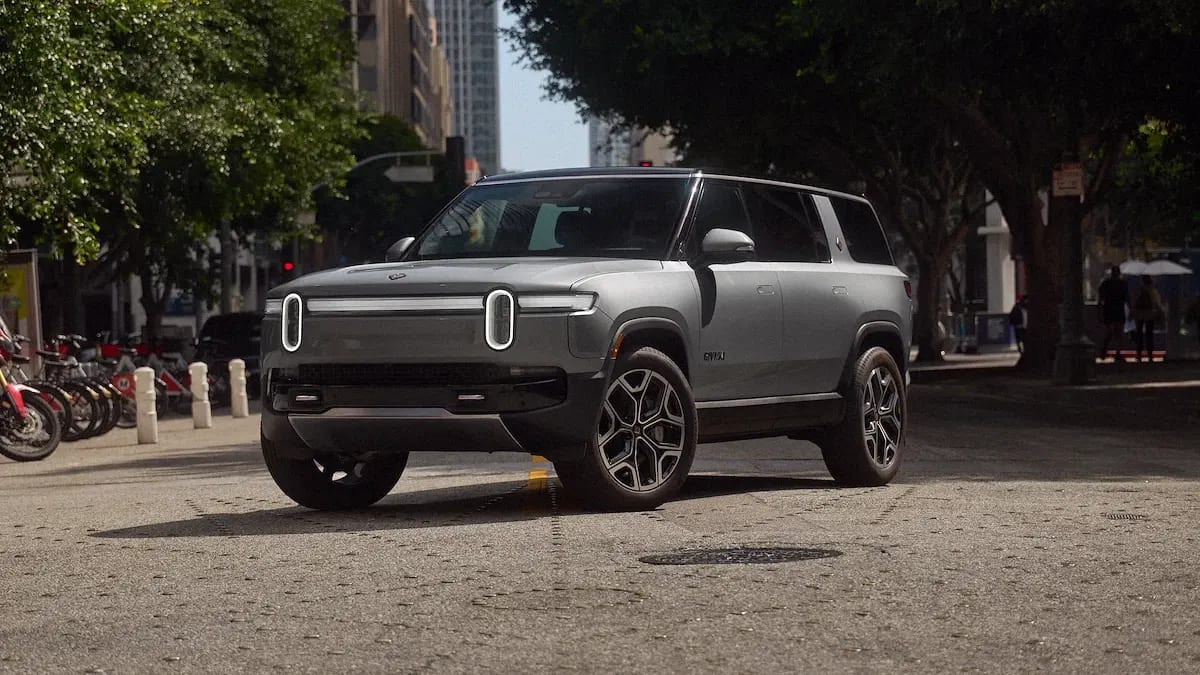

Rivian announced its 2027 model year R1T and R1S on Thursday, retiring the powertrain-based trim names that have defined the flagship line since launch and replacing them with the Premium, Performance and Quad ladder introduced on the R2.
EV reported the new names on July 28, drawn from certification documents filed with the US Environmental Protection Agency (EPA), weeks before Rivian said anything publicly.
The carline “R1T/R1S Premium Long Range” appeared in the filings exactly as it now appears in the configurator.
Entry pricing is unchanged.
The R1T Premium starts at $79,990 and the R1S Premium at $83,990, matching the 2026 Dual with Large battery configurations that became the base models after Rivian discontinued the Dual Standard variant in late June.
The Ladder
Premium is the Dual-Motor trim, with one motor front and one rear, 533 hp and 610 lb-ft.
Performance replaces the outgoing Tri configuration, with three motors, 850 hp, 1,103 lb-ft and a 2.9-second 0-60 mph, at $100,990 for the R1T and $106,990 for the R1S.
Quad remains the flagship at 1,025 hp and 1,198 lb-ft, with 0-60 in 2.5 seconds in the pickup and 2.6 in the SUV, priced at $115,990 and $121,990.
Long Range sits inside Premium rather than beside it. The configurator offers the Max battery as a $7,000 drive-system option on the Dual-Motor cars, producing the R1T Premium Long Range at $86,990 and the R1S equivalent at $90,990 — the configuration named in the certification filings, sold as an option rather than a separate trim.
The Power Upgrade, which lifts the Dual-Motor cars to 665 hp and 829 lb-ft for a 3.4-second 0-60 and unlocks the Sport, Soft Sand and Rally drive modes, costs $5,000 and remains Premium-only. That is the configuration Rivian‘s California Air Resources Board paperwork tied to the Premium designation.
The 92.5-kWh Standard pack does not appear anywhere in the 2027 lineup, formalising the change EV identified in the certification filings.
Two Sets of Range Figures
Rivian has published a range of two different wheel and tire packages.
On 22-inch Range wheels, the basis for the figures on the company’s comparison pages, Premium is rated at 329 miles, Premium Long Range at 420 in the R1T and 410 in the R1S, Performance at 371 and Quad at 374.
On the new standard all-season adventure tires, the same vehicles are quoted at 300 miles for Premium, 380 for Premium Long Range and 348 for Performance.
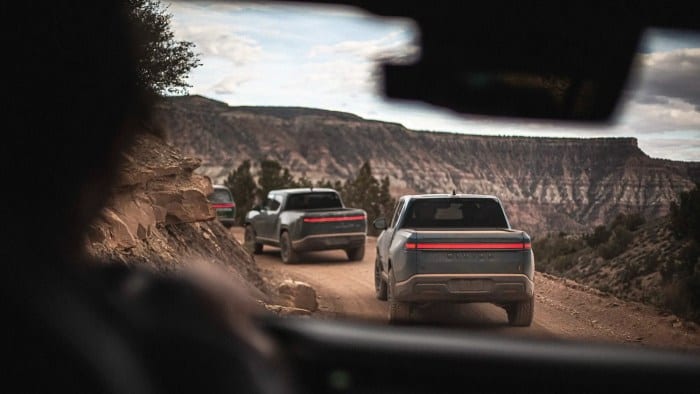
The R1T gains a 20-inch Adventure All-Season wheel and tire combination as standard equipment, which Rivian says adds traction without the range penalty of a full all-terrain fitment.
Moving from road to all-terrain tires has previously cost the pickup about 50 miles.
The company has not published a single table covering both configurations, and its own footnotes caution that some figures are preliminary estimates rather than official EPA values.
The R1S Gets Captain’s Chairs
For the first time, the R1S can be ordered with a six-seat layout with second-row captain’s chairs.
The seats are heated, with armrests that stow flush when not in use, pop-out cupholders and the ability to fold flat.
The option costs between $1,500 and $4,500 depending on interior specification, and requires the Sound and Vision package.
On the base R1S Premium the configurator lists the chairs at $4,000, bundling the $2,500 package that brings the Dynamic Glass Roof and Rivian Premium Audio.
The seven-seat layout continues on the R1S Premium and on Performance and Quad with the Black Mountain Signature interior.
Equipment and Colour
The gap between Premium and the trims above it is now equipment as much as power.
Premium runs independent air suspension with four ride heights, a knitted textile headliner and a panoramic glass roof, with the Sound and Vision package optional. Performance and Quad get five ride heights, a soft-touch sueded headliner, the Dynamic Glass Roof and Sound and Vision as standard.
The All-Terrain Package — 20-inch all-terrain wheels, a spare and a reinforced underbody shield — is available on Premium and Performance but not on Quad, which includes the shield outright. The pickup’s package carries a full-sized spare where the SUV’s carries a compact one.
Towing is unchanged at 7,700 lb for the Dual-Motor cars and 11,000 lb for Performance and Quad, while payload runs the other way at 2,116 lb for the Premium R1T against 1,702 lb and 1,669 lb higher up.
Premium is the efficiency leader at 85 MPGe against 76 for both trims above it, and carries the lowest life-cycle carbon footprint at 325 g CO2e per mile in the R1T and 321 g in the R1S.
Esker Silver becomes the standard no-cost colour across the R1 line, replacing LA Silver and carried over from the R2, where it has been the default since launch.
Interior names have also been aligned with the R2, and the R1S configurator now carries an accents and badging section the R1T does not, bundled with the 22-inch Range wheels as a Bright Package.
The certification filings also flagged a charging change that has now shipped: where 2026 vehicles included a CCS adapter, the 2027 build sheet lists a bundled SAE J1772 AC adapter, with native NACS charging standard.
Driver assistance is now a separate line. Autonomy+ is offered as a $2,500 one-time purchase after a 60-day trial, and Rivian says the features remain available for the lifetime of hardware support and transfer with the vehicle when it is sold.
Prices Held, Leases Did Not
The unchanged sticker prices do not carry through to the lease line.
Every 2027 configuration is quoted $100 a month above its 2026 equivalent, a uniform increase first reported on Thursday by Rivian owner and X user Chris Hilbert.
On the pickup, the Premium moves from $1,129 to $1,229, the Performance from $1,559 to $1,659 and the Quad from $1,979 to $2,079.
The SUV follows the same step: Premium from $1,139 to $1,239, Performance from $1,599 to $1,699 and Quad from $2,029 to $2,129.
Across a 36-month term that is $3,600 on every configuration in the range.
As the increase is flat rather than proportional, it lands hardest on the cheapest trims.
The entry cars absorb close to 8.9%, the Performance trims about 6.3% and the Quads around 5%.
The uniformity points to a change in financing terms rather than trim-by-trim residual assumptions — a money factor adjustment, a fee, or both, applied across the range.
The R1S figure also sits above an increase Rivian imposed and then withdrew earlier in the summer.
The company raised that lease to $1,189 in July before returning it to $1,139 at the start of August; the 2027 quote is $50 above the reversed July level.
The Ladder Steepens With Price
Within the 2027 range, monthly payments rise faster than sticker prices.
The R1T runs $1,229 for Premium, $1,659 for Performance and $2,079 for Quad. As a share of purchase price that is 1.54%, 1.64% and 1.79% a month, meaning the flagship costs proportionally more to lease than the entry car.
The R1S follows the same curve at 1.48%, 1.59% and 1.75%.
The comparison between the two body styles runs the other way. The R1S costs $4,000 more than the R1T at Premium but leases for only $10 a month more, and the $6,000 gaps at Performance and Quad translate into $40 and $50. Spread evenly over 36 months, a $4,000 price difference would be worth about $111 a month before financing.
Rivian‘s own lease pricing therefore assumes the SUV holds its value considerably better than the pickup — consistent with second-quarter deliveries, where the R1T fell 30.4% while the R1S held roughly flat.
Demand Backdrop
The refresh arrives against a softening flagship line.
R1 deliveries came to an estimated 7,402 units in the second quarter, down 6.3% year on year, with the R1T falling 30.4% to an estimated 1,219 units while the R1S held roughly flat at 6,183. Full-year R1 deliveries fell about 15.1% in 2025.
Rivian has attributed part of that to buyers waiting for the cheaper R2, which began external deliveries on June 9.
The company has assigned the VIN 6,000 this week, as EV reported.