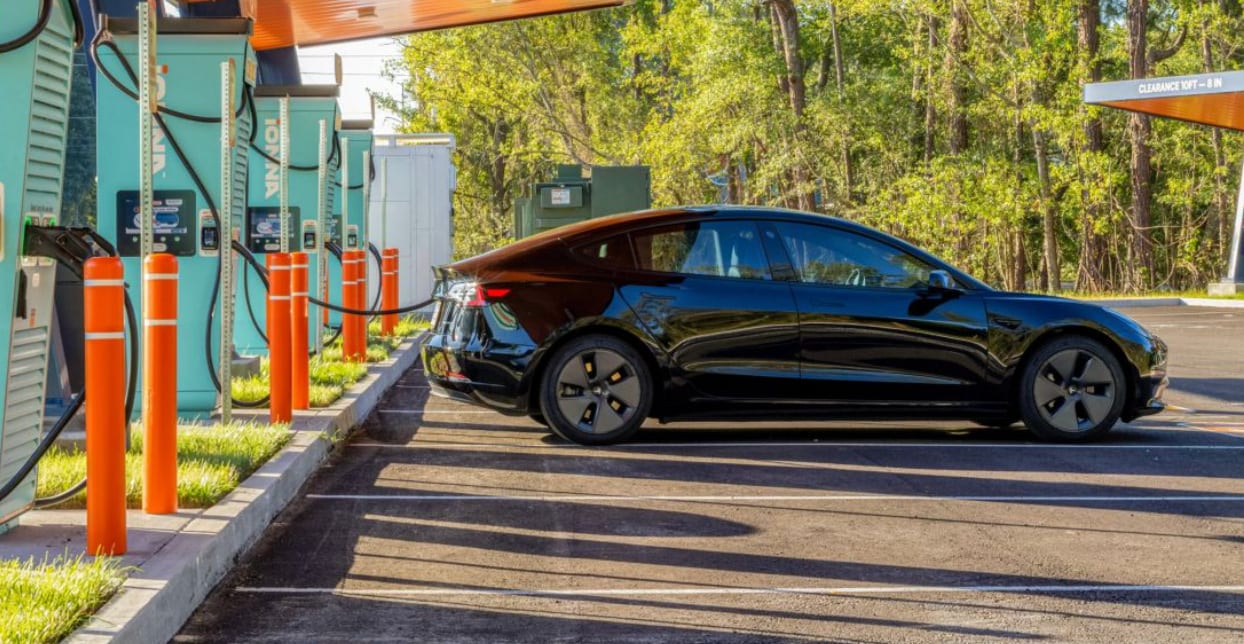

Three charging networks built by automakers swept the DC fast-charging rankings in J.D. Power’s 2026 US EV Experience Public Charging Study, released this week, in the first year all three were eligible for an award.
IONNA ranked highest with 807 points on a 1,000-point scale.
The Mercedes-Benz Charging Network took second at 797 and the Rivian Adventure Network third at 755.
The study, now in its sixth year, drew on responses from 6,594 owners of battery electric and plug-in hybrid vehicles, fielded from January through June 2026 in collaboration with the app maker PlugShare.
The Failure Rate Hit a Record Low
The non-charge visit rate — the share of drivers who arrive at a public charger and leave without charging — fell to 12% in the most recent quarter, the lowest in the study’s history, from 14% a year earlier.
J.D. Power attributed the lowest failure rates to the newer automaker-backed networks, while noting that legacy operators improved as well.
Overall satisfaction with DC fast chargers rose 12 points to 666, with gains across all ten factors the study measures. Charger availability improved most at 27 points, followed by how safe customers feel at charging locations and the cost of charging, both up 18.
Slow charging speed remains the most commonly reported problem across both charger types, though the study found it has improved substantially for DC fast chargers.
Level 2 Went the Other Way
Satisfaction with public Level 2 chargers fell 12 points to 595, driven primarily by lower scores for ease of payment and ease of charging.
That divergence — DC fast charging up 12 points, Level 2 down 12 — is the study’s sharpest internal contrast, and it sits behind J.D. Power’s warning that work remains before mainstream buyers trust public charging.
“The decline in the Level 2 charging segment shows there is still work to be done on network quality, location strategy and customer education before mainstream shoppers fully trust public charging,” said Brent Gruber, executive director of EV solutions at J.D. Power.
Only the DC fast charger segment was award-eligible this year.
Why the New Networks Won
J.D. Power quantified the gap.
The three automaker-backed networks posted their largest advantages over the segment average in ease of charging, charging speed and charger availability — in some cases exceeding 100 index points.
Gruber said the newest generation of automaker-backed networks shows what public charging looks like when it is designed around the driver, and that focusing on reliability, convenience and a more seamless journey addresses some of the biggest barriers to adoption.
He also placed the finding in commercial context, saying J.D. Power data consistently shows public charging is the top reason new-vehicle shoppers reject electric vehicles.
Study Details
The study found satisfaction varies sharply by location type.
DC fast chargers at hotels scored highest at 692, followed by gas stations and convenience stores at 689 and restaurants at 688.
At the other end, chargers at car dealerships scored 570 and those in stand-alone parking lots and garages 606 — among the least satisfying experiences owners reported.
The dealership result is the most awkward of the set, given that dealer networks are where most legacy automakers have concentrated their own charging investment.
The Scale Caveat
The ranking measures experience, not coverage, and on coverage the three winners remain small.
IONNA — backed by BMW, General Motors, Honda, Hyundai, Kia, Mercedes-Benz, Stellantis and Toyota — was announced in 2023 and opened its first Rechargeries in 2025.
It operated 1,375 ports across 150 stations as of this week, against a target of 30,000 stalls by 2030.
The company has no stations in Michigan and one in New York, gaps it intends to close through deals with Circle K and Casey’s.
The Mercedes-Benz Charging Network is a joint venture with MN8 Energy carrying a commitment of more than $1 billion to deliver 2,500 chargers across at least 400 hubs in North America by the end of the decade.
It operated more than 650 stalls across the United States as of January, when it extended into Canada with three hubs in Metro Vancouver and eight planned across the region.
Launched in November 2023 across Texas, Alabama, Georgia, Florida, South Carolina, Tennessee and Kentucky, the network said at the time it expected to reach half of US states by 2026.
It has since added a Starbucks partnership along the Interstate 5 corridor with more than 100 sites planned, and a deal with Federal Realty for over 500 stalls at more than 50 retail destinations.
Its Canadian hubs use a four-cable Alpitronic design in which every stall serves every vehicle without adapters, and Mercedes-Benz plans to begin installing Alpitronic’s 600 kW HYC1000 system at selected new charging parks in Europe and North America from this year, against a global target of more than 10,000 fast-charging points by the end of the decade.
The Rivian Adventure Network is the largest of the three and the furthest behind its own plan. It reached 1,073 stalls across 155 sites in the second quarter, up 37% and 26% respectively year on year, after adding a record 100 stalls in the period and crossing 1,000 in early June.
Average site size is 6.9 stalls, up from 6.3 a year earlier, with peak power often 300 kW.
The company set out in 2021 to build more than 3,500 chargers at over 600 locations across the United States and Canada by the end of 2023.
Two and a half years past that deadline it has under a third of the chargers, about a quarter of the sites and no Canadian locations at all.
Rivian says it has held 98% uptime across the network through 2025 by owning the hardware, software and localised maintenance. Some 97% of locations are open to non-Rivian vehicles, and 166 stalls at around 50 locations carried NACS connectors as of June, with 15 sites now running NACS exclusively.
For comparison, Rivian owners alone can access more than 21,500 Tesla Superchargers in North America.
Whether satisfaction leadership built on curated sites survives a twenty-fold expansion is the question the 2030 targets pose and this study cannot answer.
The Networks Independency
Two relationships complicate the podium.
Mercedes-Benz is one of IONNA’s eight founding backers while also operating the network that finished second to it — investing in the consortium that outscored its own branded operation.
Rivian is not an IONNA member but is a customer. The company added IONNA and Electrify America to its in-vehicle navigation with real-time availability and Plug and Charge support, having taken the same approach with Tesla‘s Superchargers.
Chief software officer Wassym Bensaid has said the company continues to invest in its own network while believing in an open ecosystem that gives customers choice.
J.D. Power published rankings for three networks only.
The release does not give a position for Tesla‘s Supercharger network, Electrify America, EVgo or any other operator, and does not state how many networks were scored but not ranked.