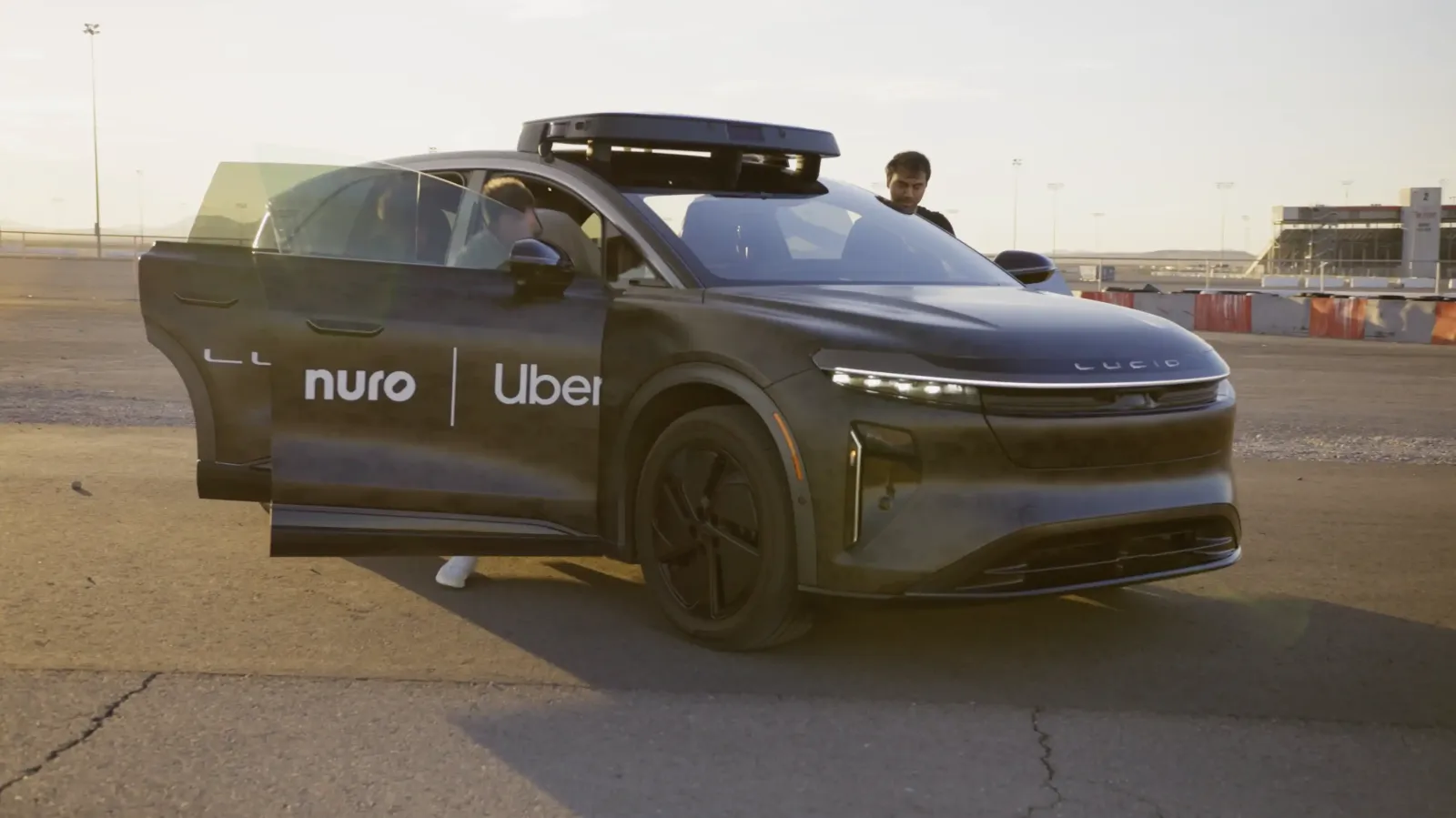
Nuro has met with police departments in Mountain View, Palo Alto and Los Altos to prepare for the launch of its robotaxi service with Uber and Lucid, the self-driving company said on Tuesday.
“We are proud and grateful to collaborate closely with our community to prepare for the launch of our robotaxi program with @Uber and @Lucid,” Nuro wrote on X, thanking the three departments “for the opportunity to share knowledge, discuss safety, and work together toward the future of autonomous mobility.”
The post is the latest sign that the partners are moving toward the San Francisco Bay Area launch they have targeted for this year, with the program still lacking the state permits needed for driverless or paid rides.
Nuro’s post on X carried three photos. One of them shows officers seated in a briefing room bearing the Palo Alto Police badge, facing a presenter and two screens titled “Requesting your Feedback.”
The slides are split into two scenarios: “If the AV did not respond as expected – but did not impact your response” and “If the AV is interfering with an emergency response.” A third photo shows officers gathered outdoors with Nuro staff.
Nuro did not say when the sessions took place or how many officers attended.
What Officers Were Told
Additional photos Nuro shared on LinkedIn show more of the material presented to Palo Alto officers.
For a vehicle that “did not respond as expected” without affecting their response, the slides say “no action is required,” but ask officers, where practical, to note the vehicle’s plate or identifier, location, date, approximate time, what they observed and field conditions, and to share that feedback through an emergency hotline. “Your feedback can help improve future AV performance,” the slide says.
A robotaxi interfering with an emergency response “requires immediate attention — we know every second matters,” the slides say, adding that remote assistance “should already be detecting and supporting the situation.” If the issue continues, officers are told to use the in-vehicle communication system or call the emergency hotline, using a QR code on the vehicle.
A separate slide, titled “Rider Support → Remote Assistance,” says officers can also call rider support through the overhead console and be transferred to remote assistance.
Remote assistance will validate the officer’s name, agency, role, badge number, unit number and callback number, and can “support/assist by completing actions remotely,” such as moving the vehicle to a waypoint or switching it to manual mode, according to the slide.
“The quickest way to reach Remote Assistance is via the Emergency Hotline,” the slide says.
The slides list an Uber emergency hotline. Its number matches the one on Uber’s public-safety page for the “Autonomous Gravity SUV—built by Lucid, driven by Nuro, and available exclusively on Uber,” which tells first responders in an active emergency to “contact local emergency services and follow your agency’s standard procedures.”
That page links to a first-responder interaction plan from Nuro dated June 2026. The plan says Nuro’s remote assistants “do not drive the vehicle” and that “the autonomous system remains responsible for vehicle control,” and adds that the Gravity “can also be operated manually.”
“Nuro will roll down the window when first responder is detected for easier access” to the two-way communication device inside the vehicle, the plan says. It asks callers to “identify the vehicle’s numerical ID, license plate, and location.”
All three cities are in Santa Clara County, one of the two counties where the California Department of Motor Vehicles has approved Nuro for driverless testing of the Lucid Gravity. The other is San Mateo County.
It was Nuro’s second public first-responder session in about a month. On October 1, it thanked “@Uber team” for joining “a training session focused on first responder interaction.”
“Community collaboration and cross-company coordination are key to advancing education, preparedness, and trust ahead of our robotaxi launch,” Nuro wrote then.
Permits Still Pending
Nuro said on May 8 that it had received a California Public Utilities Commission permit to carry passengers with a safety driver on board, building on a DMV driverless testing permit it received in April.
“They do not authorize paid rides, and the CPUC Drivered Pilot Permit does not authorize driverless passenger operations,” the company said at the time.
The CPUC’s list of autonomous vehicle permits still showed Nuro holding only a “Drivered Pilot” permit on Tuesday, with no driverless pilot or deployment authority.
The DMV’s driverless testing list, updated October 22, covers the Lucid Gravity in Santa Clara and San Mateo counties at all times of day and night, at speeds up to 45 mph. Neither the companies nor the regulators have announced a date for paid or driverless public rides.
Fleet Heading West
Lucid said on October 20 that another shipment of robotaxis built at its Arizona factory was on its way to the Bay Area, without saying how many vehicles it carried.
“Built in Arizona. Bound for the Bay. Another robotaxi shipment on the move as our fleet expands,” Lucid wrote on X.
“Pretty cool to see production prototypes for our Lucid Gravity robotaxi program with Uber and Nuro,” Nick Twork, Lucid’s Head of Global Communications, wrote on X on October 23 after visiting the Arizona factory. The car he pictured was “awaiting its halo and a few other sensors.”
On October 28, Lucid showed a turntable “designed together with our partners at @nuro” that “calibrates each sensor on the robotaxi from every angle.”
In its second-quarter results on August 4, Lucid said it had “begun delivering production-validation Lucid Gravity vehicles to Nuro” and described the program as “a top priority.”
The partners have described their engineering fleet as “nearly 100 vehicles” across the Bay Area and Houston, a figure that stayed unchanged for five months as of August.
“This summer, our global robotaxi program with @Uber and @LucidMotors entered Production Validation, incorporating rider-facing features, streamlined manufacturing processes, and soon, driverless testing,” Nuro wrote on October 8.
Lucid Chief Financial Officer Alexander De Bock called the robotaxi “unlike anything else on the road today” after his first ride in September.
Nuro’s Push
Nuro named a Chief Product Officer on October 15 and said the program “calls for a minimum of 35,000 vehicles globally across dozens of markets over the coming years.”
Co-Founder and Co-Chief Executive Officer Jiajun Zhu restated the company’s case for LiDAR last week, sharing memos arguing that cameras alone are not enough for fully driverless cars. The Lucid Gravity robotaxis run the Nuro Driver, which combines cameras, LiDAR and radar.
Houston is the program’s second planned market, with a launch targeted for mid-2027, the companies said on June 17.
Launch Timeline
Uber said in October 2025 that the Bay Area would be the first market for the service, with a launch planned for 2026.
At CES in January, the three companies said that, “pending final validation, the production intent robotaxi is expected to start production at Lucid’s Arizona factory later this year.”
A timeline in Lucid’s first-quarter shareholder deck put production of vehicles for commercial launch and the start of safety and validation work early in the fourth quarter, with commercial operation in late 2026.
Nuro said in July the program had made “great progress” after hosting Uber’s team. The program lost an engineer to Nvidia in late August, and Lucid Chief Executive Officer Silvio Napoli has called autonomy a “strategic priority”.
The Uber Deal
The program dates to July 16, 2025, when Lucid signed a vehicle production agreement with Uber, according to a filing.
“We’re thrilled to partner with Nuro and Lucid on this new robotaxi program, purpose-built just for the Uber platform,” Uber Chief Executive Officer Dara Khosrowshahi said in the July 17, 2025, announcement.
Under it, Uber and its fleet operators agreed to buy a minimum of 20,000 Gravity Plus vehicles over six years from the start of production, “which is targeted to occur in late 2026.” The minimum is conditioned on Lucid meeting certain volume and other requirements, the filing said.
A second agreement signed in April covers a minimum of 25,000 Lucid Midsize Plus robotaxis, with production targeted for late 2028. Through offset provisions, the two deals raise Uber’s total commitment to “at least 35,000 units,” according to Lucid’s second-quarter 10-Q.
Uber has invested $500 million in Lucid, according to the company, and owned about 9.6% of its common stock as of June 30, the 10-Q showed.
Uber has not disclosed how much it has invested in Nuro. Nuro said in August 2025 that part of Uber’s commitment was included in its $203 million Series E round, which valued the company at $6 billion.
Cantor Fitzgerald analyst Andres Sheppard lists the “Launch of robotaxi via Uber/Nuro (4Q26E)” among Lucid’s catalysts in an October 5 note with a ‘Neutral’ rating, according to Price Target, EV‘s sister publication that archives Wall Street analyst research on the EV, AI and semiconductor industries.
Uber will hold its third-quarter earnings call on Wednesday, November 4. Lucid will report third-quarter results five days later.