
Shen Fei, the top executive who built Nio Inc.‘s charging and battery-swap business from nothing, has stepped down as legal representative and manager of the entity that operates it, according to Chinese corporate records.
The filing showed Shen Fei exiting his roles at Wuhan Nio Energy Co., Ltd., — also known as Nio Power — with Guo Chenggang taking over as legal representative, person-in-charge and manager.
Wuhan Nio Energy was established in May 2017, with registered capital of 1.784 billion yuan — equivalent to nearly $264 million.
The company’s business scope spans the research and development of energy-recovery systems, the sale of new-energy-vehicle battery-swap facilities, and the development of electric motors and their control systems — the core of Nio‘s “chargeable, swappable, upgradable” model.
The company is wholly owned by Nio Energy Investment (Hubei) Co., Ltd., which is itself more than 90% held by Nio China, with the balance in the hands of Hubei and Wuhan state capital.
Shen remains president of the Onvo sub-brand and a senior VP of Nio Inc.
The Man Who Built Nio Power
Shen joined the company in 2015 as its 274th employee, holding a doctorate in electrical engineering and arriving from Sieyuan Electric, where he had spent 2007 to 2015 as vice general manager and product director.
He rose to senior vice president and became the architect of Nio‘s bet on battery swapping, the model that separates battery ownership from the vehicle and lets owners upgrade to a larger pack on demand.
“I have always believed that battery swapping is the true value creator,” he said while presenting the third-generation swap stations in 2023, having earlier called battery-as-a-service the only way to match the experience of refuelling a petrol car.
As of Tuesday, the network he built spanned 3,911 battery-swap stations across China, 1,042 of them along highways, and had completed more than 114.3 million cumulative swaps, alongside 5,067 charging stations with 29,157 piles — infrastructure no rival has matched.
The system has kept setting records, passing 100 million swaps in February and topping 177,000 in a single day during the Spring Festival travel rush.
The network has also grown increasingly public, connecting more than 1.5 million third-party charging piles, with non-Nio users accounting for 86.2% of the electricity its own chargers deliver.
Even after moving to Onvo, Shen has kept shaping the network’s next phase, championing larger, expandable swap “hubs”for high-demand cities and fifth-generation stations due to begin deploying in the third quarter.
A Handover Now Complete
The Wuhan filing closes a transition that began more than a year ago.
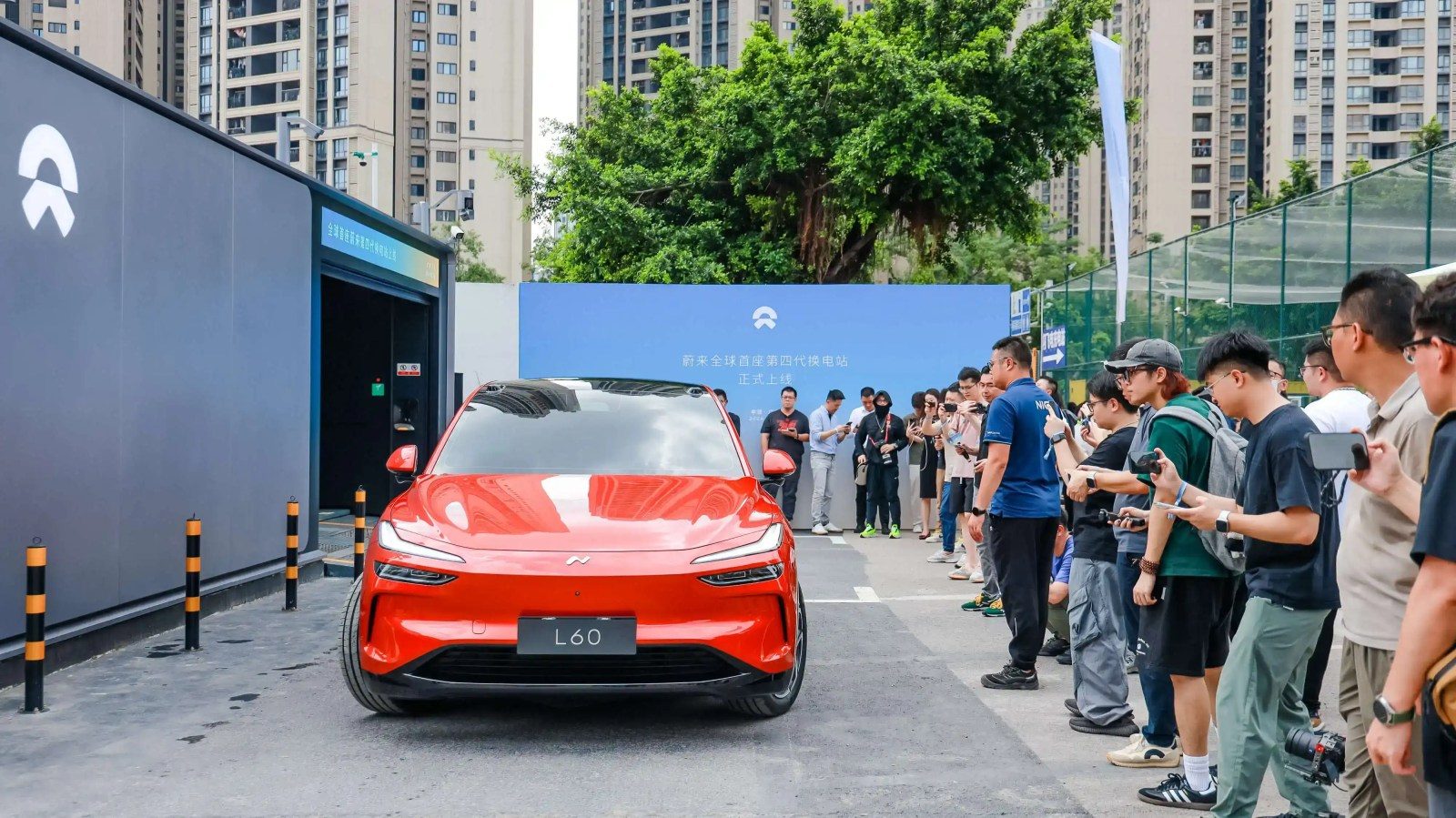
In April 2025, Nio named Shen president of Onvo, its family-focused sub-brand, replacing Alan Ai, a former WeWork and Disney executive who left after the debut L60 SUV missed early sales targets.
“I take on a new challenge today,” Shen wrote on the Onvo app at the time, framing the move as an extension of his swap-network work.
He reports to Nio co-founder and president Qin Lihong, and the operational leadership of the energy business shifted then to chief financial officer Stanley Qu, who holds both titles.
The legal-representative title stayed with Shen until now, and its transfer to Guo completes the separation — operational oversight with Qu, the registered legal helm passing to a lower-profile manager.
Guo keeps a low public profile and has not featured prominently in Nio‘s disclosed organisation, leaving his broader remit unclear.
Shen, meanwhile, has a brand to revive, having relaunched a refreshed L60 in June after Onvo posted its weakest monthly deliveries since its September 2024 launch.
A Business Built to Stand Alone
The timing aligns with Nio‘s push to turn Nio Power into a more independent, externally funded operation, much of it anchored in Hubei province, where Wuhan sits.
In March 2025, battery giant CATL agreed to invest up to 2.5 billion yuan, about $346 million, in Nio Power — a deal Shen himself signed as senior VP — targeting a unified national swap network and shared standards.
The two partners separately formed a battery-asset joint venture in Wuhan and signed a five-year strategic agreement, part of a wider cluster of Nio energy companies in Hubei that also includes Weineng, a distinct battery-asset operator in which CATL already holds roughly 11%.
Founder and chief executive William Li has reaffirmed the goal of adding 1,000 battery-swap stations this year alone, aiming for roughly 4,600 by year-end — though with 3,911 in place by mid-June, most of that build-out still has to land in the second half.
The unit also serves as a release valve for wider financial strain, with chief executive William Li seeking a European battery-swap partner to share the cost of extending the network abroad.
Reaching break-even hinges on raising station utilisation, which in turn depends on partners beyond Nio launching swap-capable models.
Still Mostly Nio’s Own
Nio‘s swap alliance counts seven automakers, among them Changan, Geely, Chery and GAC, with CATL as an investor, yet no partner has launched a mass-produced swap model more than two years on.
Li has publicly tempered the weight he places on the alliance, even as fifth-generation stations — built to serve the Nio, Onvo and Firefly brands together — approach a delayed rollout.