
Nio signed a strategic cooperation agreement with semiconductor supplier GigaDevice on Friday, as the Chinese EV maker expands its automotive chip ecosystem further.
Under the agreement, the two companies will jointly develop automotive-grade chips and next-generation electronic and electrical (E/E) architectures for future Nio vehicles.
GigaDevice will provide automotive memory, microcontrollers (MCUs) and related chip solutions, while Nio will contribute vehicle development expertise, system integration capabilities and application requirements to support chip design and validation.
The partnership will focus on smart cockpit and intelligent driving applications — covering the entire process from chip specification definition and joint research and development to vehicle-level validation and mass production.
According to GigaDevice, the company “will draw on its expertise and large-scale production capabilities in memory, microcontrollers (MCUs), and related peripheral chips to provide Nio with high-performance, highly reliable automotive-grade chip products and system solutions.”
The companies aim to establish an end-to-end development pipeline to accelerate the commercialization of new technologies and develop industry-leading automotive chip solutions.
For GigaDevice, the partnership expands its presence in the automotive semiconductor sector, where demand for automotive-grade memory and controller chips continues to grow as vehicles become increasingly software-defined.
Late last year, Chinese media outlet LatePost reported that Nio had secured the first customer for its in-house developed autonomous driving chip Shenji NX9031, licensing it to an automotive semiconductor company in the first deal of its kind for the Chinese EV maker.
It remains unclear whether the deal with GigaDevice is the one reported.
Nio’s Chip Development
The agreement comes as Nio continues to increase investment in semiconductor technologies, an area the company sees as strategically important for intelligent vehicles.
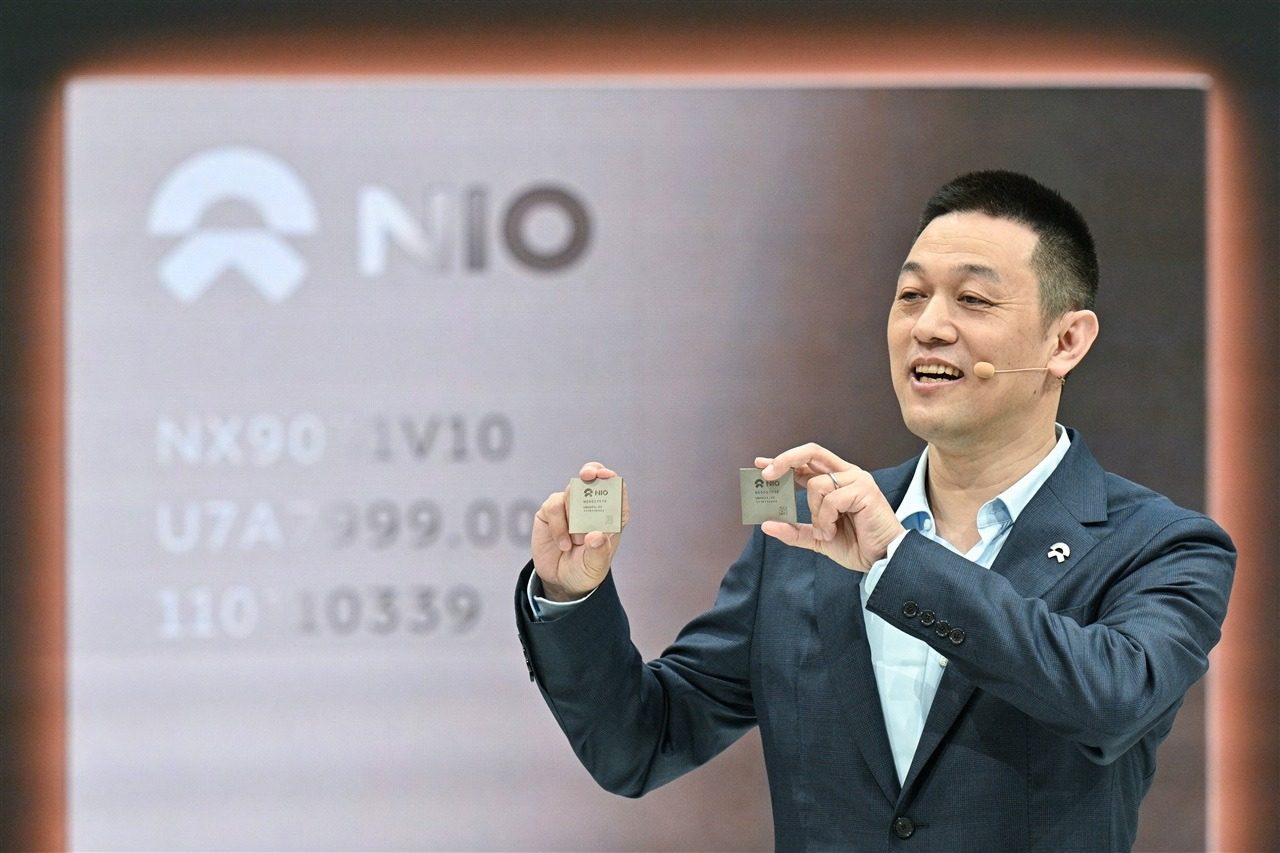
Nio entered automotive chip development in 2021 and has since introduced several in-house chips — including the Yangjian LiDAR main control chip and the Shenji NX9031 intelligent driving processor.
The Shenji NX9031, built on a 5-nanometer process, made its production debut in the ET9 last year.
It has since been included in most model releases, including the facelifts of the ‘5566’ entry-level series and the all-new ES8 — which has been driving the company’s sales for the past eight months.
The chip is also included in the newly launched ES9 — which became Nio‘s flagship SUV and the largest in China.
The EV maker has since shipped more than 250,000 units with the chip, and is expanding its adoption across the lineup — including the recently launched Onvo L90.
According to founder and CEO William Li, bringing the chip to the Onvo brand allows Nio to consolidate its assisted-driving software architecture across multiple vehicle platforms, improving research and development efficiency while strengthening data collection and closed-loop training capabilities.
The company’s founder added that the recent fundraising at its chip subsidiary, Shenji, would give the company more resources and flexibility to develop upcoming chip products, especially more affordable ones.
William Li has previously said that more than 80% of Nio vehicles delivered in the second half of 2026 are expected to use the company’s self-developed intelligent driving chip.
Nio World Model
The Shenji NX9031 is central to Nio‘s effort to reduce reliance on third-party semiconductor suppliers while creating a unified software and hardware platform for advanced driver-assistance systems.
The company views it as a key enabler of the Nio World Model (NWM) software platform.
According to Li, the chip delivers industry-leading performance in AI inference, memory bandwidth, image processing and chip-to-chip communication, while being the first automotive-grade intelligent driving chip manufactured on a 5-nanometer process.
The hardware expansion complements NWM’s software rollout.
Nio initially deployed the system to more than 460,000 existing vehicles running the Banyan operating system and powered by four Nvidia Orin X processors before extending support to newer models equipped with the Shenji NX9031.
By standardizing both its software stack and in-house silicon, Nio aims to accelerate the development and deployment of its next-generation intelligent driving features while lowering long-term development costs.