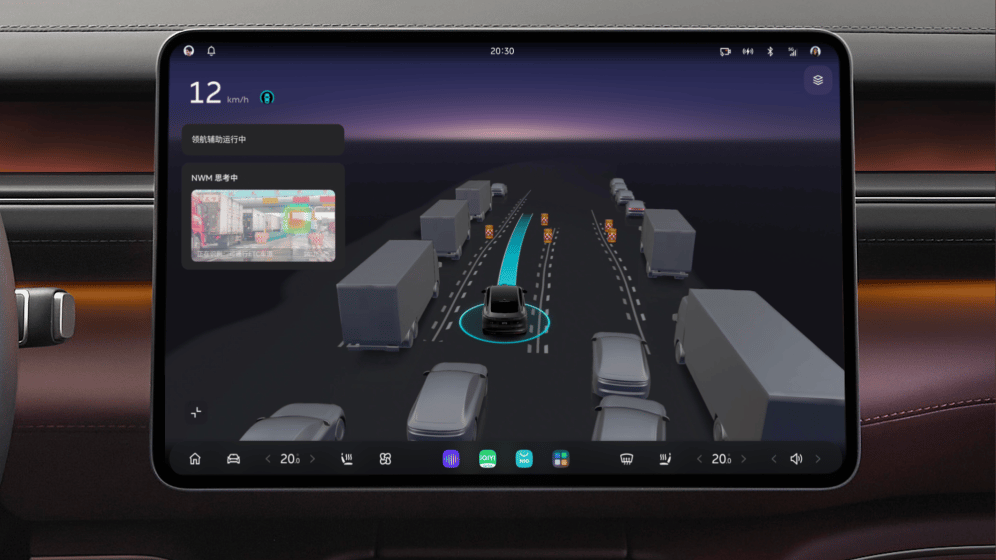

Nio will release a major update to its assisted-driving software in China in June, founder and CEO William Li said on Thursday, while claiming that the system delivers the same “or even better” performance as rival systems while using a fraction of the cloud computing power.
Li disclosed the timing during the company’s first-quarter earnings call, framing the update as the latest in a rapid cadence of releases built on Nio’s NIO World Model (NWM), the architecture that underpins its assisted-driving system.
“In June, both new and existing users will receive the next major NWM upgrade, bringing noticeable improvements across driving, parking and active-safety scenarios,” the founder of the Chinese EV maker said in his opening remarks.
The update will reach owners across Nio’s lineup, extending a system the company has been pushing out through a series of over-the-air releases since the middle of last year.
A Faster Release Cadence
Li said Nio moved this year to an architecture combining the world model with closed-loop reinforcement learning, and that the approach has room to keep improving while running far leaner than rival systems.
“It has great potential for continuous development and iteration, as well as good efficiency, because we are using only 20% of the cloud computing power compared with our competitors to achieve the same level — or even better — smart-driving experience and performance,” Li said.
The June release will not be the last this year. “Later this year we will have another two major upgrades. So we are quite confident in the overall assisted-driving performance and its growth potential,” Li said.
The June update is the next milestone after the version Nio rolled out earlier this year, which the company has credited with a sharp rise in how much its customers lean on the system.
Usage Climbs Sharply
Nio said the new NWM version markedly improved the full-scenario Navigate on Pilot experience in the first quarter.
Within one quarter of the rollout, urban Navigate on Pilot mileage rose 92% quarter-over-quarter, while the share of driving time spent using assisted driving increased 116%.
The first quarter built on momentum the company reported in February, the first full month after the late-January software push.
Nio said in early March that total mileage driven using its assisted-driving system surpassed 200 million kilometers in a single month for the first time in February, an 81.5% increase from January.
Usage of the urban navigate-on-autopilot feature jumped over the same period, with total mileage and driving time rising 76.7% and 81.7% respectively from the previous month.
The number of users who spent more than half their driving time on assisted-driving features rose 210.6% from January.
The travel surge over China’s Spring Festival holiday contributed.
Starting February 18, Nio’s assisted-driving system recorded daily usage above 10 million kilometers for six consecutive days, with urban piloted-driving time up 344.7% from the same holiday period a year earlier.
In-House Chip
The software roadmap runs alongside a hardware shift. Li said that by the second half of the year, more than 80% to 85% of Nio’s cars will carry its in-house developed smart-driving chip.
That chip, the Shenji NX9031, is the world’s first automotive-grade chip built on a five-nanometer process, with what Li described as industry-leading capabilities in inference, data bandwidth, image-signal processing and inter-chip communication.
The chip was first mass-produced on the Nio ET9 in March last year, and the company has since shipped more than 250,000 units to its vehicles. Nio has introduced the chip to newer products, starting with the Onvo L90.
“By introducing it to the Onvo brand, we can also merge the assisted-driving software baseline, improving overall R&D efficiency and enhancing data closed-loop capabilities,” Li said.
The earlier NWM software push reached more than 460,000 existing Nio vehicles equipped with the Banyan system and four Nvidia Orin X chips, before being extended to newer models running the Shenji NX9031.
A Subscription Revenue Stream
Li also positioned assisted driving as a future source of recurring revenue, tying it to the services and community businesses that Nio reports under other sales.
“We will continue our subscription services and business model, as it will also become a very important revenue driver among our other sales revenue,” Li said.
Nio is offering free subscriptions to some early or new users for now, but said used-car buyers will have to pay for the assisted-driving subscription, opening a longer-term revenue channel as vehicles change hands.
The push matters to Nio’s margins. The company reported an other-sales margin of 20.6% in the first quarter, a four-year high, supported by the growing scale and profitability of its services and community businesses.
Li said Nio has now completed the entire chain behind its assisted-driving offering, from the chip to the model and architecture to the closed-loop data and the business model.
He added that the recent fundraising at its chip subsidiary, Shenji, would give the company more resources and flexibility to develop upcoming chip products, especially more affordable ones.
That full-stack push has not been free of internal upheaval.
As EV exclusively reported on May 3, Nio reversed the leadership of its SkyOS full-domain operating system, reinstating veteran engineer Qiyan Wang after ousting the vice president who had overseen the platform — a move a person familiar with the matter tied to the company’s cost-control drive.
The Prior Update
The June release follows Cedar 1.4.0, the seventh version of Nio’s intelligent system and the largest software update yet for its most expensive models, which the company began rolling out in February.
That update brought more than 80 new features and optimizations to the ET9 sedan and the third-generation ES8 across assisted driving, the smart cockpit, the in-car voice assistant and the driving experience.
The headline improvements centered on the navigation-assist system, with efficiency-based lane changes in cities, better on-ramp and off-ramp accuracy on highways, and improved handling of construction zones.
Cedar 1.4.0 also expanded Nio’s parking features, adding the ability to save non-fixed and unmarked parking spots and a scheduled remote-parking function.
It introduced new safety systems, including misacceleration inhibition, improved rear-obstacle detection while reversing, and an automatic emergency steering system able to handle more complex scenarios such as oncoming traffic and vehicles emerging from blind spots.
The flagship Cedar platform runs on the Shenji NX9031 chip, while Nio’s European models continue to run on the separate Banyan operating system, and a Cedar S variant powers the company’s more affordable refreshed lineup — the ES6, EC6, ET5 and ET5 Touring — creating a multi-platform software ecosystem that Nio has been updating through a steady stream of over-the-air releases since mid-2025.
What Comes Next
With the June update and two further upgrades planned for later in the year, Nio is betting that a leaner, faster-iterating software stack and its own silicon can keep its assisted-driving system competitive while feeding a subscription business it expects to become a meaningful revenue driver.
The first measure of whether the strategy is working will come in usage data and subscription uptake through the rest of 2026, as the in-house chip spreads across the lineup and the free trials Nio is offering early users begin to convert into paid plans.