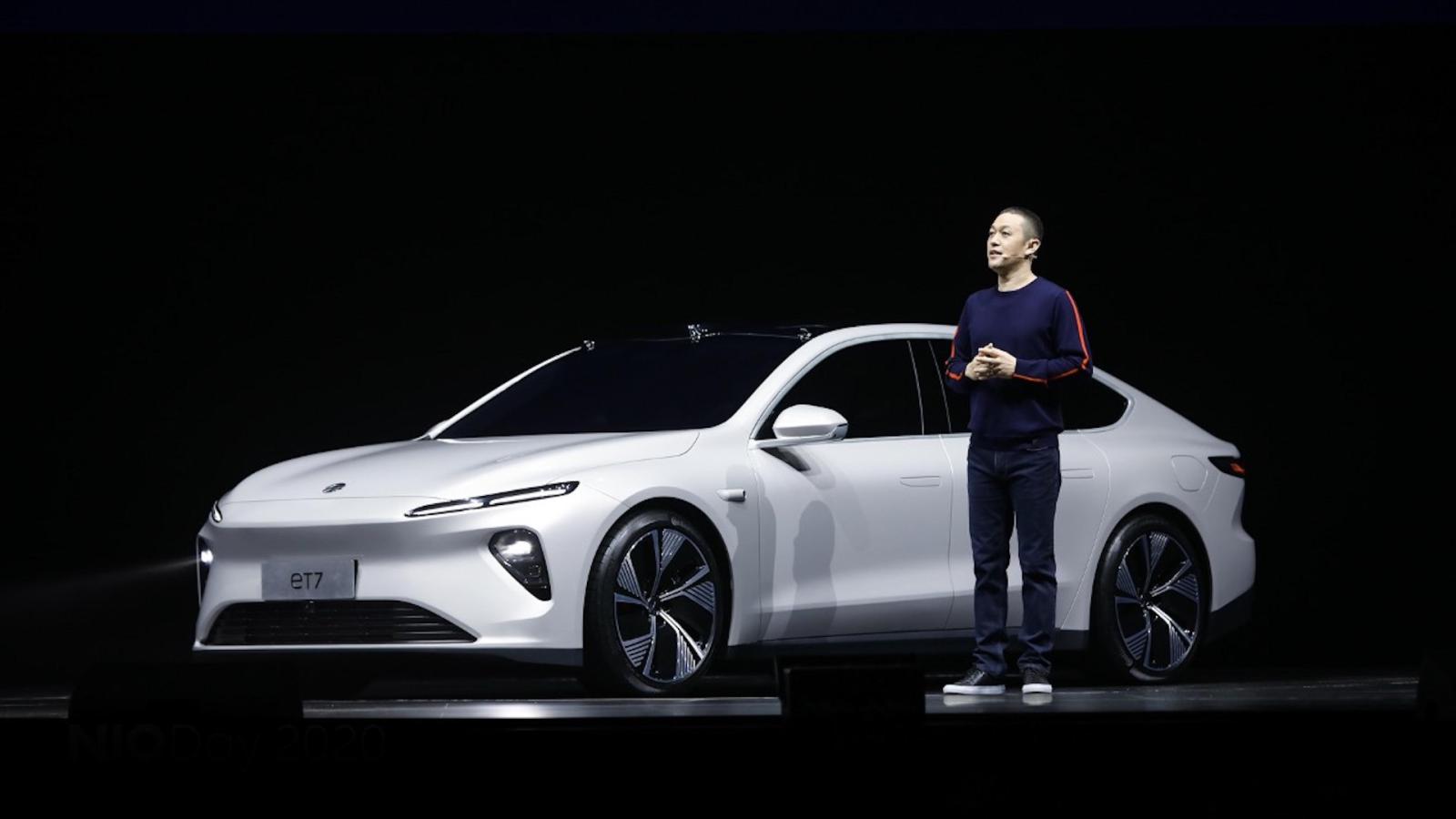

When the Chinese EV maker Nio pulled the cover off the ET7 in January 2021, the sedan carried the weight of the company’s future. That month, the market capitalization surpassed $100 billion.
The vehicle was Nio‘s first sedan, the first model on its second-generation NT2.0 platform, and the first Nio car fitted with LiDAR, the laser-based sensing technology that maps a vehicle’s surroundings in three dimensions.
More than five years on, the ET7 sells in tiny numbers, with just 11 units registered in China in May, and a next-generation version is not expected before 2027.
The ET7’s collapse echoes that of the EC7, its 7-series coupe-SUV stablemate, which also slid to record lows last month as the premium EV brand continues to focus on SUVs.
This is the full story of the ET7 model that defined a platform, from the concept stage through every edition and refresh, to the reinvention now promised for next year.
A Concept in Shanghai
The ET7’s roots trace to April 2019, when Nio revealed the ET Preview, a concept sedan, at Auto Shanghai.
That show car previewed the brand’s planned ET series and, specifically, the ET7.
Nio used the reveal to signal a move beyond the SUVs that had defined its early lineup, the ES8, ES6 and EC6, into the sedan segment.
The Nio Day Debut and a Record That Still Stands
Nio unveiled the production ET7 on January 9, 2021, at its annual ‘Nio Day’ annual event, held that year in Chengdu.
The timing marked the company’s high-water mark.
Nio‘s US-listed shares reached an all-time high of $66.99 that month, a peak that still stands today, five and a half years later.
As the debut model for the NT2.0 platform, the ET7 introduced the second-generation architecture that would go on to underpin nearly every Nio model that followed.
Aquila, Nio‘s super-sensing suite, made its debut on the car, built around 33 sensors including a roof-mounted lidar in the distinctive “watchtower,” alongside the Adam supercomputer powered by four Nvidia Orin chips.
Banyan, the operating system, and NOMI, the brand’s animatronic in-car artificial-intelligence assistant, rounded out the cabin technology.
Positioned as a rival to the Tesla Model S, the ET7 measured 5,101 millimeters long on a 3,060-millimeter wheelbase, with dual motors producing 480 kilowatts, frameless soft-close doors and flush handles.
Inside, it paired a 10.2-inch driver display with a 12.8-inch central touchscreen, a head-up display, a 23-speaker 1,000-watt audio system, 256-color ambient lighting and an intelligent fragrance system.
A third-generation Qualcomm Snapdragon cockpit platform handled connectivity, with 5G, NFC and Bluetooth 5.2, and the ET7 became the first production car to use Karuun, a sustainable rattan material.
Nio priced the ET7 from 448,000 yuan before subsidies at the launch, or from 378,000 yuan under its Battery as a Service leasing scheme.
A limited ET7 Premier Edition arrived alongside it at 526,000 yuan before subsidies, or 398,000 yuan under Battery as a Service.
Batteries, Range and Solid-State
From the outset, the ET7’s defining flexibility was its battery menu, enabled by Nio‘s battery-swap and Battery as a Service model.
At its 2021 unveiling, the sedan was offered with 70-kilowatt-hour and 100-kilowatt-hour packs, with a 150-kilowatt-hour option promised for late 2022, and the standard pack was upgraded to 75 kilowatt-hours by the time deliveries began.
Charging ranged from up to 140 kilowatts on the 75-kilowatt-hour standard pack to 180 kilowatts on the 100-kilowatt-hour long-range unit, an NMC cell-to-pack from CATL or CALB good for as much as 705 kilometers of range.
The headline act was the 150-kilowatt-hour semi-solid-state pack from WeLion, introduced in mid-2024 with a claimed NEDC range of 1,050 kilometers.
Nio billed it as the first mass-produced automotive traction battery to use semi-solid-state electrolyte technology, delivering 50% more capacity for only about 20 kilograms more weight than the 555-kilogram 100-kilowatt-hour pack.
Founder and Chief Executive William Li underscored the milestone on December 17, 2023, personally driving an ET7 to demonstrate the pack’s ultra-long range.
Built under a contract-manufacturing arrangement with JAC Motors in Hefei, Anhui province, the ET7 also marked a milestone in April 2022, when a white example became Nio‘s 200,000th car, and the sedan later earned a five-star Euro NCAP rating.
The contract with JAC was later ended and Nio currently operates three EV factories in Hefei.
Deliveries followed more than a year after the unveiling.
Nio began building customer cars on March 10, 2022, and handed over the first ET7s on March 28, 2022, making it the first NT2.0 model to reach customers.
The European Push
The ET7 also became Nio‘s passport into the heart of Europe.
Nio had first entered the continent in 2021, selling the ES8 in Norway, but the ET7 led its broader expansion.
At the Nio Berlin event on October 7, 2022, the company unveiled the ET7, the ET5 and the EL7 — the European name for the ES7 due to a trademark with Audi — for four new markets.
First European deliveries of the ET7 took place in October 2022 in Germany and the Netherlands, with Denmark and Sweden following in November.
Nio initially offered only leasing, drawing criticism, before adding purchase options on November 21, 2022.
In Germany, the ET7 started at 69,900 euros without a battery, or 81,900 euros with the 100-kilowatt-hour pack included, with battery rental at 169 euros a month for the 75-kilowatt-hour unit and 289 euros for the 100-kilowatt-hour one.
Those prices put Nio in direct competition with Mercedes-Benz, BMW and Audi rather than Tesla.
The Editions and the Refresh Cycle
In China, the ET7 evolved through a series of annual updates and renamed trims.
Beyond the standard car and the limited Premier Edition offered at launch, the early ET7 was differentiated mainly by its battery tier.
The first true refresh arrived at Auto Shanghai on April 18, 2023, when Li unveiled a revised ET7 with more than 15 enhancements, including improved seats and a 40-watt wireless charging pad, split into a Standard Edition and a Signature Edition.
That 2023 version started at 458,000 yuan before Nio trimmed the price by 30,000 yuan and shifted its free battery-swap package to a paid option.
The most substantial overhaul came a year later.
Pre-orders for the 2024 ET7 opened on April 16, 2024, with a 5,000-yuan deposit, and the car launched on April 25 at the Beijing Auto Show, billed as the third version of the sedan since 2021 and carrying roughly 180 upgrades.
The changes were concentrated inside, adding two 14.5-inch 3K OLED rear screens, a NIO Link multi-screen conferencing feature, 18-way front seats and a redesigned head-up display, while the standard pack switched to an LFP cell-to-pack design with a faster 170-kilowatt charging rate.
Trim names changed again, to an Executive Edition and an Executive Signature Edition, replacing the earlier standard and Signature versions, with the entry price held at 428,000 yuan and the top 100-kilowatt-hour trim rising by 10,000 yuan.
That 2024 model would prove to be the ET7’s last comprehensive update.
When Nio began rolling out quarterly facelifts for its entry models in 2025, Li named only the ET5, ET5 Touring, ES6 and EC6 for revisions.
The ET7, along with the older ES8, EC7 and ES7, was pointedly left out, continuing to receive only over-the-air software updates rather than a new model-year hardware refresh.
That pattern repeated in April 2026, when Nio refreshed the four entry-level “5566” models again but not the ET7.
Demand Slips Away
For all the early iteration, the ET7 could not hold its ground.
Demand for the sedan, and for Nio‘s sedans more broadly, fell short of expectations through 2024 and 2025 as Chinese buyers gravitated toward SUVs and competition intensified.
The arrival of the ET9, Nio‘s flagship executive sedan and the first model on the newer NT3.0 platform, with deliveries from early 2025, also displaced the ET7 from the flagship role it had held since launch.
From there, the decline was steep.
ET7 registrations fell to 239 units in China in January 2025, and the slide deepened as the year wore on.
By mid-2025, sales of the Nio brand in China had fallen by more than 30% year over year for two straight months, dropping about 35% to 13,270 units in May and 31.2% to 14,593 units in June, even as the June figure rose 10% from the prior month.
Against that backdrop, Nio turned to aggressive discounting on the aging 7-series.
EV reported exclusively in July 2025 that the company was offering discounts of up to 190,000 yuan ($26,480) on the ET7 and the EC7 coupe SUV to “clear inventory,” according to a person familiar with the matter.
Tied to the 75-kilowatt-hour battery-subscription version, the offer cut the ET7 to a starting price of 230,000 yuan ($32,000), down 45.2% from its then-current official starting price of 420,000 yuan ($58,500), with the EC7 starting at 260,000 yuan.
Stock units in the campaign had been produced “within the past six months,” the same person told EV, adding that a refreshed version of both 7-series models was “expected in about half a year.”
Both cars had been left out of the portfolio upgrade announced in May, and the ET7 received no hardware changes that year, leaving Nio to discount its way through unsold stock rather than renew the line.
The discounting produced only a brief lift, with ET7 registrations in China reaching 564 units in July 2025, the model’s strongest month of the year, before the slide resumed.
By December 2025, after falling through 137 units in September, 72 in October and 57 in November, ET7 registrations settled at just 78 units, leaving full-year 2025 sales at about 3,046 units.
Monthly volumes collapsed in 2026, with the ET7 registering 15 units in China in January, 20 in February, 17 in March, 22 in April and 11 in May, each down more than 90% from a year earlier and near the bottom of Nio‘s lineup.
In Europe, the picture was bleaker still, with Nio resorting to a six-month “Try & Buy” trial to revive interest while continuing to sell 2023- and 2024-built ET7 inventory across the region.
A 2027 Revamp Expected but Not Confirmed
The ET7’s future appears to hinge on a redesign expected in 2027, though Nio has not confirmed a specific update for the model.
Co-founder and President Qin Lihong has been explicit that sedans sit lower in the company’s near-term priorities, speaking about the lineup broadly rather than naming the ET7.
“We will not launch a new sedan in 2026,” Lihong said in September last year, adding that the brand had placed sedans “slightly later” in its timing.
He framed the choice around the market’s direction, saying Nio had been putting more emphasis on SUVs because they remain a large and growing segment in China while sedans gradually decline.
The strategy is visible across the lineup, with the all-new ES8 serving as the volume engine and the newly launched ES9, the largest electric SUV Nio has built, anchoring the top of the range.
A comprehensive third-generation platform redesign for the entry models is expected in 2027, led by a revamped ES6 that Lihong expects to become the brand’s most popular Gen 3 model.
Lihong’s remarks centered on those older and entry-level models rather than the ET7 by name, and while the flagship sedan is widely expected to be included in the 2027 wave, Nio has not formally confirmed a next-generation ET7 or a timeline for one.
Nio has told European customers not to expect its next-generation NT3 models in the region until late 2027 or early 2028, underscoring how distant the sedan’s reinvention remains for overseas buyers.
For now, the platform, design and on-sale date of any new ET7 remain undisclosed.