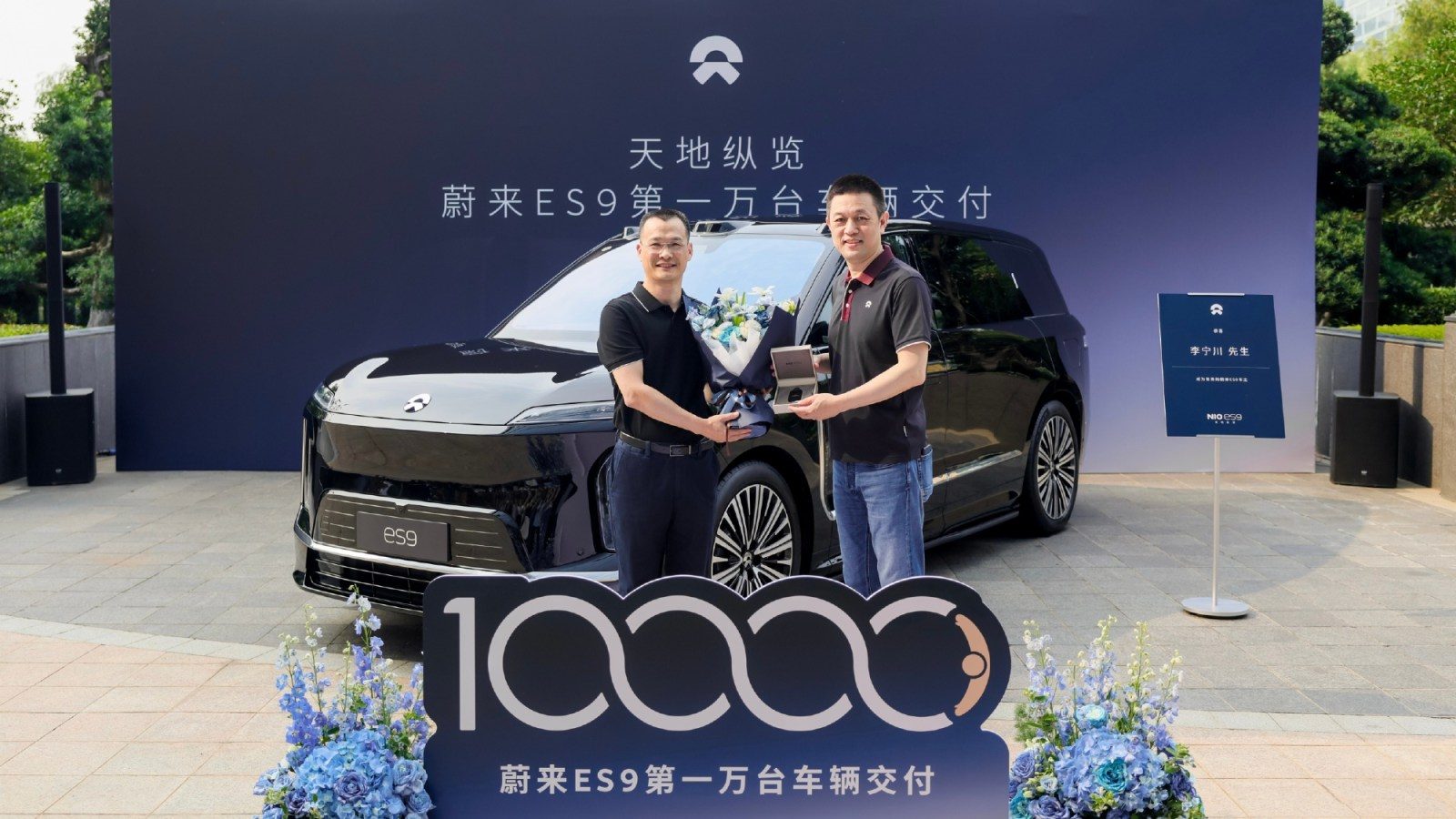

Nio delivered the 10,000th unit of its flagship ES9 on Friday, about a month after the full-size electric SUV first reached customers, one of the fastest ramps for a premium model in China.
Founder and chief executive officer William Li said the handover set “a new speed record for premium BEVs” priced above 500,000 yuan ($73,500) in the country, writing on X that the milestone came just 30 days after the first delivery.
The 10,000th unit was delivered to Li Ningchuan, founder of Zhejiang EV-Tech, Li said.
Standing as Nio‘s most expensive SUV, the ES9 anchors its push into China’s expanding market for large luxury SUVs.
Deliveries of the model began on May 28, making June effectively its first full month on the road.
An early burst of 3,108 units in the last four days of May gave the ramp a running start.
Once the launch backlog clears, Bank of China International expects the ES9 to settle at 3,000 to 4,000 deliveries a month, while Deutsche Bank forecasts about 5,000 once second-half production fully ramps.
From Pre-Sale to Launch
Nio unveiled the ES9 on April 9 in Hangzhou with pre-sale prices from 528,000 yuan ($77,200), and Li called it the most important product of the year for the brand.
Orders from buyers outside the existing community ran at more than 1.5 times the pace seen in the first days after the ES8 launch in September 2025, Li said the following day.
Test drives opened on May 11, and the company held its launch event on May 27 before starting customer deliveries the next day, accelerating from an originally guided June 1 date.
Final pricing landed 30,000 yuan below pre-sale levels across all three trims.
The entry Executive Luxury Edition starts at 498,000 yuan ($73,000) with the battery, or 390,000 yuan ($57,300) under Nio‘s Battery-as-a-Service leasing plan.
Above that, the Executive Signature opens at 558,000 yuan ($82,100) and the range-topping Horizon Special Edition at 628,000 yuan ($92,400).
Deliveries are starting with the six-seat layout, with an aisle-seat version due in mid-July.
To enable same-day handovers at launch, the company had built pre-launch inventory of at least 6,000 cars.
Demand Skews to the Top
Dealer checks pointed to a fierce start, with stores averaging 40 to 45 firm orders apiece in the first 72 hours and more than 95% of buyers choosing the battery-leasing option.
Days after deliveries began, Nio‘s configurator showed waits of 16 to 17 weeks for the two priciest trims, against three to four weeks for the entry version.
That gap inverts the usual pattern, in which the cheapest, highest-volume trim carries the longest queue.
For the ES9, the wait lengthens as the price climbs, echoing the ES8’s launch backlog, when waits stretched to 24 to 26 weeks.
Nio paired the launch with aggressive financing, led by a 60-month plan that charges no interest for the first 24 months and a 3% annualized fee over the rest.
A 5,000-yuan reservation deposit paid before May 27 counted as 10,000 yuan toward the purchase, an incentive that expired when formal orders opened.
Frontline staff projected conversion above 50%, and analysts counted more than 25,000 non-cancellable orders early on.
A Bet on Margins and Profit
The flagship sits at the heart of Nio‘s wager that high-margin large SUVs can carry it to a first full year of profit in 2026.
President Qin Lihong has said the model will generate the highest gross profit of any Nio SUV, carrying “a reasonable gross margin” despite its richer specification.
That case builds on the third-generation ES8, which runs a gross margin near 20% and helped drive the company’s first quarterly profit in the fourth quarter of 2025.
For months the ES8 has led China’s large-SUV charts, making up roughly 77% of Nio-brand deliveries in the first quarter and pulling the average price higher.
Positioned against the BMW X7 and the Mercedes GLS, the ES9 lifts Nio‘s average selling price while widening the top of its range.
Rather than cannibalize the ES8, the new model has lifted it, with ES8 orders rising about 30% week-over-week after ES9 test drives began.
Li has framed 2026 as the start of a new growth phase, targeting 40% to 50% annual sales growth led by large SUVs.
The June Math
A strong ramp arrives as Nio needs the volume to hit its second-quarter target.
The company guided second-quarter deliveries to between 110,000 and 115,000 vehicles, a year-over-year gain of 52.7% to 59.6%.
Deliveries reached 29,356 in April and 37,705 in May, leaving between 42,939 and 47,939 due in June to land inside that range.
Sub-brand Onvo added 5,949 L80 deliveries within 15 days of launch, helping it top 10,000 in May.
Back in April, Li told staff to seize the quarter, naming the ES9 and Onvo‘s L80 as the top priorities and crediting the flagship’s pre-orders with lifting demand across the lineup.
Built on the ET9’s Chassis
Both the ES8 and the ES9 ride on Nio‘s NT3.0 platform, sharing a 900-volt architecture, a 520-kilowatt powertrain and a 102-kilowatt-hour CATL battery.
The flagship adds the SkyRide active chassis it shares with the ET9 sedan, pairing ClearMotion’s fully active suspension with steer-by-wire and rear-wheel steering.
Two in-house Shenji NX9031 chips and three LiDAR sensors handle its assisted driving.
At nearly 5.4 meters long, the ES9 stretches about 85 millimeters beyond the ES8, making it the largest SUV on sale in China.
Nio named basketball great Yao Ming, an eight-time NBA All-Star, as a chief experience officer for the model.