
Nio‘s founder and CEO, William Li, identified the Nio ES9 and the upcoming Onvo L80 as the company’s top priorities for the second quarter during an internal meeting earlier this week.
Both models are set for their public debut at the Beijing Auto Show, which opens next week and runs through May 3.
Li told employees that “executing strategic new product launches well” is the quarter’s most important objective.
“There will be a new product effect in May and June, and deliveries should steadily increase,” he said.
The ES9 was unveiled last week, becoming China’s largest SUV ever.
The model will be launched in May and begin deliveries in June, co-founder and President Qin Lihong said earlier this year.
The L80 — a five-seat version of the Onvo L90 three-row SUV — is scheduled to be unveiled on April 20, with launch and deliveries planned for mid-May.
“These two models are extremely important,” Li said. “We must mobilize the company’s best resources — supply chain, manufacturing, quality, user experience — and achieve our targets this quarter.”
Li described both as category creators. “ES9 defines a new category of intelligent electric executive flagship SUV, and L80 defines a dual-cabin large five-seat category,” he said.
Chinese media outlet LatePost was the first to report on the internal meeting.
ES9 Pre-Orders
William Li said pre-orders for the ES9 have surpassed internal expectations and driven order growth for other models in the lineup.
Earlier this week, the CEO had stated that orders from non-Nio buyers in the first days after the pre-launch were more than 1.5 times the equivalent figure from the ES8 launch.
“This shows ES9 is reaching new users who previously felt Nio did not fully meet their needs. There is a breakout effect,” he noted.
The ES9 also lifted demand across the range.
“ES8 orders increased significantly, and ET9 orders reached a recent high,” Li said. “Many users came to look at ES9 and ended up preferring something more driver-focused, choosing ET9. Others felt ES9 was too large and chose ES8 instead.”
The third-generation ES8 sold out its 2025 production capacity within 36 hours of its launch last September and accumulated over 100,000 orders within 48 hours.
The ES9 opened pre-sales in three trims starting from 528,000 yuan ($77,400), or 420,000 yuan ($61,600) under Nio‘s Battery as a Service scheme.
The official launch event and final pricing are due on May 28, with customer deliveries scheduled to begin on June 1.
“Supply chain and manufacturing teams are working overtime,” Li said. “June will show a more complete result.”
Bank of China International expects the ES9 to stabilize at monthly deliveries of 3,000 to 4,000 units, driving combined ES8 and ES9 sales above 10,000 units per month.
High-Margin Strategy
According to William Li, the group’s upcoming models “are all high-margin large vehicles,” adding that “the next two months are critical.”
The emphasis on “high-margin large vehicles” comes as Nio faces rising input costs.
Li acknowledged that “raw material prices are rising, as are semiconductor and component costs” and that “per-vehicle costs are increasing.”
“But this is not unique to us; the whole industry is experiencing cost increases,” he said. “So we must manage operations more carefully. Can we offset rising costs? We believe there is a chance. Spend money where it matters, cut unnecessary spending, and avoid unclear or optional expenditures.”
Co-founder and President Qin Lihong said last week that the ES9 will generate the highest gross profit amount among all Nio SUVs.
The ES9 is priced more than 100,000 yuan above the ES8, which Qin has said carries a gross margin of around 20%, generating roughly 80,000 yuan in gross profit per unit.
Vehicle margin for the fourth quarter reached 18.1%, up from 13.1% a year before.
The new ES8 is nearing its 100,000th delivery milestone, which suggests that the vehicle has generated an estimated 8 billion yuan in gross profit since its September launch.
The model was the single biggest contributor to Nio‘s first-ever quarterly profit — a net profit of 122.4 million yuan in Q4 2025, compared with a net loss of 7.13 billion yuan a year earlier.
Despite achieving its first quarterly profit late last year, Nio still recorded annual losses exceeding 10 billion yuan last year.
Li addressed the losses directly.
“We are not living just to achieve profitability in a single quarter,” he said. “Our company must achieve high-quality operating targets every quarter, creating value for users and shareholders.”
Onvo L80 to Lead Q2 Recovery
The Onvo L80 — a five-seat variant of the L90 — was also flagged by William Li as a critical launch in the second quarter.
Li drew a direct line from the success of the L90 and ES8 in reshaping the large three-row SUV segment.
“Before these launches, extended-range vehicles dominated,” he said. “Afterward, the situation reversed. In the latest monthly data, extended-range now accounts for only about 60% of pure electric sales in this segment — this is a major shift.”
He expects the L80 to have a similar effect in the large five-seat SUV market.
“For the 200,000-yuan-plus [$29,300] large five-seat SUV market, the L80 will be a revolutionary product,” Li said.
He also predicted the model would boost L90 and L60 sales, “just as L90 previously boosted L60.”
The L80 launch comes as Onvo‘s sales have begun to recover from a difficult start to 2026.
The sub-brand delivered just 3,481 vehicles in January — a 41% year-on-year decline and a 62% drop month over month — marking its worst month since launch.
Deliveries rebounded to 6,877 units in March.
In the second quarter, Onvo is also planning a lineup update.
The refreshed L90 will be the first Onvo model to feature LiDAR, and it is also expected to make its debut at the Beijing Auto Show.
Q1 Review
Li convenes heads of various business units at the beginning of each quarter to review the prior period and set targets for the one ahead, LatePost reports.
The group delivered 83,465 vehicles between January and March, up 98.3% year over year, exceeding its guidance range of 80,000 to 83,000 units.
“Revenue growth is expected to be slightly higher because of the higher proportion of high-priced models,” Li said.
The CEO credited the company’s CBU (Cell Business Unit) mechanism — a performance-oriented framework introduced last year that requires each department to manage its own budget and return on investment — with improving cost discipline.
“Overall cost control in Q1 was also good,” he said. “Since last year, we have been pushing the CBU full-staff operations mechanism, and this awareness has already been established.”
CBU Mechanism
The framework has been central to Nio‘s push toward profitability.
Under the CBU model, the company cut 10,600 jobs in 2025, eliminating roughly 40% of its R&D workforce.
The cost-cutting push also extended to Nio‘s flagship retail network — the company ended 2025 with fewer Nio House showrooms than a year earlier, the first annual decline since it began opening the spaces.
The restructuring initially led Nio to shelve planned models under its Onvo sub-brand, though development has since resumed — according to a prior report by LatePost — following the strong market response to the L90 and the third-generation ES8.
Li said the mechanism is not solely about cutting costs.
“CBU is not just about cost reduction — it is about understanding what money should be spent on and what outcomes it brings,” he said. “If we understand that clearly, we can invest confidently; otherwise, spending becomes uncertain.”
He urged teams to continue deepening the framework in the second quarter.
“If we seize Q2 well — with new product launches, model year transitions, and capability upgrades — we will reach a new level, making Q3 and Q4 easier,” he said.
Non-Vehicle Business and AI
Li devoted a portion of the meeting to Nio‘s non-vehicle business, which he said made “a significant contribution to profitability” in the fourth quarter.
“Last year, non-vehicle revenue reached 100 billion yuan, which is a key difference in our business model,” Li said.
He pushed for deeper integration of artificial intelligence across all business units.
“It is not about using an AI tool once — it is about building AI capability into business operations,” he said.
“If AI can help us sell 5% more vehicles, that alone offsets the impact of rising raw material costs,” he noted.
R&D expenses dropped 44.3% year over year in the fourth quarter, while administrative costs fell 27.5%.
Firefly and Other Updates
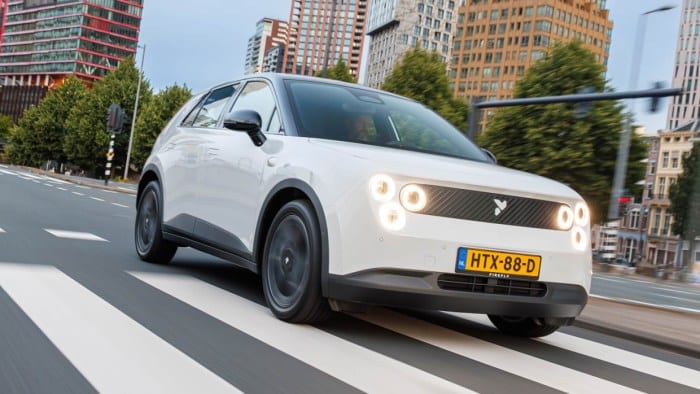
Li briefly noted that Firefly — Nio‘s compact sub-brand — “recently received a minor refresh” and that “market feedback has been good.”
The brand launched a refreshed version of its debut model earlier this month, with an upgraded 120 kW motor and new ADAS features at an unchanged starting price.
He also stressed the importance of avoiding delivery bottlenecks after new product launches.
“We must avoid situations where market signals and orders are already clear, but new vehicle deliveries are delayed,” he said.
The Nio Group is targeting 40–50% delivery growth for the full year, implying between 456,000 and 489,000 vehicles across its three brands.