Nio‘s U.S.-listed shares swung from sharp gains to losses on Thursday as a margin warning from management overshadowed a first quarter that beat on revenue and non-GAAP profitability.
The stock had surged more than 5% to $6.05 about 40 minutes before the stock market opened, during the company’s earnings conference call that followed the results.
It then reversed during the earnings conference call, falling 10.4% from that peak.
As of publication time, the shares were down 3.07% at $5.42.
The reversal tracked comments from finance chief Stanley Yu Qu, who warned of mounting raw-material cost pressure across the industry and guided full-year vehicle margin below the level just reported.
US-listed shares have gained about 7% year to date.
A Strong Quarter on Paper
Nio delivered 83,465 vehicles in the first quarter, up 98.3% year over year.
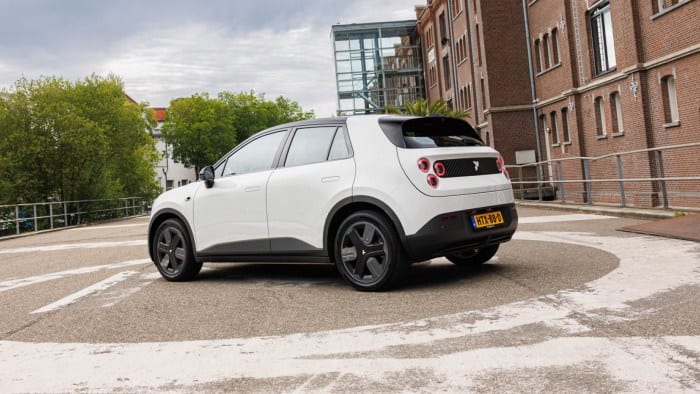
The Nio brand accounted for 58,543 units, the Onvo brand 13,339, and the Firefly brand 11,583.
Total revenue rose 112.2% to 25.53 billion yuan ($3.70 billion).
Vehicle margin reached 18.8%, improving quarter over quarter for a fourth consecutive period, while overall gross margin climbed to 19.0% from 7.6% a year earlier.
The net loss narrowed to 332.1 million yuan from 6.75 billion yuan in the first quarter of 2025.
Excluding share-based compensation, Nio posted an adjusted net profit of 43.5 million yuan, its second straight non-GAAP profitable quarter.
Cash and equivalents rose to 48.2 billion yuan, and net current assets turned positive.
The company also reported a higher average selling price in the quarter, driven by a favorable product mix.
Revenue of 25.53 billion yuan came in just below the consensus estimate of 25.57 billion yuan, according to StreetInsider.
On an adjusted basis, the company posted earnings of 0.02 yuan per share, which StreetInsider said beat the analyst estimate of a 0.34 yuan loss by 0.36 yuan.
The Margin Warning
The improvement masked a cost problem Nio flagged for the rest of the year.
Qu said raw-material costs were rising across the industry, citing memory chips, lithium carbonate, NCM battery materials, copper and aluminum.
He said the cost impact would average around 10,000 yuan or more per vehicle starting in the second quarter.
“There is rising material cost pressure facing the entire industry,” Qu said.
Despite that pressure, the company still targets a full-year vehicle margin of around 17% to 18%.
That range sits at or below the 18.8% vehicle margin posted in the first quarter, signaling limited room for further margin expansion even as deliveries climb.
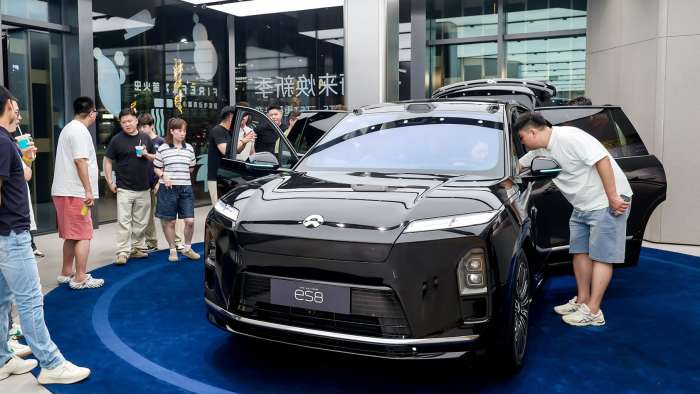
To defend margins, Qu said Nio would increase the mix of higher-priced models such as the ES8 and ES9, hold pricing on moderate-margin cars, and pursue supply-chain savings.
“We will not compromise on the margin performance of such cars for the sake of volume,” Qu said of its moderate-margin models.
Founder and CEO William Li reinforced the pricing stance.
“Our overall strategy is still to stabilize our prices,” Li said, adding that the company is “dialing back on some discounts and promotions” rather than sacrificing margin for volume.
Second-Quarter Guidance
Nio guided second-quarter deliveries to a range of 110,000 to 115,000 vehicles, representing year-over-year growth of 52.7% to 59.6%.
The range compares with 72,056 vehicles delivered in the second quarter of 2025.
Combined, Nio expects to deliver between 80,644 and 85,644 vehicles across May and June.
It expects revenue of 32.78 billion yuan to 34.44 billion yuan, up 72.4% to 81.2% from a year earlier.
That compares with 19.0 billion yuan a year earlier, and would mark a sequential rebound from the 25.53 billion yuan reported in the first quarter.
The company delivered 29,356 vehicles in April, up 22.8% year over year.
Management did not proactively reaffirm a full-year delivery target on the call.
A 40% to 50% full-year volume assumption was raised by a Morgan Stanley analyst as the premise of a question, but neither Li nor Qu denied or confirmed the figure.
Li instead said the company aims to launch around five to seven new or refreshed products each year and to lead market share in each segment rather than chase absolute volume.
The only full-year targets management affirmed were financial: positive non-GAAP operating profit for 2026 and a vehicle margin of around 17% to 18%.
ES9 Launch and ES8 Momentum
Li used the call to address demand for the new ES9, the brand’s flagship executive SUV, which launches and begins deliveries on May 27.
He declined to give specific order figures but voiced confidence in demand as pre-orders accelerated following the May 11 start of test drives.
Li said the ES9 competes with combustion-engine flagships such as the BMW X7 and Mercedes GLS, while the ES8 serves as an all-around SUV.
He said a consensus had formed among buyers that, as he put it, “Nio will be the next car after Mercedes, BMW and Audi.”
In the first quarter, the Nio brand carried an average selling price of 390,000 yuan, roughly 50,000 yuan above BMW‘s, according to Li.
He said the ES9 was not cannibalizing the ES8 but lifting it.
“We have actually witnessed an increase in order intake for the ES8 after the pre-launch of the ES9,” Li said.
Nio said ES8 order intake hit a record high, rising 30% week over week after test drives began.
The all-new ES8 reached its 100,000th delivery in 215 days and has led China’s segment for vehicles priced above 400,000 yuan for five consecutive months, regardless of powertrain.
Technology and Network
Li said Nio‘s in-house NX9031 smart-driving chip has shipped more than 250,000 units since its debut on the ET9, and would equip more than 80% to 85% of the company’s cars in the second half.
He said the chip uses only “20% of the cloud computing power compared with our competitors” to match or beat their performance.
He said the latest version of the Nio WorldModel runs on about a fifth of the cloud computing power used by rivals to achieve comparable or better performance.
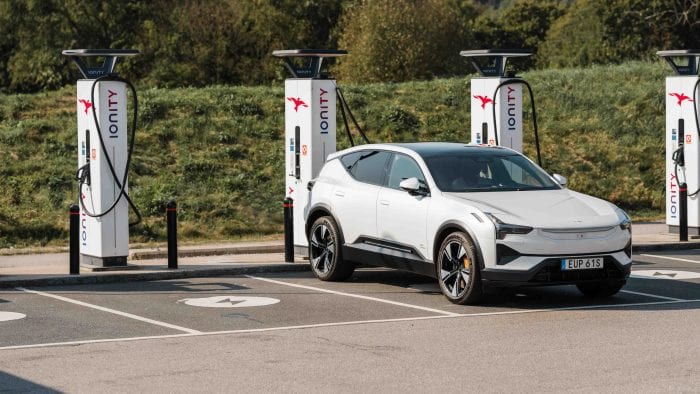
The company operates 3,916 power-swap stations worldwide and targets more than 1,000 additional stations this year.
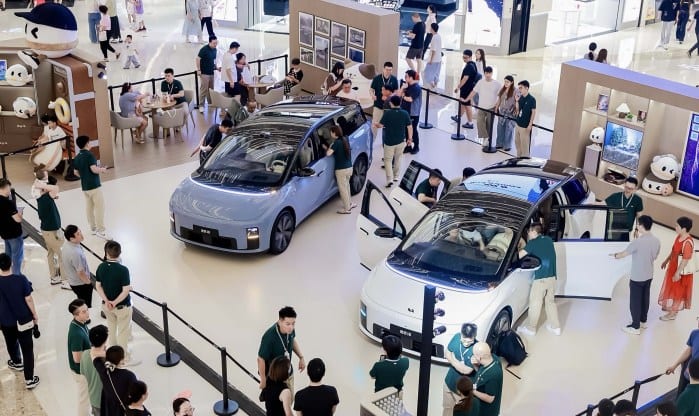
On the sales side, Nio ended the quarter with nine fewer main-brand showrooms and ten more Onvo stores as it reshaped its retail footprint.