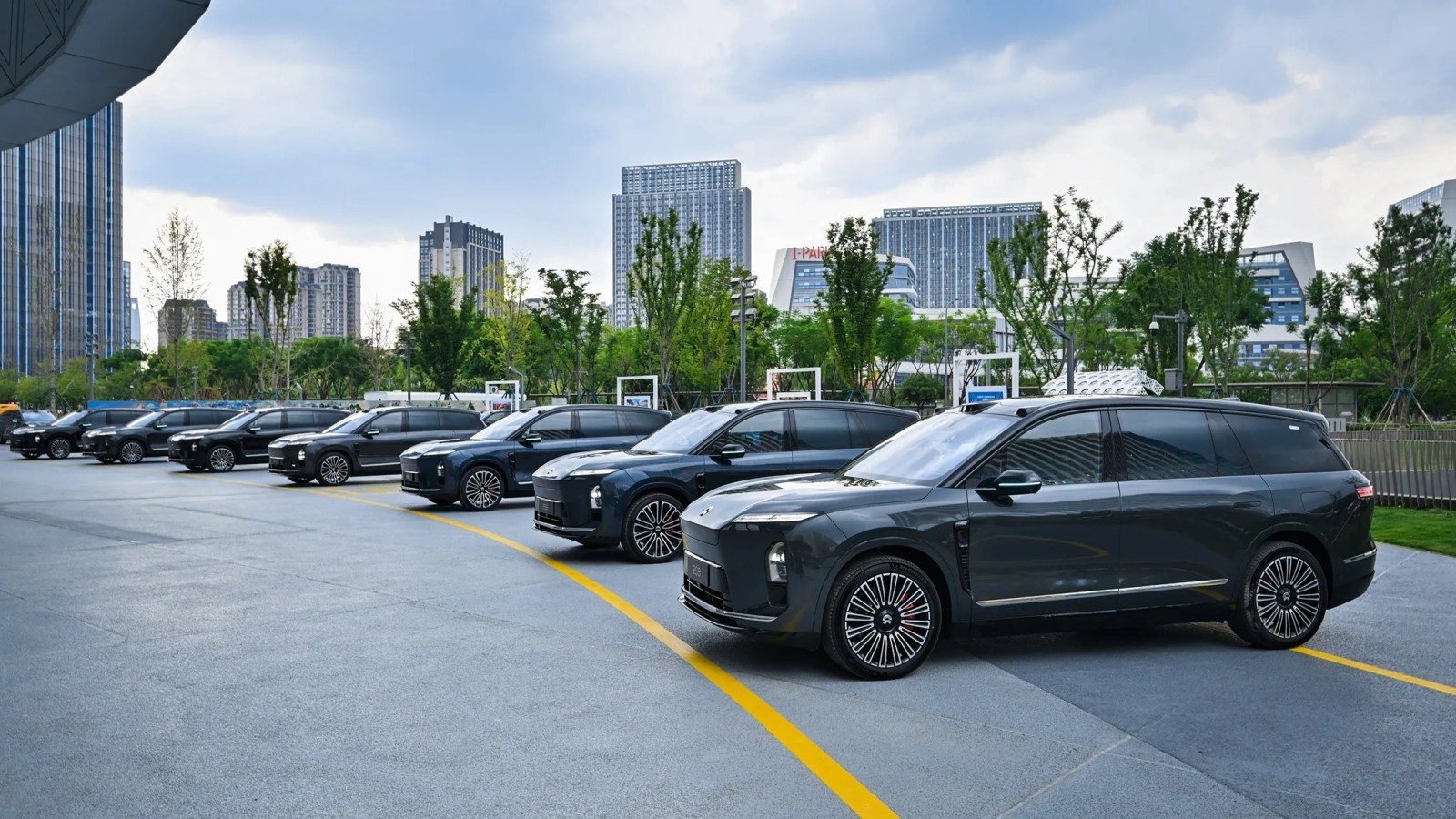

Nio‘s flagship ES8 will reach its 140,000th cumulative delivery “this week,” the company’s Head of User Operations Yang Bo announced on Weibo this Monday.
The milestone would extend a production rhythm that has locked the model into a cadence of about 30 days between each 10,000 units since April.
“This week, we’ll deliver our 140,000th brand-new ES8,” Yang wrote. “Thank you for 140,000 votes of confidence.”
The figure could land anywhere from Tuesday to Sunday, depending on when the handover takes place, and it would come 27 to 32 days after the ES8 crossed 130,000 on July 22.
The window keeps the model squarely inside the pace it has maintained for four consecutive intervals.
Nio has recently added the five-seat variant and does not break down deliveries by trim when announcing similar milestones.
The 30-Day Rhythm
The third-generation ES8’s delivery history splits into two distinct phases.
An early ramp from its September 2025 launch through year-end saw the model surge from 2,803 units in its first month to 22,258 in December, and the gap between 10,000-unit milestones compressed to as few as 11 days in late December as an initial order backlog cleared.
A bumpier stretch followed earlier this year, coinciding with the Chinese New Year and a chip shortage — which stretched the interval to 27 days between the 60,000th and 70,000th units, and the cadence remained uneven through March.
Since the model reached 100,000 deliveries on April 23, however, every subsequent batch of 10,000 has taken almost exactly 30 days.
The 110,000th unit arrived on May 23, the 120,000th on June 22 and the 130,000th on July 22 — each gap precisely 30 days.
If the 140,000th ES8 is delivered on Thursday, August 21, that pattern would extend to a fourth consecutive 30-day interval.
An earlier handover would mark a slight acceleration; a later one, a marginal lengthening.
The implied daily delivery rate across the possible dates ranges from roughly 370 units per day if the milestone falls on Tuesday to about 313 per day if it arrives on Sunday.
Both figures sit close to the 333-per-day average the model has sustained since April.
Monthly Figures Behind the Milestones
The monthly delivery data behind those milestones tells a story of stabilisation rather than decline.
After peaking at 22,258 in December 2025, ES8 volumes settled into a band between roughly 11,000 and 17,600 through the first five months of 2026.
June broke below that range at 8,966 units — a 22% sequential drop that coincided with the ES9’s arrival, which pulled premium buyers toward the top of Nio‘s lineup.
July brought a recovery.
The ES8 delivered 10,284 units, a 14.7% rebound from June that put the model back above the 10,000-unit threshold it had held for seven consecutive months before the ES9’s debut.
The prior version of the ES8 delivered just 77 units in August 2025, its final full month before the new model replaced it.
Every month of 2026 has shown triple- or quadruple-digit year-over-year growth against those legacy figures.
After the June dip, July’s 14.7% sequential gain suggests the ES9 launch created a one-month disruption rather than a structural shift in ES8 demand, which the five-seat ES8 also helped combat.
The Five-Seat Factor
July was the first full month in which the ES8 was available in five-, six- and seven-seat configurations after deliveries of the Five-Seat Version began on July 10.
The variant opened pre-orders on June 28 at a starting price of 382,800 yuan ($56,800), or 274,800 yuan ($40,800) under Battery-as-a-Service.
A launch incentive — five years of complimentary NOP+ and a cabin accessory kit — expired on July 31, concentrating initial order intake inside the month.
August will be the first clean read on underlying five-seat demand without a promotional pull-forward, and the milestone announcement suggests the variant has not cannibalised volume from the six- and seven-seat models in any material way.
Where the ES8 Sits Inside Nio
The ES8 accounted for 51.4% of the Nio brand’s 20,008 July deliveries and 28.6% of the 35,934 vehicles the group handed over across all three brands.
Through the first seven months of 2026, Nio brand deliveries total 139,496 units, a 60.1% increase on the same period a year earlier.
The ES8’s share has remained above 50% in most months, making it the single largest contributor to the premium marque’s volume.
Deutsche Bank has argued the two do not cannibalize each other given the price gap, positioning the ES8 as a family vehicle against the Li Auto L8 and the Aito M8 and the ES9 as an executive car against the Aito M9 and the Zeekr 9X.
Production Cadence as Signal
The four-month run of near-identical 30-day intervals between each 10,000-unit milestone offers a clearer signal about production capacity than any single monthly figure.
Seasonal swings, model-mix shifts and promotional campaigns can move deliveries up or down within a given month, but the milestone cadence strips those factors away and measures the underlying throughput of Nio‘s manufacturing and logistics chain.
A sustained 30-day cadence implies a production rate of roughly 10,000 ES8 units per month and around 120,000 per year.
The model delivered 88,902 units in the first seven months of 2026, and the second half will be the first in which it faces a full-year comparison against a model that was already ramping.
Nio sets no public delivery target for the ES8 alone, guiding instead at the group level to 40% to 50% growth on 2025’s 326,028 units.