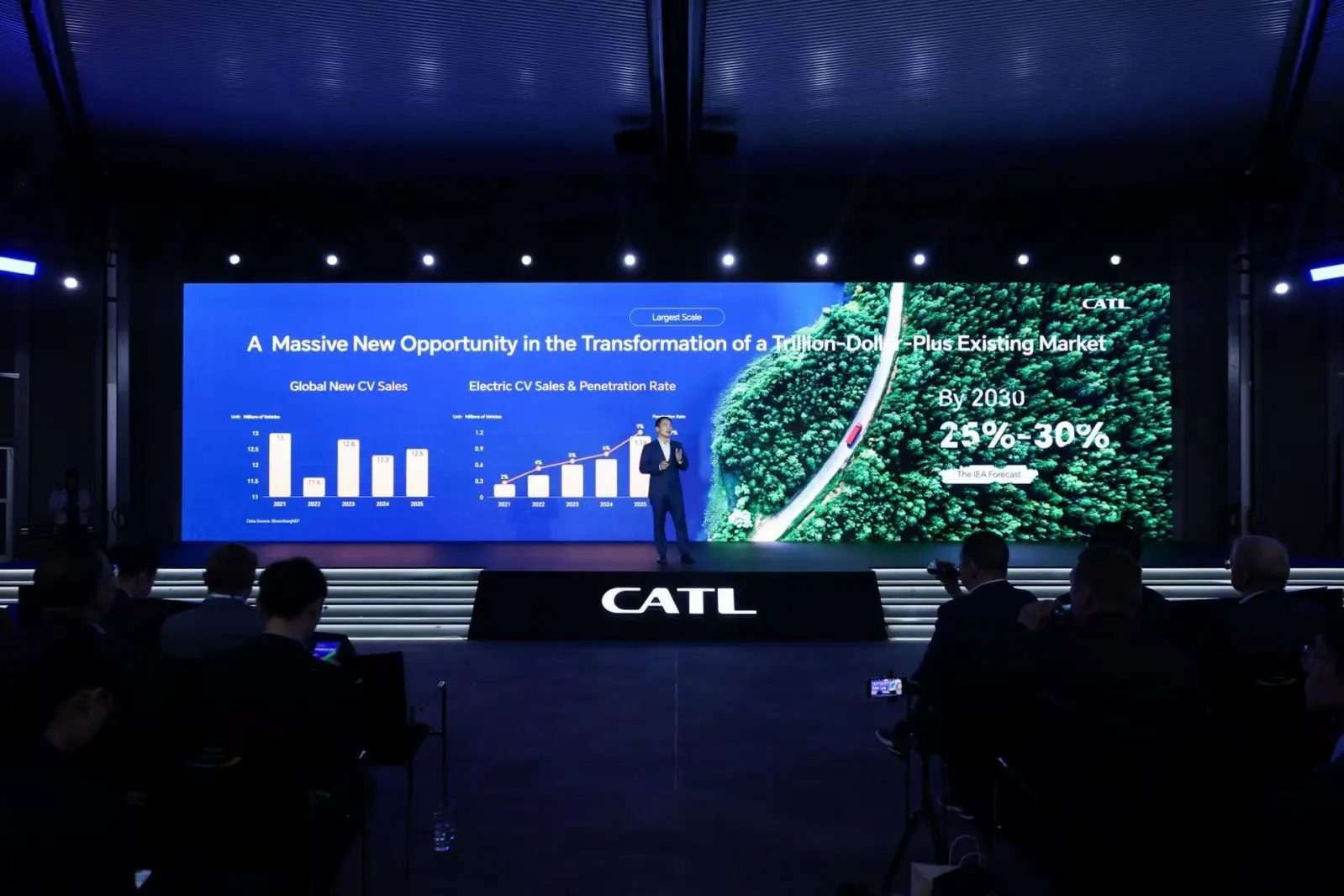

CATL has officially unveiled Tectrans II, a modular commercial-vehicle battery platform, at IAA Transportation in Hannover, calling commercial-vehicle electrification “the third wave of the global energy transition.”
The heavy-duty truck version delivers up to 1,000 km (621 miles) of range, supports megawatt-class charging and carries a design life of 12 years or 1.5 million km, according to the company.
CATL said the platform was “built around real operating needs” and designed to support “faster payback, higher operating returns and stronger residual value” for fleet customers.
The announcement, made on press day at the biennial commercial-vehicle show on September 14, extends the Tectrans II lineup beyond the light commercial vehicles and cold-climate variants CATL has rolled out since January.
A medium-duty truck version and a bus version were also presented, covering use cases from ports and mining to urban delivery and passenger transport.
Megawatt Charging and Efficiency
CATL’s headline claim centres on charging speed.
The heavy-duty Tectrans II supports megawatt-level charging and reaches 80% state of charge in 25 minutes, a figure aimed squarely at operators who need to minimise dwell time on long-haul corridors.
Round-trip efficiency reaches 96%, which CATL said is about three percentage points above the current industry level.
Higher round-trip efficiency (RTE) means less energy lost as heat during charge-discharge cycles — a metric that directly affects per-kilometre operating costs for fleet operators running high-mileage routes.
The 1,000 km range figure marks a step up from CATL’s first-generation Tectrans heavy-duty long-range battery, launched in November 2024, which paired a 1,000 kWh pack with 220 Wh/kg energy density to deliver 800 km (497 miles) on a single charge.
CATL has not disclosed the pack capacity or cell chemistry underpinning the new 1,000 km claim.
Earlier Tectrans Versions
The Tectrans brand first appeared at IAA Transportation 2024, when CATL presented two heavy-duty truck batteries: a Superfast Charging Edition with a 4C peak rate capable of reaching 70% in 15 minutes, and a Long Life Edition rated at 15 years or 2.8 million km.
Both offered up to 500 km (311 miles) of range.
CATL expanded the lineup domestically in November 2024 with long-range and construction-machinery editions.
Measured against those first-generation products, the new heavy-duty Tectrans II shifts the charging architecture from 4C cell-level supercharging to megawatt-class infrastructure charging and more than double maximum range from 500 km to 1,000 km.
Additionally, it adjusts the durability target to 12 years or 1.5 million km — a different balance from the original Long Life Edition’s 15-year, 2.8-million-km specification.
CATL has not said which charging protocol the platform uses.
The Megawatt Charging System standard, backed by CharIN and adopted by truck makers including Daimler Truck, Volvo and Traton, is the European route, but megawatt-class charging and MCS are not the same thing.
Tesla is deploying its own megawatt-class Megacharger protocol for the Semi, which arrived at the same Hannover show with a European-spec version listing 550 km of range and 800 kW charging.
Commercial Battery Portfolio
The heavy-duty product joins a Tectrans II series that CATL has built out in stages through 2026.
In January, the company launched the industry’s first mass-produced sodium-ion battery for light commercial vehicles under the Tectrans II banner.
The 45 kWh sodium-ion pack retains 90% of usable capacity at minus 40°C and targets micro-trucks and small vans operating in extreme cold environments.
The same January release included an ultra-fast charging variant capable of charging from 20% to 80% in 30 minutes at minus 15°C, a high-temperature version adding 60% range in 18 minutes with cell life reaching 5,000 cycles at 45°C, and a long-range version delivering 800 km from a 253 kWh pack.
In July, CATL added an 8C ultra-fast charging edition for light commercial vehicles, reaching 80% state of charge in six minutes and 48 seconds — a speed the company described as the fastest in the logistics sector.
The 8C battery carries a warranty of up to 10 years or one million km and uses cell-level internal resistance reduced to 50% of the industry average.
CATL’s commercial-vehicle strategy in China relies on a dual-track approach: ultra-fast charging for light commercial vehicles and standardised battery swapping for heavy-duty trucks.
The company has completed more than 300 heavy-duty truck battery-swapping stations and targets about 900 by the end of 2026.
For passenger vehicles and light commercial vehicles, CATL’s Choco-Swap network has reached 1,470 stations across 99 cities, with a target of 4,000 integrated charge-and-swap stations by the end of 2026.
European Ambitions
Hannover is a deliberate stage for CATL’s heavy-duty push.
Europe’s CO₂ emission standards for heavy-duty vehicles, adopted in 2024, require a 45% reduction in average fleet emissions by 2030 and 90% by 2040 compared with 2019 levels — a regulatory trajectory that compels fleet operators to accelerate zero-emission truck procurement.
CATL already operates a battery factory in Arnstadt, Germany, one of 15 production facilities worldwide.
Its larger European bet is at Debrecen in Hungary, a planned 100 GWh plant where Hungarian authorities barred work in three areas on August 25 after nine workers showed elevated nickel levels during commissioning.
The unveiling places CATL’s commercial-vehicle battery offering alongside a crowded field at IAA 2026.
Tesla brought a European-homologated Semi with 550 km of range at 40 tonnes gross combination weight. Deliveries start from 2027.
Chinese OEMs including Skyworth Auto, FAW Trucks, Dongfeng, Foton and Farizon are also exhibiting electric trucks at the show.
BYD, CATL’s closest domestic rival, used the same press day to unveil the ETT 44, a 44-tonne tractor running a 651 kWh Blade battery on an 851-volt architecture, with up to 600 km of range, a ten-year or 1.2 million km battery warranty, and 1.5 MW charging taking it from 20% to 80% in about 20 minutes.
CATL held a 39.2% share of the global EV battery market in 2025, according to SNE Research.
In China, the company commanded 45.5% of installed battery capacity in March.
Full-year revenue reached 423.7 billion yuan ($63.1 billion) in 2025, with net income of 72.2 billion yuan ($10.8 billion).
CATL said on X that the company “will continue to provide high-quality, reliable battery products, localized services and long-term support for commercial vehicle customers worldwide.”
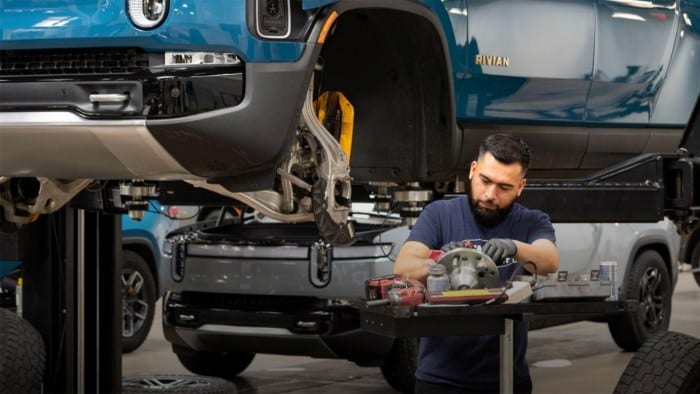
The company is already expanding its global after-sales service network to 100 cities by the end of 2026, with direct service centres using robotic automation to diagnose and repair batteries within 72 hours.
IAA Transportation 2026 runs from September 15 to 20 at the Hannover Fairground.