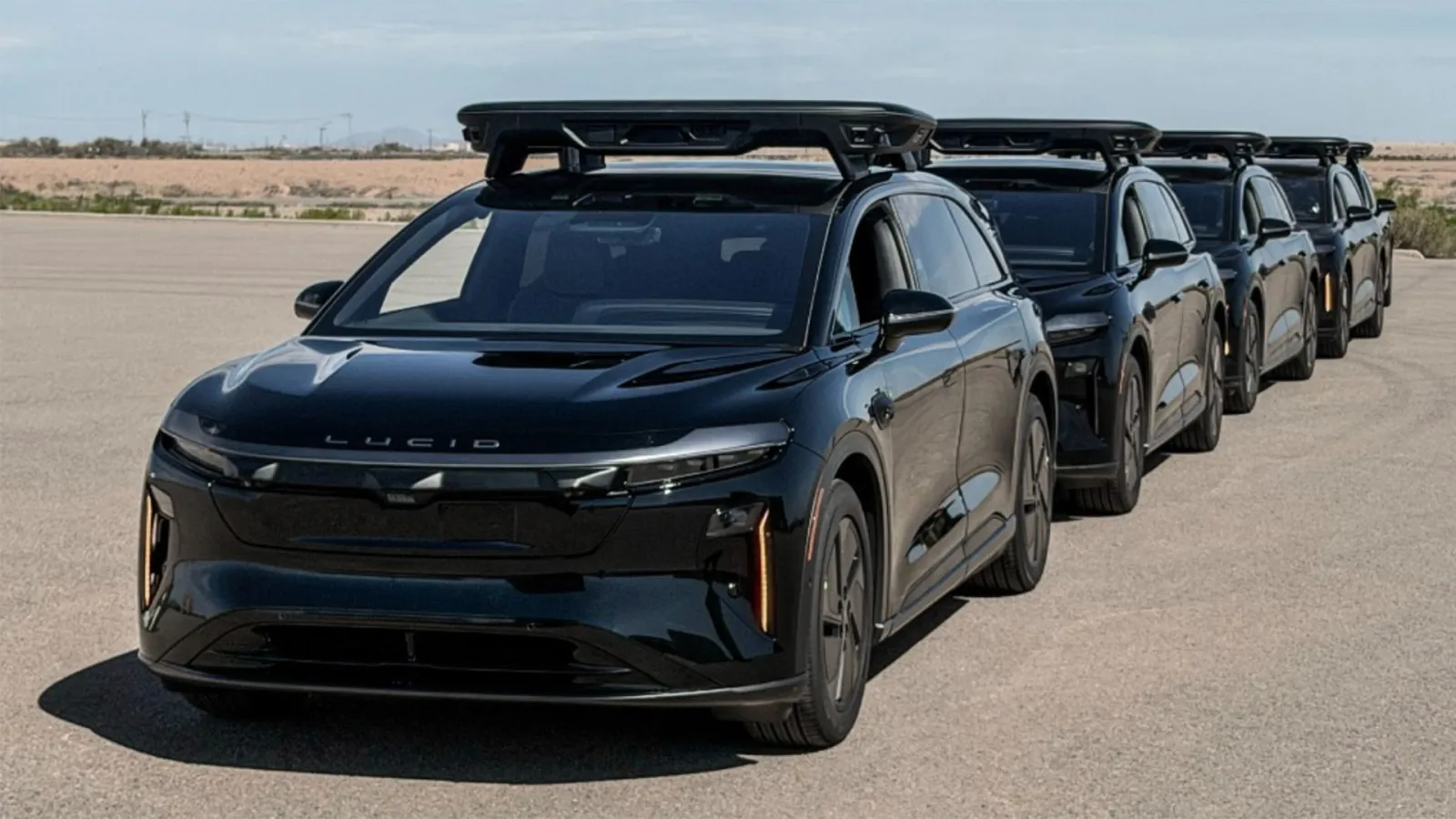
Nuro Co-Founder and Co-Chief Executive Officer Jiajun Zhu has put the company’s positions on four of the autonomous-driving industry’s most contested questions back in front of the public, as its robotaxi program with Lucid and Uber nears a commercial launch.
“It’s a good time again to discuss these AV topics: cameras vs. LiDAR, HD maps vs. no HD maps, model architectures, and L2+ vs. L4,” Zhu wrote on LinkedIn late on Tuesday. “We have very clear, deeply considered views on all of these.”
He shared four memos he said he had written for Nuro’s team. Each one was shared on Nuro’s blog between March and July.
Cameras are not enough for L4
In the sensor memo, published in late March, Zhu wrote that camera-only systems can already outperform an average human driver, but that LiDAR and radar raise the ceiling.
Nuro has built and tested both vision-only and multi-sensor systems and compared them directly, he wrote. The outputs can look alike on video, but systems that add LiDAR and radar “consistently perform better” on object recall, especially at night and for pedestrians.
“Safety achieved through late detection and hard maneuvers is not the same as the best achievable safety,” he wrote, citing low sun angles, dirty lenses and unlit stationary objects at highway speeds at night.
Zhu also rejected the argument that machines should drive with cameras because humans drive with their eyes. “Mimicking human limitations is not a requirement for building the safest or most capable system,” he wrote.
The Co-CEO expects fully driverless systems to carry multiple sensor types, while entry-level cars and driver-assistance systems may rely on cameras “for a very long time.”
HD maps as a prior
In the map memo, published on April 14, Zhu wrote that having high-definition maps “is strictly better than not having them,” because they help with occlusions, traffic-light association and school zones.
But a capable Level 4 vehicle “should not require a pre-built HD map to function,” he wrote. He predicted that future driverless systems will enter new cities without HD maps and build them once a fleet is running there.
‘The myth of AV 2.0’
In the architecture memo, published the same day, Zhu argued that the industry’s framing of rule-based “AV 1.0” against AI-driven “AV 2.0” is outdated, because “virtually all serious autonomy efforts are deeply AI-centric.”
Even systems described as end-to-end remain structured, he wrote. Nuro’s foundation model is trained end-to-end from sensors to driving actions but adds human-interpretable outputs and pretraining with perception and map supervision.
L2 and L4 are different businesses
The strategy memo, published in early July, makes the sharpest claim. Zhu wrote that Level 2 driver assistance and Level 4 driverless systems “are very different products,” with different costs, sensors, validation needs and business models.
“A company that tries to do both may end up being the best at neither,” he wrote. He described L2 systems as built for $300 to $1,000 hardware budgets and coverage in 100 countries.
Zhu argued that data from camera-only L2 fleets does not close the gap to L4 because it lacks the sensors an L4 system needs. “The gap between L2 and L4 is not just a data gap. It is a safety engineering gap, a validation gap, and a product design gap,” he wrote.
His preferred route is to prove L4 in robotaxis across dozens of metro areas first and then sell the same system in personally owned cars. “At Nuro, we are building scalable L4 technology, not an L2 product,” he wrote.
Where the industry stands
The memos do not name companies, but the industry is split along the lines Zhu describes as most driverless operators use LiDAR.
Waymo‘s sixth-generation system, which began fully driverless operations in February, carries 13 cameras, four LiDAR units and six radars.
Amazon’s Zoox fits LiDAR, radar and cameras at each corner of its purpose-built robotaxi, and Baidu‘s Apollo RT6 carries eight LiDAR units. The Lucid Gravity robotaxis for Uber run the Nuro Driver, whose combination of cameras, LiDAR and radar Zhu defends in the memo.
Rivian is moving the same way in consumer cars. It plans to fit its first R2 SUVs with LiDAR for employees at the end of this year and for customers in 2027.
The sensors have also become a supply-chain question. A US laboratory is reviewing the security of Chinese-made LiDAR with industry funding, according to a report in August.
Tesla leads the camera-only camp. It sells its FSD (Supervised) system to owners and runs camera-only robotaxis in Texas, and Chief Executive Officer Elon Musk has repeatedly mocked Waymo.
In China, XPeng began producing a robotaxi in May that “operates without LiDAR or high-definition maps” and “adopts a pure vision solution,” the company said. Most Chinese robotaxi operators use LiDAR-equipped vehicles.
Some carmakers have also stepped back from LiDAR. Volvo said in July it would permanently drop the sensors from its cars and compensate EX90 and ES90 owners for features that would not arrive. “I did try to warn them,” Musk wrote on X. “Humans drive using neural nets and optical sensors. Same is true for robot cars.”
Nuro’s strategy memo marks a tighter focus than the company’s 2024 pitch.
When it began licensing its Nuro Driver to automakers in September 2024, Chief Technology Officer Andrew Clare said carmakers were also interested in Level 2+ and Level 3 applications.
Nuro’s March sensor memo still described a “universal autonomy platform” that can meet partners “whether they are pursuing advanced driver assistance or fully driverless systems.” The July memo says Nuro is “choosing not to package” its technology into a standalone, low-cost L2 consumer product.
The Lucid-Uber test
The memos’ claims face a public test in the Lucid-Uber program. Uber agreed in July 2025 to buy at least 20,000 Lucid Gravity SUVs fitted with the Nuro Driver over six years, and invested in Nuro’s $203 million Series E at a $6 billion valuation.
The partners have named the Bay Area and Houston as their first two markets. They described their engineering fleet as “nearly 100 vehicles” for five months running as of August.
The program entered production validation this summer, Nuro said in an October 8 post. Lucid’s new Chief Financial Officer, Alexander De Bock, called the robotaxi “unlike anything else on the road today” after his first ride in September.
Lucid said last week it was shipping another batch of robotaxis to the San Francisco Bay Area, where the partners aim to start commercial service this year, and Nuro named a Chief Product Officer on October 15.