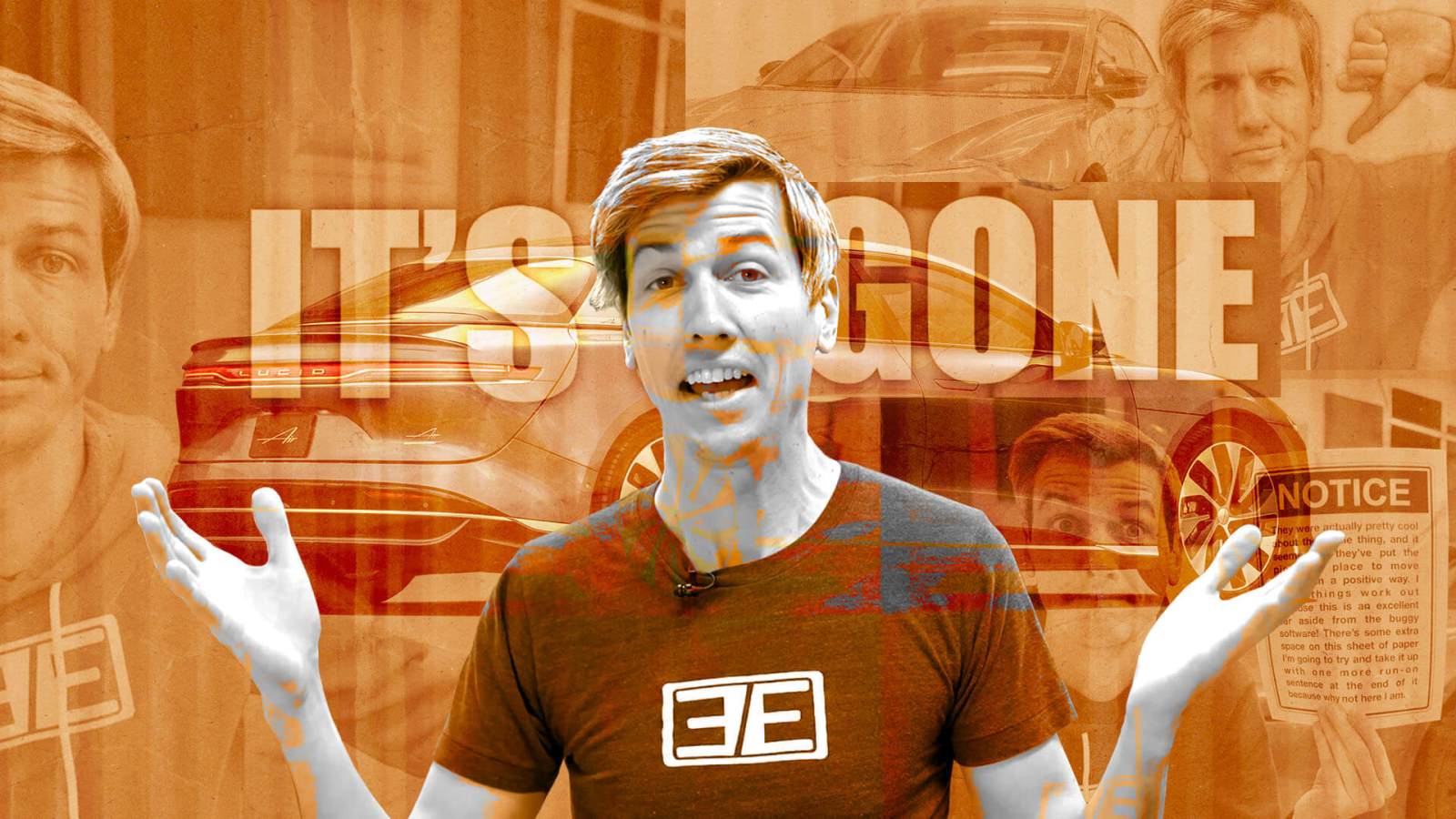

Lucid is buying back the Air sedan owned by Jason Fenske, the engineer behind the popular YouTube channel ‘Engineering Explained’, after 11 months of software problems that the host said culminated in a single weekend trip with at least eight separate failures.
The buyback marks an escalation in a story EV has followed since December, when Fenske’s first review aired and Lucidpublicly responded in January, promising a major software overhaul by the fall of 2026.
Fenske detailed the buyback in a video posted Friday titled “Lucid Is Buying My Car Back – More Problems!”
The video, on a channel with 4.2 million subscribers, had drawn over half a million views and more than 6,000 comments within two days.
Fenske said he signed a document framing the deal around consumer-protection law.
“This offer is intended to provide you, at a minimum, with what you may be entitled to under Lemon Law,” he said, reading from the agreement.
The Breaking Point
Fenske said he had intended to lease the Air Touring for three years before deciding whether to keep it, but reached his limit after a 400-mile weekend trip.
“Life with the Lucid is a whole lot different than the brief stints” before buying, he said, echoing the framing of his earlier reviews.
The failures began before he left. The rear doors would not open even though the car was unlocked and the handles had deployed, while the front doors worked.
“This is why people hate these style door handles,” Fenske said of the electronic releases.
On the road, he found the two rear climate zones blowing different temperatures despite identical settings.
Using a data-logging thermometer at home, he measured one rear vent blowing about 10 degrees Celsius hotter than the other, with the car parked in his garage and both zones set to 65 degrees Fahrenheit.
The reversing camera’s guide lines failed to load. Apple CarPlay loaded but would not start navigation, then later would not load at all. “It just spins and spins, and nothing happens,” he said.
A Setting That Changed on Its Own
The failure Fenske said alarmed him most involved the car’s stop mode, which he had set to “hold” since buying the vehicle, enabling one-pedal driving that brings the car to a complete stop.
After parking at a ski shop with no one inside the car, he said the setting switched itself from “hold” to “roll.” When he put the car in reverse and lifted off the brake, it rolled forward instead of holding.
“I’m freaking out, because I’m like, is the car broken?” he said.
Fenske said the implications could be serious in the wrong place. “Think of a scenario where you’re parallel parked on a steep hill,” he said, citing San Francisco, where he said a collision with the car ahead would have been likely.
The same trip brought a recurring incorrect speed limit, with the car reading 75 miles per hour in a 45-mph zone, and music that paused repeatedly. “I’ve had it pause three times during the same song,” he said, adding that it never resumed on its own.
A Longer List of Faults
Fenske said the weekend was only his breaking point, not the full extent of the problems since his last video.
The audio system, he said, failed frequently and in varied ways: sometimes silent, sometimes tinny, sometimes playing only through the rear speakers with the balance centered.
He said the Lucid mobile app drained 46% of his iPhone 17’s battery in a single day while skiing, almost entirely through background activity, compared with 7% used by a separate app tracking him by GPS for five hours.
Other faults included heated seats that switched off on their own and an episode in which the car would not engage drive or reverse because it behaved as though it were plugged in when it was not.
“The car feels broken,” he said.
How the Buyback Unfolded
After documenting the weekend’s failures and emailing them to Lucid, Fenske said the company agreed the behavior was unacceptable and initially proposed replacing his car with a new Air while keeping his lease payments unchanged.
That plan ran into a legal constraint, he said: keeping the payments identical required an exact-spec replacement.
Fenske estimated the Air Touring alone offered more than 4,600 unique build combinations, making a precise match impractical for a low-volume automaker.
Lucid instead offered to buy the car back outright, refunding every payment he had made, he said.
Fenske said he declined to start a new Lucid lease for three reasons.
The price had risen, with an equivalent vehicle now estimated at about $1,130 a month against his roughly $865, an increase of about $265.
Additionally, a new lease would restart the three-year term, and a shorter term would push the payment to around $1,440 a month. And he was unwilling to risk the same software experience again.
“I love this car on paper, and I love the way it drives,” he said, but added he did not want to repeat the experience.
Praise for the Engineering, Still
As in his earlier videos, Fenske separated the car’s engineering from its software, a distinction that has run through EV‘s coverage of the saga.
He described the buyback as the right move by the automaker. “I’m very appreciative of Lucid for just doing the right thing,” he said.
Addressing viewers who noted his audience likely eased the process, Fenske agreed it probably helped but argued the principle held regardless. He said any owner facing failures this frequent on a car stickering around $85,000 should have options to repair, replace or return it.
In a pinned comment posted Friday, Fenske returned to that question, saying he was not “naive” enough to believe he was treated like everyone else given his platform.
His advice to other owners was to document problems thoroughly, recording video where possible, on the reasoning that issues that cannot be easily recreated are harder to get addressed.
He also pushed back on commenters who suggested he missed his former Tesla.
Fenske said he did not miss the Model 3, which he called a great car he had enjoyed, and noted he had gone from four cars to three, now keeping a Toyota GR Corolla, a Shelby GT350 and a Ford Maverick.
A Loaner That Also Faltered
Lucid offered Fenske a Gravity SUV as a long-term loaner while he had no replacement vehicle, which he said he planned to live with before reviewing.
In an “Unfortunate Update” card shown on screen near the end of the video, Fenske said the Gravity loaner was taken back to Lucid service shortly after filming because of a passenger-side window that would not roll back up even after multiple vehicle resets, along with an intermittent cruise-control cancel button and cameras that repeatedly failed to load.
“I am not sure if I will complete the long term loan,” he wrote, while again crediting the company’s engineering and its handling of the situation.
Background
Fenske’s December review, titled “Owning A Lucid Has Been Super Disappointing,” drew more than 692,000 views within a day and framed the car as brilliantly engineered but undermined by its software.
In January, Lucid responded in a follow-up video and acknowledged its software had fallen short, a recognition it tied to a restructuring that put Emad Dlala, promoted to Senior VP of Engineering and Figital, in charge of all product development including software.
The company promised UX 3.0, which it called a complete overhaul of its user-experience software, by early fall 2026.
The update was set for vehicles bought or leased after April 2024, with owners of older cars able to access it by paying $950 to upgrade to a second-generation infotainment processor.
Lucid had also fixed several issues by January, including the bug that stopped Fenske’s car from loading over-the-air updates, plug-and-charge at Electrify America stations, and an automatic climate setting that switched on the heated seats. Later Lucid updates added Plug & Charge support at Tesla Superchargers, though the Air’s update cadence has trailed that of the Gravity.
Fenske said in the buyback video that Lucid‘s January response, which he called respectable, was the reason he chose to keep the car and “see this thing through.”
Lucid had not issued a public response to the buyback video at press time.