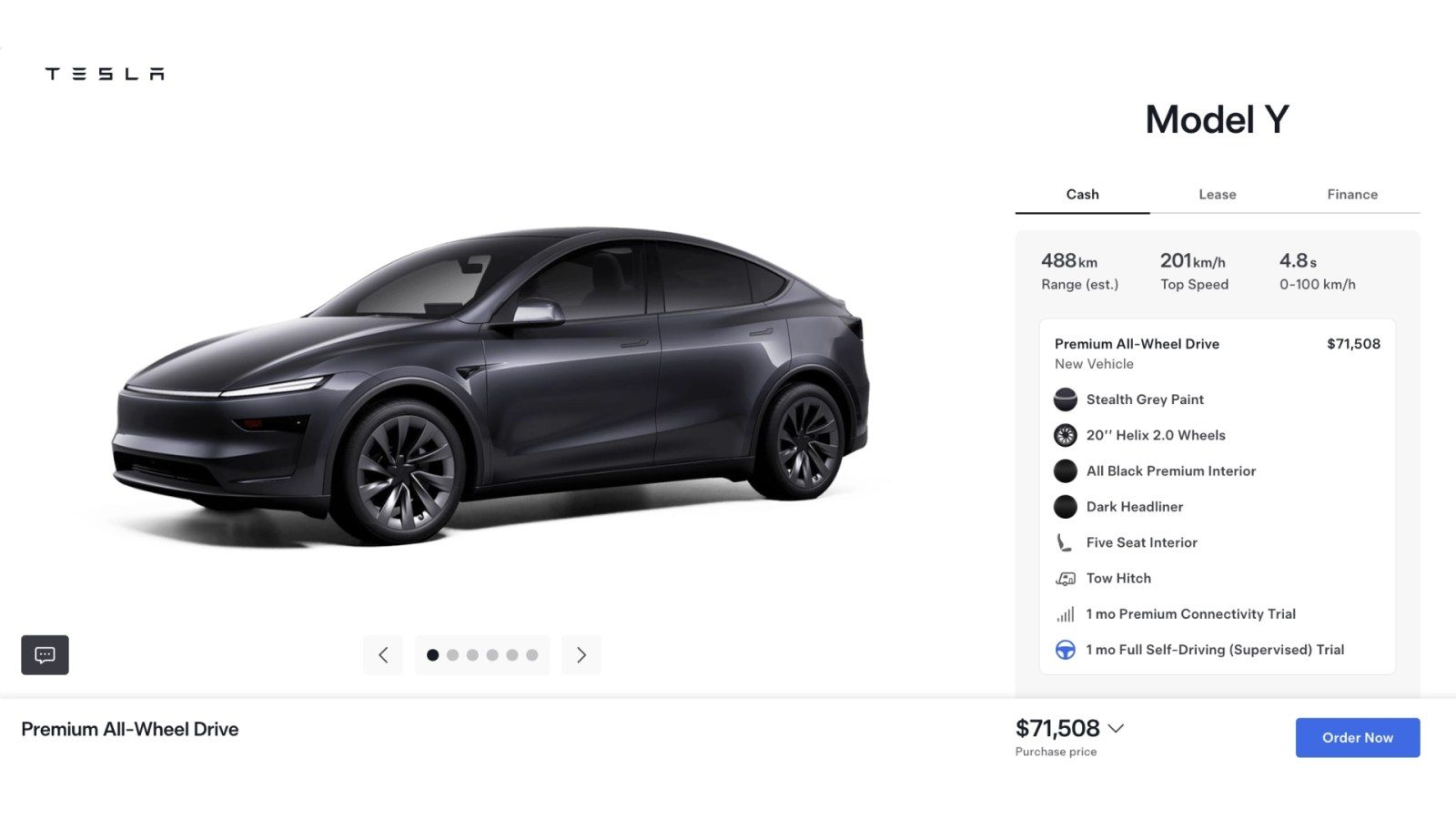

A single Tesla Model Y appeared on the company’s Canadian inventory page on Monday, according to Drive Tesla Canada, making it the only unit of the world’s best-selling model to be available for immediate delivery.
The 2026 Premium All-Wheel Drive, finished in Stealth Grey with 20-inch Helix 2.0 wheels, is listed at C$68,890 near Dartmouth, Nova Scotia, with one-month Full Self-Driving trial and the tow hitch included.
Dartmouth is the same port where Berlin-built Model Ys first arrived in Canada a year ago, when Tesla offloaded its first European-made units to bypass tariffs on US-built vehicles.
Finding available stock, however, requires searching through specific postal codes on Tesla’s website.
Drive Tesla Canada, which tracks inventory across all Canadian locations, shows a total of just 10 vehicles nationwide as of Monday morning.
Beyond the lone Model Y, the remaining nine units consist of a single Model 3 and eight Cybertrucks.
The Model 3 is a 2026 Premium Rear-Wheel Drive in Ultra Red, priced at C$43,390 and marked as in transit near Winnipeg with 10 km on the odometer.
Earlier this year, Tesla began shipping the sedan from its GigaShanghai factory instead of the United States, after Ottawa cut its tariff on Chinese-built electric vehicles.
Cybertruck inventory is spread across five cities — Calgary, Dartmouth, Edmonton, West Vancouver and Winnipeg — with prices ranging from C$130,100 for a 2025 demo Premium AWD with 3,369 km near Dartmouth to C$175,990 for a 2026 Cyberbeast with 6 km near West Vancouver.
Tesla has never introduced the base AWD Cybertruck trim in Canada — the entry point available to US buyers at US$69,990.
Canadian buyers can only access the Premium AWD, starting at C$139,990 on the configurator, and the Cyberbeast at C$167,990.
Both are built at Giga Texas in Austin and face the full weight of Canada’s 25% counter-tariff on US-assembled vehicles.
Three Continents, One Market
Canada now receives each of its Tesla models from a different continent.
Model Y units ship from GigaBerlin in Grünheide, Germany. Model 3 sedans come from Giga Shanghai. Cybertrucks arrive from Texas.
Each route is governed by a different trade arrangement, and only one of the three attracts a punitive tariff.
Tesla began importing European-made Model Ys into Canada in September 2025, after Ottawa’s 25% counter-tariff on US-built vehicles made Fremont-sourced units economically unviable.
Berlin-built vehicles qualify for Canada’s free trade agreements, allowing the entry-level RWD variant to fall below the C$50,000 threshold required for the federal Electric Vehicle Affordability Program (EVAP) rebate of up to C$5,000.
Shanghai-built Model 3 sedans entered the Canadian market on May 1 at a starting price of C$39,490 for the Premium RWD — about half the price of the Fremont-sourced variant it replaced.
The Shanghai car does not qualify for the C$5,000 rebate, because eligibility requires manufacture in a free-trade-agreement country. Buyers pay the full price with no federal offset.
Tesla relaunched the Model 3 Premium AWD trim in June at C$49,990, rounding out the sedan’s Canadian lineup.
Both trims are sourced from Shanghai under a trade agreement Prime Minister Mark Carney’s government struck with Beijing in January, which replaced the 100% surtax on Chinese-made EVs with a 6.1% most-favored-nation tariff rate and an annual quota of 49,000 vehicles.
Waiting Times Ballooned
As recently as March, Model Y orders placed in Canada carried wait times of four to six weeks for the RWD and Premium trims.
By late July, all three variants had been pushed to December 2026 or January 2027. Orders placed today face a wait of three to four months.
Every Model Y trim — RWD at C$49,990, Premium AWD at C$64,990 and Performance at C$74,990 — shows an estimated delivery of December 2026 to January 2027 on Tesla’s Canadian configurator.
From the end of August, Model 3 trims display the same window across the board: the Premium RWD at C$39,490, Premium AWD at C$49,990 and Performance at C$74,990 all list December 2026 to January 2027.
Cybertruck follows the same pattern.
GigaBerlin’s production constraints are a factor on the Model Y side, and they have tightened rather than eased.
Plant chief André Thierig said in June that the facility was producing around 5,000 vehicles per week and aimed to ramp output to over 6,000 units in July, as it maxed out its supply chain capacity.
It has not reached the target. Handelsblatt reported last week that Grünheide is running below 6,500 and that Tesla has ordered three mandatory special shifts in September, on the 18th, 19th and 25th, covering the whole of vehicle production.
Berlin supplies not only Canada but all European markets, leaving limited allocation flexibility for a market that represents a fraction of the plant’s total output. Tesla registered 21,767 new cars in the European Union in May alone, up 152% year on year.
On the Model 3 side, Shanghai-built cars cross the Pacific to Canada’s west coast, a logistics chain that adds weeks to delivery even before production queues are factored in.
On the Model 3 side, the Shanghai-to-Canada route involves trans-Pacific shipping through the Port of Vancouver — a logistics chain that adds weeks to delivery even before production queues are factored in.
Only 15,603 Chinese-built EVs were imported into Canada during the first six months of the quota program through August 31 — well short of the 24,500 permits available.
Tesla is presumed to be the main beneficiary, though Global Affairs Canada does not identify importers or brands in its utilisation reports and no carmaker has confirmed a share.
The unused volume carries forward. Global Affairs Canada has moved 8,897 first-window permits into the second, so 33,397 vehicles can enter at 6.1% between September 1 and February 28, against the 24,500 originally allocated.
Trade Escalation Continues
A return to US-sourced vehicles appears unlikely under current trade conditions.
Canada’s 25% counter-tariff on US auto imports has been in force since April 2025.
Ottawa kept the automotive surtax in place even when it rolled back other retaliatory measures in September 2025, signaling the sector’s role as a durable point of leverage.
Trade relations between Washington and Ottawa have deteriorated further since.
Negotiations collapsed on August 21, and US President Donald Trump announced on August 24 that tariffs on all Canadian-made cars, trucks and auto parts would rise to 50% effective January 1, 2027.
Canada’s latest round of counter-tariffs — imposing duties of 15%, 25% and 50% on C$27.6 billion worth of American goods — took effect on September 8.
Model Y units from Berlin similarly avoid the US tariff because they are German-origin goods.
Only the Cybertruck, built at Giga Texas, faces the full weight of Canada’s US automotive counter-tariff — a cost already reflected in its C$139,990 starting price.