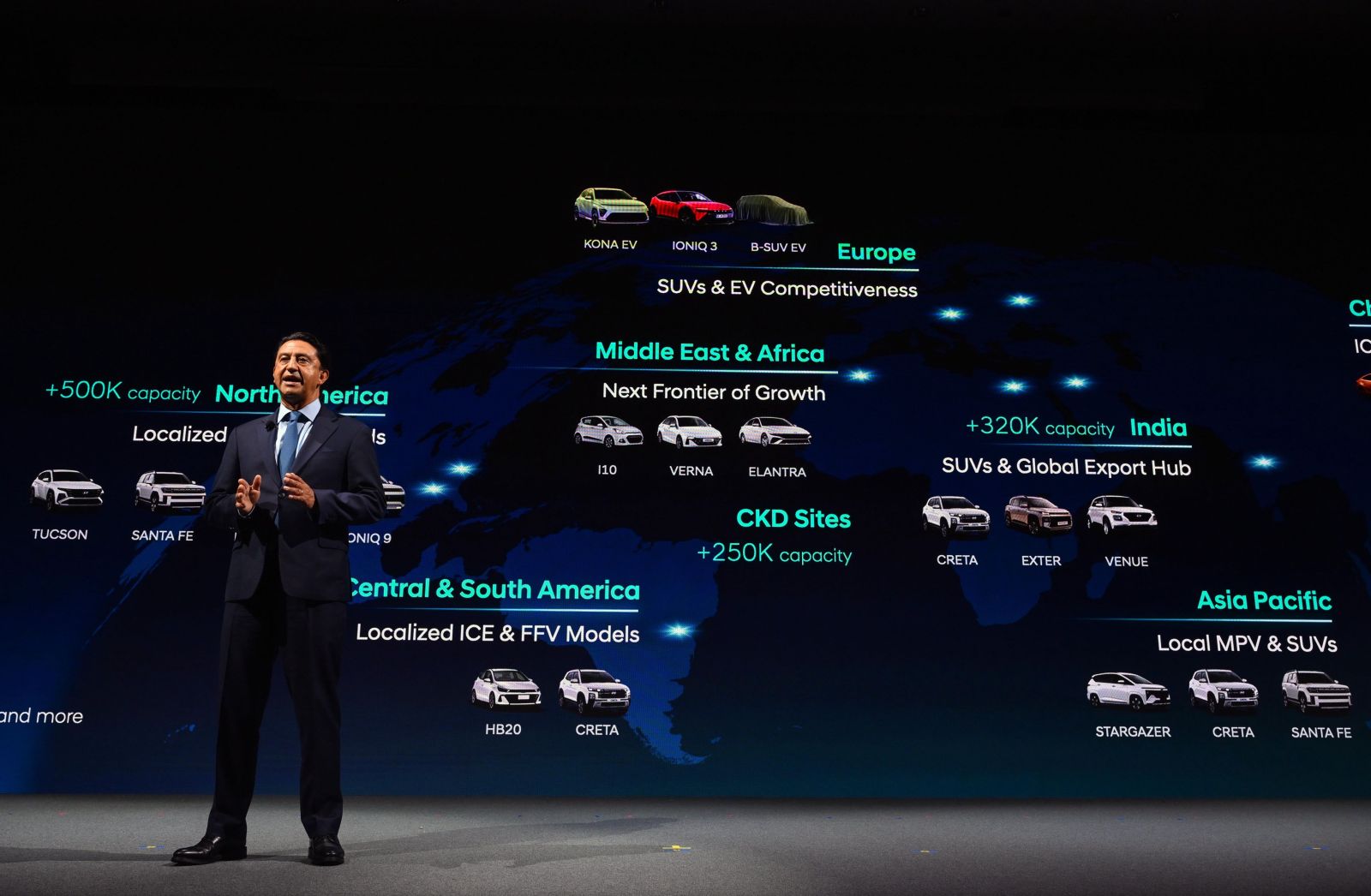

Hyundai Motor Company said electrified vehicles will account for 60% of its sales by 2030, against 23% in 2025, as it set out a product and capital plan at its CEO Investor Day in Seoul on Wednesday.
The company reaffirmed a target of 5.55 million global sales by 2030, equal to a 6% world market share, and raised its 2030 operating profit margin target to above 9% from a previous range of 8% to 9%.
Guidance for this year was left unchanged at 6.3% to 7.3%.
The Product Plan
Hyundai will carry out more than 100 global product launches and refreshes by 2030, including at least 18 entries into new products or market segments.
Those break down as 58 in North America, 49 in Korea, 41 in Europe, 26 in India and 22 in China. The regional figures sum to more than 100 because individual models count in several markets.
Seven new vehicles arrive within the next eight months. Named models include an all-new Elantra, the IONIQ 3, a new Tucson and Tucson Hybrid, the first Santa Fe EREV, an A-segment electric SUV for India, a global B-segment SUV and a B-segment SUV for Europe.
The company also described a push into what it calls white spaces — segments where it is underrepresented, including body-on-frame vehicles, a midsize pickup and light commercial vehicles.
EREVs
The first extended-range electric models launch from the first half of 2027, targeting more than 600 miles of range.
The Santa Fe EREV will be built in the United States at Hyundai Motor Manufacturing Alabama.
Hyundai will use its own battery cells in both extended-range and pure electric vehicles from the first half of 2027. In the extended-range application, the company says the cells will use less than half the battery capacity of a comparable electric vehicle while delivering equivalent performance and driving dynamics.
The in-house cells deliver more than double the output of the company’s previous high-nickel cells, with 40% faster charging. A new thermal runaway protection technology debuts on the Genesis GV90.
Separately, mid-nickel NCM cells for pure electric vehicles are intended to cut battery cost by around 30% while maintaining performance in real-world conditions. From 2028, cloud-based battery management is expected to extend battery life by 20%.
Manufacturing
Global manufacturing capacity expands by 1.27 million units by 2030.
North America accounts for 500,000 of that, with local parts sourcing rising above 80%. India adds 320,000, Korea 200,000 and completely-knocked-down sites a further 250,000.
A new electric vehicle facility in Ulsan begins production with the Genesis GV90. Hyundai describes it as a software-defined factory, deploying 108 advanced manufacturing tools, artificial intelligence-enabled quality control and inspection, and a manufacturing AI agent.
In North America, Hyundai will introduce ten hybrid models by 2030 and expects hybrids to account for half of regional sales. In China, the company says it is pursuing a turnaround by leaning on local design, manufacturing and partnerships.
Genesis and N
Genesis enters its second decade with its first hybrid, its first extended-range electric vehicle and the GV90 flagship sport utility vehicle, targeting 350,000 annual sales across more than 40 markets by 2030.
Hyundai N, the performance line, will expand to 100,000 annual sales by 2030 and gains a new volume high-performance tier.
Autonomy and Robotics
The autonomous driving roadmap runs in stages.
Atria AI, the company’s driving foundation model, begins real-world data collection in Korea this year. Level 2+ capability arrives on Hyundai’s first mass-produced software-defined vehicle in 2028, in collaboration with NVIDIA. A 100-megawatt artificial intelligence data centre with more than 50,000 graphics processing units comes online from 2029.
Robotaxi supply scales through Waymo, with deliveries beginning in the fourth quarter of 2026.
On robotics, Hyundai is scaling commercialisation through Boston Dynamics and exploring distribution and financing. US robot production begins in 2028 with 30,000 units of annual capacity, and the company’s robot manufacturing capability expands ten-fold by the end of this year.
“Boston Dynamics is now part of Hyundai Motor Group,” said José Muñoz, president and chief executive of Hyundai Motor Company. “We’re building Spot and Stretch robots, and soon, we’ll be mass producing Atlas humanoid robots. We have existing potential distribution for selling robots through our dealer partners.”
Muñoz added that Hyundai Capital is exploring the feasibility of financing robot sales.
The Financial Position
Hyundai delivered two million wholesale units in the first half, generating revenue of 95.2 trillion won — about $68.9 billion — up 2.7% year on year, with an operating profit margin of 5.6%. Market capitalisation has averaged 105 trillion won so far this year.
The revenue figure is the one that rose. Second-quarter wholesale volume fell 6.9% to 991,885 units, and second-quarter operating profit dropped 20.8% to 2.85 trillion won, with the company citing supply disruptions and a volatile trade environment.
The 2030 margin target of above 9% is supported by a three-percentage-point reduction in the cost of sales ratio.
Hyundai guided in January to 4.16 million wholesale units this year. Reaching 5.55 million by 2030 implies growth of 33.4% over four years, and lifting electrified sales from 23% to 60% of the mix means multiplying that share by roughly two and a half times.