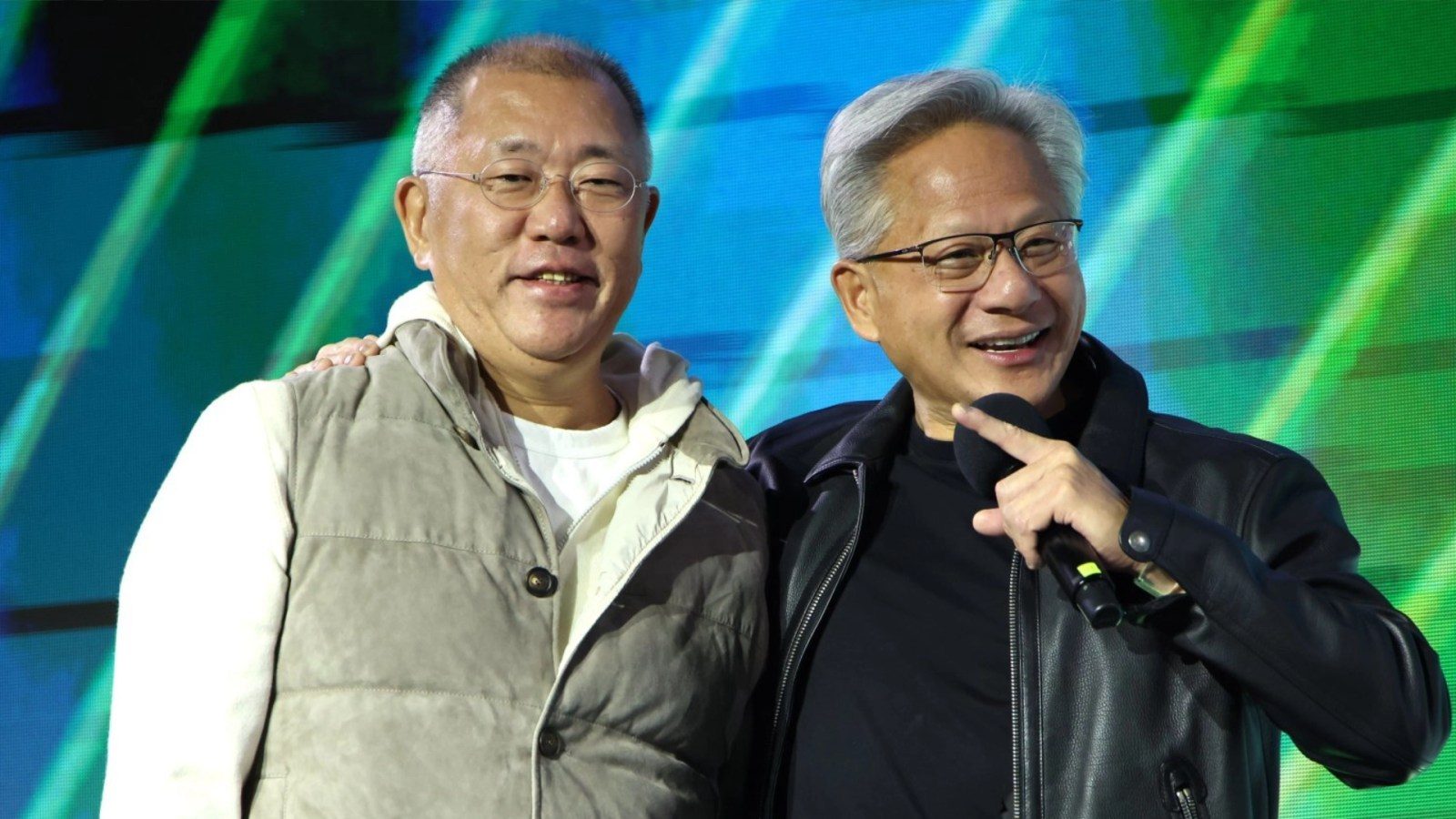

Nvidia‘s founder and CEO Jensen Huang visited Hyundai Motor Group‘s headquarters in Seoul on Monday, capping a four-day South Korea tour with an endorsement of the automaker’s position in the emerging physical AI race.
Huang met Executive Chair Euisun Chung at the group’s Yangjae campus, where he viewed its first mass-produced mobility robot platform.
“The union of Hyundai‘s capabilities in this new era with artificial intelligence ignites and sparks physical AI, the next evolution of artificial intelligence, robotics,” the Nvidia chief stated in recorded remarks alongside Chung.
According to him, “no one is in a better position to take advantage of that and to create that than Hyundai.”
He described Hyundai as “incredible at manufacturing, incredible at mobility, incredible at heavy industries, manufacturing at extremely large scales.”
Huang called Chung a “very dear friend” and said a partnership that began in self-driving cars is now expanding into robotaxis, autonomous mobility, robotics, and AI factories.
“We have many exciting projects to do that we look forward to telling you more about,” he added, without disclosing specifics.
Partnership Spans a Decade
Hyundai Motor Group — encompassing Hyundai, Kia, and Genesis — has worked with Nvidia since 2015 on intelligent vehicle systems.
A major early milestone came in November 2020, when all three brands announced Nvidia DRIVE would power in-vehicle infotainment across their future lineups starting with 2022 models.
Cooperation escalated sharply in January 2025 at CES.
Hyundai unveiled a broad strategic partnership covering accelerated computing, generative AI, and industrial digitalization tools such as Nvidia‘s Omniverse digital-twin platform.
By October 2025, both sides had agreed to build a Nvidia Blackwell-powered AI factory — supercomputer infrastructure designed to support autonomous driving, smart factories, and robotics.
Backed by roughly $3 billion in joint investment with the South Korean government, the effort includes an Nvidia AI Technology Center and a Hyundai Motor Group Physical AI Application Center.
“AI is revolutionizing every facet of every industry,” Huang said at the October 2025 announcement. Chung called the deepening collaboration “a pivotal step forward” and said both companies were “laying the foundation for a robust AI ecosystem in Korea.”
Hyundai plans to deploy up to 50,000 Nvidia Blackwell GPUs for training and validating AI models across in-vehicle intelligence, autonomous driving, factory automation, and robotics.
From Atria to Alpamayo
Monday’s visit comes as the South Korean company recalibrates its autonomous-driving strategy around Nvidia technology.
In January 2026, Korean outlet TheElec reported that Hyundai‘s internally developed Atria AI system — built over the prior year by software subsidiary 42dot — scored just 25 out of 100 in an internal benchmark evaluation.
Tesla‘s FSD topped the same test at 90. Sources said Atria relied partly on conventional rule-based control logic and lacked the data scale of rival systems.
Nvidia‘s Alpamayo platform stands in stark contrast.
Unveiled at CES in January 2026 as the industry’s first reasoning-based autonomous-driving AI, Alpamayo features more than 10 billion parameters and draws on driving data from over 2,500 cities worldwide.
Local media outlet Korea Times reported Hyundai could formally adopt Nvidia‘s Alpamayo platform as the automaker races to close its gap with Tesla and Chinese rivals in commercially viable autonomous systems.
Hyundai, Kia, and Nvidia formalized an expanded partnership at GTC in March, specifically targeting next-generation autonomous driving.
Under the agreement, Hyundai plans to integrate Nvidia DRIVE Hyperion technology for Level 2+ systems in select vehicles while advancing Level 4 robotaxi development through Motional, its autonomous-driving joint venture.
Nvidia‘s VP of Automotive Rishi Dhall said at the time that the collaboration combines Hyundai‘s vehicle engineering leadership with Nvidia‘s accelerated computing and AI.
The goal, Dhall said, spans “from advanced driver assistance in select production vehicles to scalable robotaxi services with Motional.”
Heung-Soo Kim,Executive VP and Head of Hyundai Motor Group‘s Global Strategy Office, called the expanded partnership “an important milestone.”
According to Kim, the group would strengthen competitiveness from Level 2+ technology through Level 4 robotaxi services under a unified framework.
Leadership Reshuffle
Hyundai has simultaneously reshaped its autonomous-driving leadership to reflect the strategic shift.
In January 2026, the group appointed Park Min-woo — a former Nvidia VP who spent more than eight years bridging the chipmaker’s research division and autonomous-vehicle development — as CEO of 42dot and head of a new Advanced Vehicle Program division.
Days later, Hyundai hired Milan Kovac, former head of Tesla‘s Optimus humanoid robot program, as a director at Boston Dynamics.
Hyundai acquired the robotics firm in 2021. Both appointments signaled intent to accelerate on two fronts — autonomous driving and humanoid robotics — at once.
Boston Dynamics’ Atlas humanoid robot featured prominently in pre-visit reporting and is understood to have been a key discussion topic during Monday’s meeting.
Hyundai‘s Yangjae headquarters recently completed renovations transforming its lobby into a robotics testbed with three types of deployed robots, Korean media reported.
A Hyundai VP noted earlier this year that humanoid robots still face significant technical hurdles before commercial deployment, but Nvidia‘s physical AI infrastructure could shorten development timelines.