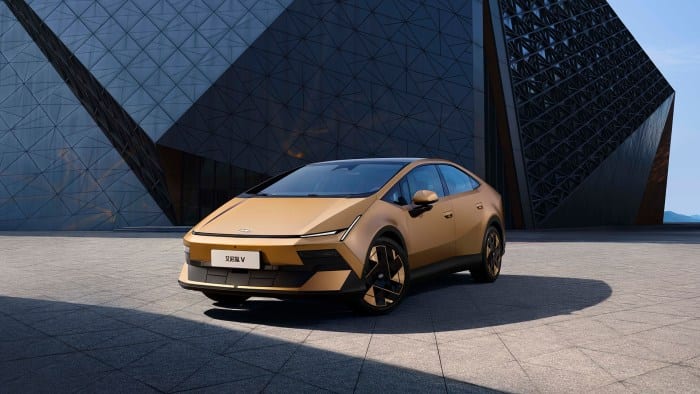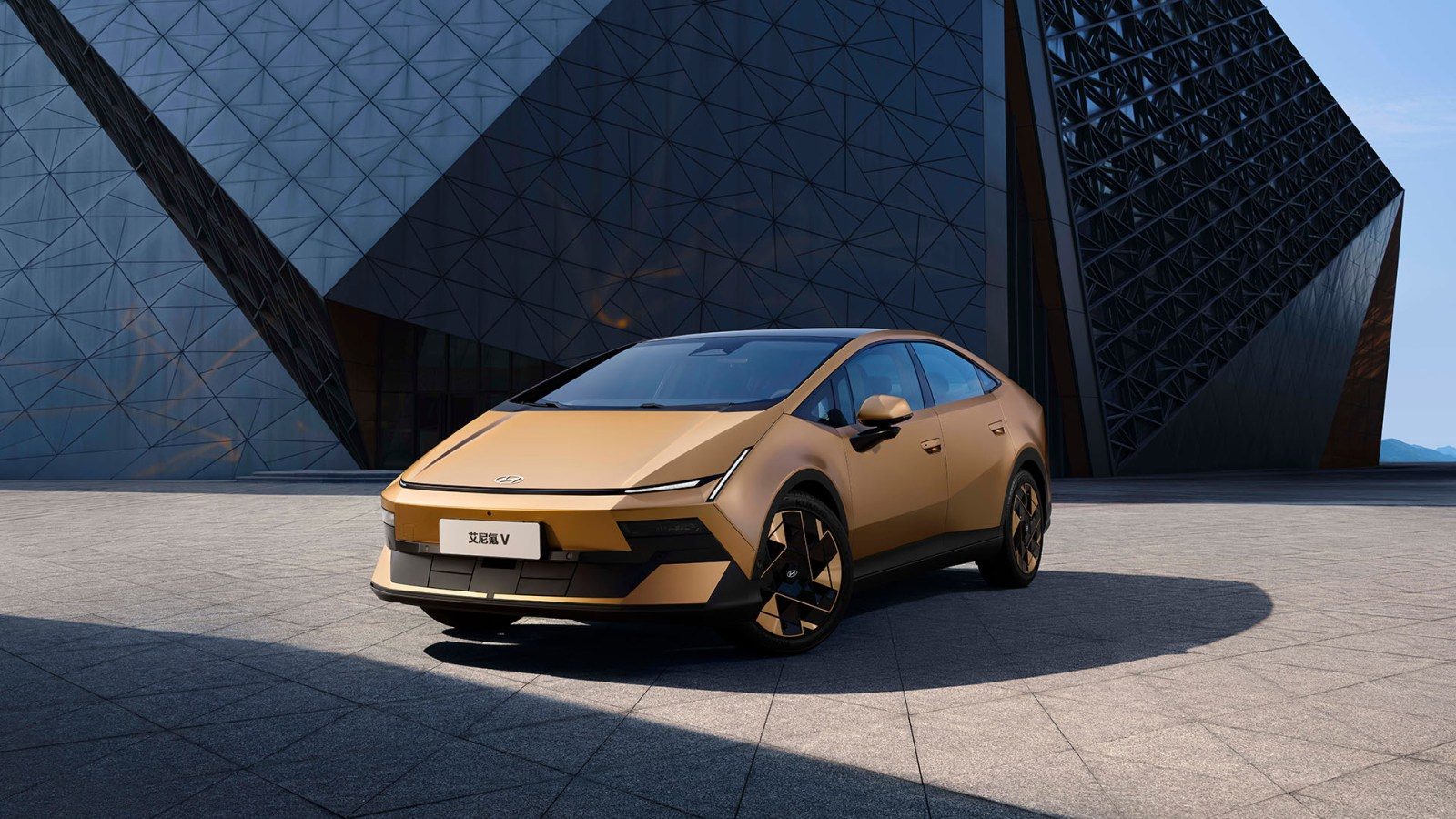

Hyundai‘s Chinese joint venture launched the Ioniq V electric sedan on Tuesday at a list price of 109,900 yuan ($16,400), with a limited-time offer taking the entry version to 99,900 yuan ($14,900).
The five-version range tops out at 139,900 yuan ($20,800), or 131,900 yuan ($19,700) under the launch offer.
The Ioniq V is the first model of Hyundai’s Ioniq electric brand developed for China, and the first of 20 new models Beijing Hyundai plans to launch over five years.
Pre-sales opened at the Chengdu Auto Show on August 21 with three versions from 119,900 yuan. The new entry version and the launch offer bring the starting price 20,000 yuan ($3,000) lower.
Beijing Hyundai did not disclose order numbers or a delivery date at the launch.
Two Batteries, Front-Wheel Drive
The 540 versions use a 53.48 kWh lithium iron phosphate battery from CATL and a 140 kW motor, for 540 km of range on China’s CLTC cycle, according to Beijing Hyundai’s specification sheet.
The 650 versions use a 66.85 kWh pack and a 168 kW motor, for 650 km.
Every version is front-wheel drive, with a torsion-beam rear axle, and charges from 30% to 80% in 20 minutes on a DC fast charger, the specification sheet shows.
The sedan measures 4,900 mm long, with a 2,900 mm wheelbase. The model is built on Hyundai’s E-GMP platform with an 800-volt system.
The 20-minute charging time is slower than the 10% to 80% in about 18 minutes that Hyundai quotes for its 800-volt Ioniq 5 SUV.
Chinese Suppliers
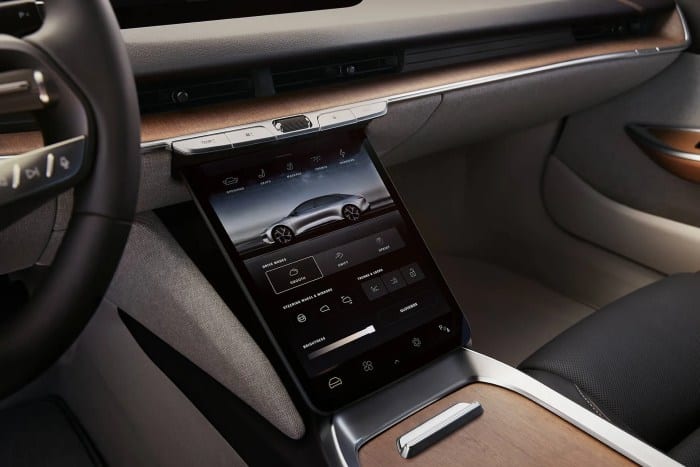
Driver assistance comes from Momenta, using cameras rather than LiDAR, and the cockpit runs on a Qualcomm Snapdragon 8295P chip with a 27-inch 4K display.
The voice assistant combines AI models from ByteDance’s Volcano Engine and Baidu.
A city function that learns and repeats routes of up to 150 km, and memory parking, “will be updated later via OTA,” Beijing Hyundai’s website says, so neither is available at launch.
First owners get a lifetime warranty on the battery, motor and electronic control system.
500,000 Target
Hyundai Motor unveiled the Ioniq V at the Beijing Auto Show on April 24, where Chief Executive Officer José Muñoz said the company was “tripling down on our commitment to China.”
Hyundai and its partner BAIC Group have committed a combined 8 billion yuan ($1.19 billion) to Beijing Hyundai, under an agreement reached in December 2024.
Beijing Hyundai aims for 500,000 annual sales, “driven by renewed growth in the Chinese market and expanded export opportunities,” Hyundai said in April.
It sold about 210,000 vehicles in 2025, up 14.8%, Xinhua and National Business Daily reported.
The next model is an SUV due in the first half of 2027, Hyundai said.
“The development cycle of the Ioniq V was at least three years. We could not have built it in 18 months,” Beijing Hyundai General Manager Li Fenggang said in August.
Muñoz said in April that Hyundai was “conducting feasibility studies” on exporting the Ioniq V, naming Asia-Pacific, Australia, the Middle East and Latin America as possible markets.