
Fully electric vans had their best month on record in Britain in September and still reached less than half the market share required by law, underlining a split between car fleets that are nearing their electric targets and working vehicles that are not.
Registrations of electric vans rose 13.4% from a year earlier to 4,832, the Society of Motor Manufacturers and Traders (SMMT) said on Monday.
The trade body put their share at 9.6% in a light commercial vehicle market that grew 4.8% to 49,704 units, its sixth straight month of growth.
Large vans, the biggest segment, rose 11.1% to 36,302, while pickup registrations fell 53.8% to 2,658.
The share for the year to date is 10.8%, against a 24% target for 2026 under the Zero Emission Vehicle Mandate.
“September’s record electric van uptake shows manufacturers are delivering, with investment in new models and substantial discounts helping operators make the switch,” said SMMT Chief Executive Mike Hawes.
“Yet, even with high fuel prices, demand remains less than half the mandated level due to higher purchase costs, grid delays and a shortage of van-suitable charging,” he said.
Cars Are Much Closer
The contrast with cars is sharp. Fully electric cars took 28.3% of new car registrations in September, with volume up 36.3% to 99,201, final SMMT figures published on Monday showed.
The 2026 mandate target for cars is 33%, and the share for the year to date is 26.2%, with 454,947 electric cars among 1,732,090 registrations.
Fleets are the bulk of that market, accounting for 190,998 of the month’s 350,536 new cars, or 54.5%.
Fleet registrations rose 9.6% and private ones 13.9%.
Company car tax rates and salary sacrifice schemes have made electric cars the default choice for many fleet drivers, and Chinese brands have added cheaper models, taking more than a quarter of the September market.
Vans have no equivalent pull, and operators buy them on cost and payload.
A Review Closing This Month
The figures land while the mandate itself is under review.
The government opened a consultation on August 14 that runs until October 23, covering the path to ending sales of new petrol and diesel cars in 2030 and to all new cars and vans being zero emission by 2035.
Transport Secretary Heidi Alexander said at the launch that the end goal had not changed.
The SMMT, which represents carmakers, has used each monthly release to argue that the van targets are out of reach without more support.
The Vehicles That Work Hardest
The switch is slowest where vehicles carry loads, tow or run around the clock.
Parcel carrier DPD is among the operators that have moved furthest, ordering 341 Mercedes-Benz eSprinter vans in September to take its UK electric fleet past 4,000, with all of them due in service by the end of this month.
“Large panel vans are the backbone of DPD’s last-mile delivery,” said Olly Craughan, Head of Sustainability at DPD UK.
In the public sector, National Highways expects to electrify its ordinary cars and vans by 2027 but has given itself until 2030 for the 355 patrol vehicles its Traffic Officers use on England’s motorways.
Hyundai said on September 21 that it had supplied four Ioniq 9 SUVs for a trial in that role.
They are being tested alongside four Kia EV9s and one Volvo EX90, The Fast Charge reported in February, citing documents obtained under freedom of information rules.
“Currently, there isn’t a fully-electric heavy-duty 4×4 SUV capable of meeting our requirements,” National Highways’ National Fleet Manager Martin Edgecox told Business Car in December 2024.
The Ioniq 9 offers up to 385 miles of range in passenger form, against the 450 miles Edgecox described as the requirement.
Heavy trucks are further back still.
Container haulier Maritime Transport said on Monday that it had put five Renault Trucks E-Tech T electric tractor units into service, taking its electric truck fleet to 56 under a government-backed demonstration programme, with the new vehicles based at Wakefield and Avonmouth.
Each has a range of up to 300 kilometres on a charge.
Fleet Buyers Meet in Birmingham
The data arrives a day before Fleet & Mobility Live, the industry’s main UK trade show, opens at the NEC in Birmingham.
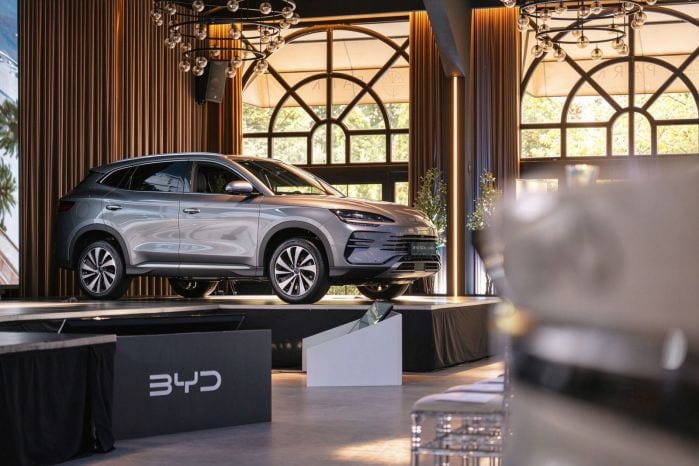
Carmakers are using it to court company buyers, with BYD showing six models including its premium Denza Z9GT and an electric van.
“DENZA is an important next step in the evolution of BYD Group in the UK fleet market,” said Claudio de Freitas, Head of UK Fleet Sales for BYD.
For car fleets, the question at the show is which electric model to choose. For van, patrol and truck fleets, it is still whether one exists that can do the job.