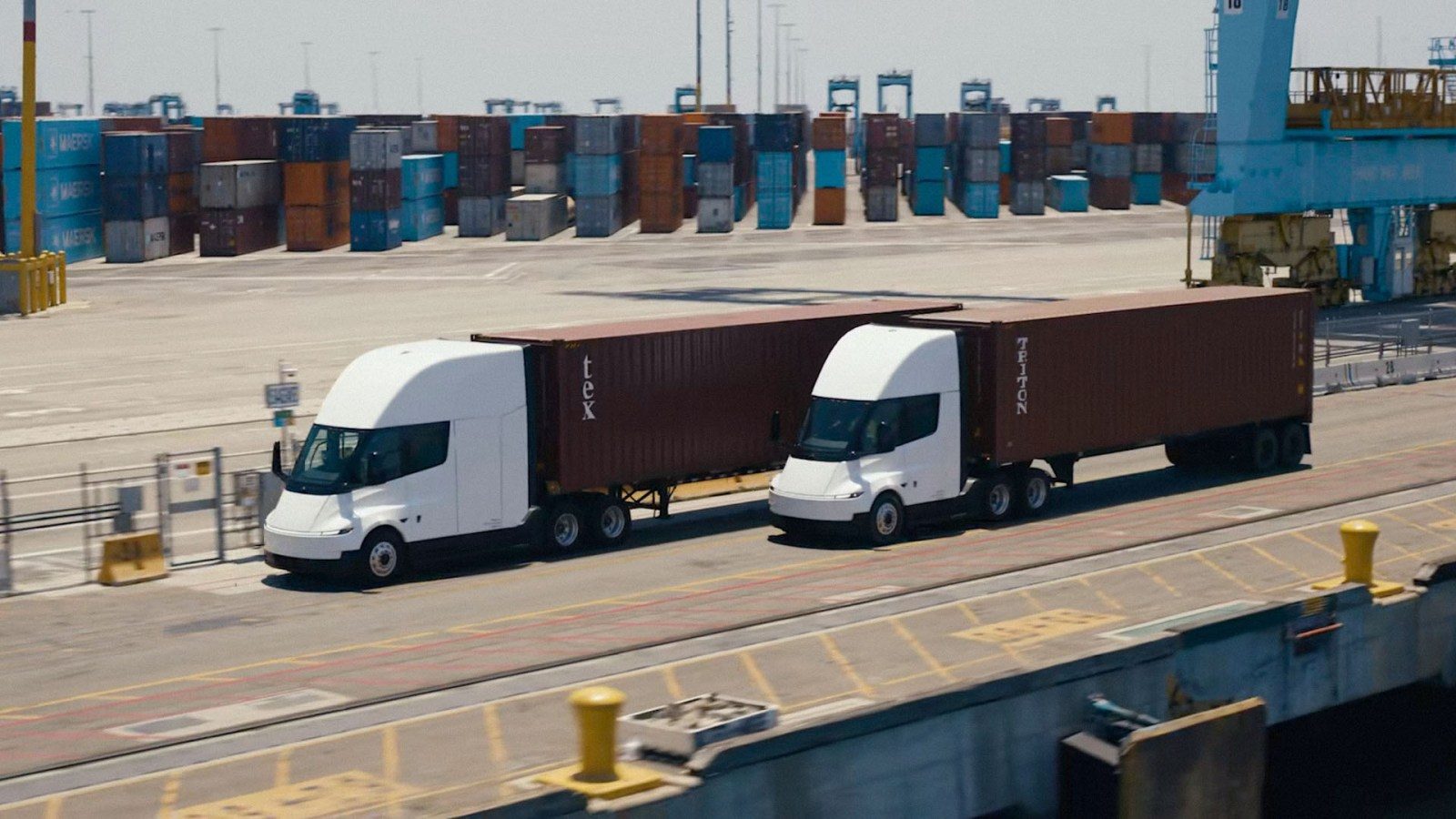

Tesla brought the European version of its Semi truck to IAA Transportation in Germany on Monday, the first showing of a truck homologated for Europe, with test rides offered throughout the week.
The truck differs from the US version in several visible ways, and Tesla has published an energy consumption figure that commentators have compared favourably with European electric rivals such as Volvo and Scania.
Tesla published European specifications on September 11, listing a single Standard Range tractor with 550 km of range at 40 tonnes gross combination weight, 1.0 kWh per kilometre of energy consumption, 800 kW of peak drive power from three rear-axle motors, a kerb weight under 9,100 kg and deliveries from 2027.
Cameras and Lighting
As EVwire‘s Jaan Juurikas described, reporting from the Hannover show, camera monitor systems are replacing the large protruding physical mirrors required in the United States under FMVSS 111.
European regulations have permitted camera mirrors since 2016 under UN R46, and Tesla adopted them for drag reduction and visibility.
Juurikas wrote on X this Monday that the Semi “has 10 cameras around the truck” and, according to the team, “there are literally no dead spots around the truck and I could see it: a full 360° view.”
Sawyer Merritt, a Tesla shareholder and one of the largest influencers on X with more than a million followers, posted a side-by-side comparison image of the two trucks immediately after the September 11 announcement.
The European version drops the full-width lightbar in favour of individual headlights closer to the Tesla Model Y Standard look.
Amber marker lights present on the US cab are absent on the European model.
Front lighting follows ECE standards rather than the US FMVSS 108 self-certification framework.
Reports from the show floor also note a possibly shorter wheelbase and the removal of the rear black fairing to maximise trailer length under EU combination limits, which are typically 16.5 metres with aerodynamic exemptions allowing more.
“Tesla team confirmed to me that the cab of the Tesla Semi in Europe is exactly the same length and width as the US version, no changes in that has been made (Standard Range),” Jaan Juurikas also wrote on Monday, adding that “they benefit from the aerodynamic truck regulation exemption that allows running regular trailers.”
Different Battery Strategy
Both trucks share the same core architecture.
Three independent motors on the rear axles produce up to 800 kW of peak power. Charging runs on the MCS 3.2 standard.
An electric power take-off supplies up to 25 kW for trailer auxiliaries such as refrigeration and hydraulics.
Inside the cab, a central driving position, dual touchscreens, acoustic glass, a heated and ventilated seat and standing headroom are unchanged.
The European model launches only in the Standard Range trim, which uses a 548 kWh battery pack — the same as one of the two trims sold in the United States.
A Long Range version with an 822 kWh pack, rated at about 500 miles (805 km) in the US, has not been announced for Europe.
Merritt explained the reasoning over the weekend: short-haul trips represent about 50% of semi-truck activity in Europe, and EU driving-time rules cap a single stint at 4.5 hours.
He was citing known Eurostat data: about 45% of goods moved by road in Europe travel less than 300 km.
Range and Charging Differences
In the United States, the Standard Range is rated at about 325 miles (523 km) at 82,000 lb, approximately 37.2 tonnes, with energy consumption of about 1.7 kWh per mile, or around 1.06 kWh/km.
The European truck claims 550 km at a heavier 40-tonne test weight on 1.0 kWh/km.
Tesla’s German-language fine print specifies the conditions behind that figure: constant 80 km/h, 20°C, flat road, tandem-axle aerodynamic kit and a dry-freight trailer.
Lower motorway speeds in Europe — typically 80 to 90 km/h for trucks, compared with higher US highway limits — and the aerodynamic gains from camera mirrors explain the longer range on the same battery.
Peak Megacharger power in Europe is listed at 800 kW, recovering about 60% of range in 30 minutes.
The US Long Range charges at up to 1.2 MW. Tesla also lists a 120 kW Basecharger for overnight depot use in Europe.
Efficiency vs Range
Merritt argued that the 1.0 kWh/km consumption figure matters more to fleet operators than the headline range number.
Current European electric trucks from Volvo Trucks and Scania consume approximately 1.1 kWh/km at 40 tonnes.
A 10% efficiency advantage at scale compounds across thousands of kilometres per truck per year and translates directly into lower electricity costs and fewer charging stops.
At 9,100 kg the European Semi is lighter than many competitors.
Mercedes-Benz’s eActros 600 carries a 621 kWh battery for 500 km at 40 tonnes, which works out to about 1.24 kWh/km.
Tesla’s lighter tractor leaves about 24 tonnes of payload at the 40-tonne limit with a standard 13.6-metre dry van, before any allowance for the two-tonne zero-emission weight bonus that EU rules permit and member states apply unevenly.
Production and European Timeline
Tesla has been building the Semi at volume at a dedicated 1.7-million-square-foot facility adjacent to Gigafactory Nevada since late April.
A formal plant inauguration is scheduled for September 24, four days after IAA closes.
In the United States, deliveries have expanded beyond early fleet customers like PepsiCo, with Einride ordering 500 trucks in August for Amazon and other customers and Big F Transport placing an order for 40 units in May.
The fleet logged 13.5 million miles across a few hundred trucks as of March.
European deliveries are scheduled to start in 2027.
Tesla has not announced pricing, a European order configurator or local production.
The company hired Usuf Schermo as Head of Business Development for EMEA in mid-2025, recruiting from Volta Trucks and Evum Motors, and has added a business development manager for Semi sales in France.
Space has been reserved in the cab structure for a sleeper berth — relevant for European long-haul rest rules — but none is specified on the current website.
Charging infrastructure details and country rollout plans are expected at or after the Hannover show.