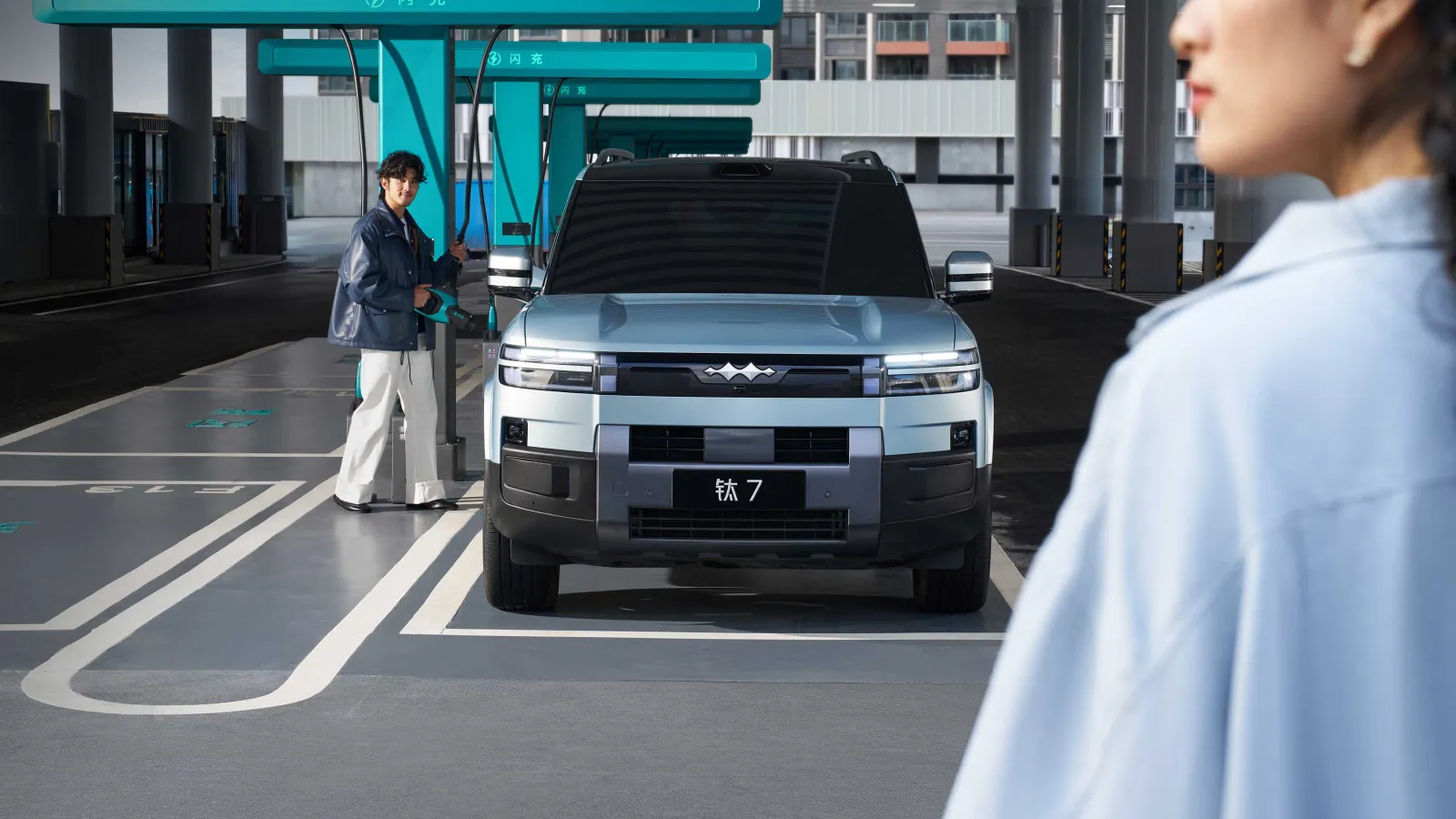
More than two in five Canadians who are inclined to buy an EV say they might hold off for more Chinese models, a new poll shows, as Geely, Chery, BYD and Dongfeng prepare to enter a market where imports from China are capped by quota.
Some 42% of “likely EV buyers” said they might “wait for more Chinese EVs to become available,” according to the survey conducted by Abacus Data and published by Clean Energy Canada, the think tank that commissioned it, on October 9.
Another 37% said there were “too few electric pickup options,” and Clean Energy Canada said both of these “more time-bound barriers” were twice as common among EV-inclined Canadians, “suggesting they could be having a real impact on current EV sales.”
Abacus surveyed 2,762 adults online from September 18 to 23, and said a comparable probability sample of that size would carry a margin of error of plus or minus 1.86 percentage points, 19 times out of 20.
Interest Up, Sales Below 2024
Nearly half (48%) of Canadians said they were inclined to go electric for their next vehicle, up three percentage points from 45% in both April and 2025.
Interest was highest among younger respondents, at 67% of those aged 18 to 29 and 58% of those aged 30 to 44.
Upfront cost and charging remain the most common worries, with 72% of those leaning toward an EV concerned about price and 63% about inadequate charging infrastructure.
Clean Energy Canada said awareness of cheaper models was lagging, as 60% of potential buyers said they were at least somewhat aware of new EVs priced from C$30,000 to C$40,000 ($21,100 to $28,200), but only 20% were very aware of them.
Fully electric and plug-in hybrid vehicles accounted for 10.8% of new registrations in the first quarter and 10.7% in the second.
That puts the first half at about 10.8%, up from about 8.6% a year earlier, but below the full-year share of 14.6% in 2024, before federal and provincial rebates lapsed.
The share fell to 9.5% in 2025, and registrations of zero-emission vehicles returned to year-on-year growth in the first quarter after Ottawa launched its new Electric Vehicle Affordability Program on February 16.
Ottawa has also proposed repealing the zero-emission vehicle sales requirements in its light-vehicle emissions rules, with public consultation open until October 29, according to the Canada Gazette.
Geely Commits
Geely is the latest Chinese group to set a date, saying on October 9 that its mainstream Geely brand would start selling vehicles in Canada in 2027 without naming a model, price, dealer or launch city.
Geely Auto Canada has a team in place and is building a retail and service network with “highly trusted and experienced partners,” the company said.
“Trust is earned over time, and we are committed to earning it here,” said Bryan Wu, Managing Director of Geely Auto Canada.
The company has not said whether Zeekr or Lynk & Co, the two other brands in Geely Auto Group, will follow, although Toronto leadership roles advertised in April were posted by Zeekr International.
Its Canadian website names only the Geely E5, sold in China as the Galaxy E5, and refers to a “new generation of electrified vehicles,” a term that leaves room for plug-in hybrids.
A Geely EX5 electric SUV was filmed on a Toronto-area road wearing Ontario manufacturer plates in August.
Geely Holding Group already sells China-built cars in Canada through Polestar, which reintroduced the Polestar 2 in June at C$69,900 ($49,300), and Lotus, whose Wuhan-built Eletre began arriving in July.
Who Else Is Coming
Chery’s Omoda & Jaecoo became the first Chinese brand to set a Canadian timeframe, saying on its website that its vehicles are “coming late 2026,” without naming models, prices or dealers.
BYD’s Canadian website still says “coming soon” with no date, while the company has been testing four models in Canada and has engaged a dealer-acquisition firm to find sites for about 20 dealerships, starting in the Greater Toronto Area.
Dongfeng’s Canadian distributor is targeting 2027.
XPeng said in July that Canada’s “door is open” and that its entry would be long-term rather than a handful of cars, without giving a date.
The Import Quota
The buyers who wait may find supply tighter than the quota suggests.
Canada agreed in January to let 49,000 China-built EVs a year into the country at the 6.1% most-favored-nation tariff, replacing the 100% surtax imposed in October 2024.
Only 15,931 permits had been used as of October 9, leaving 33,069 for the quota year ending on February 28, according to Global Affairs Canada’s weekly utilization report, the latest available, with the next update due at 3 p.m. Eastern Time on Friday.
The second six-month window, which opened on September 1 with 24,500 permits plus 8,897 carried over from the first, had drawn just 328, or about 1%.
September’s tally doubled from 160 in the September 25 report after 168 non-plug-in hybrid SUVs priced above C$35,000 ($24,700) were added, the same customs line that carried 259 vehicles in July, consistent with Ford’s revival of the Hangzhou-built Lincoln Nautilus hybrid, though Ford has not confirmed its quota use.
The data names no manufacturers.
Yet Tesla paused orders for its Shanghai-built Model 3 Premium versions in Canada this week, saying demand had exhausted its import quota.
“Ordering resumes if Govt of Canada issues more quota, expected March 2027,” a banner on Tesla’s Canadian configurator still said on Friday.
Tesla’s public policy lead in Canada, Iain Myrans, wrote on LinkedIn that Global Affairs Canada tells automakers in advance the maximum number of vehicles they can expect to bring in for a period.
“So, while the program outwardly looks like it is a first-come-first-served model, there is a lot more behind it,” he wrote.
The current notice says the department could set aside part of the quota for automakers, “including new entrants.”
From March 2027, at least 10% of quota imports must carry a free-on-board value of C$35,000 or less, a share that rises to 50% by 2030.
China-built vehicles also remain ineligible for the federal rebate of up to C$5,000 ($3,500), which is limited to vehicles built in Canada or in countries with free-trade agreements with Canada.
That leaves Chinese models competing without an incentive available on many rival EVs.
A European Tilt
The poll also found that 47% of Canadians would prefer a vehicle market shaped more by Europe, against 21% who favored a US-based one.
“Closer alignment with European vehicle standards would help ensure Canadians have access to the EVs they want—not just the ones Americans buy,” Melanson said in Clean Energy Canada’s release.
“With Chinese EVs finally hitting dealership lots and the release of Ford’s budget electric pickup truck, 2027 could shape up to be a pivotal year for Canadian EV adoption,” he said.
Some 69% of respondents agreed that public chargers in Canada should be required to accept credit or debit cards, as they must in some other places including Europe, while 12% disagreed.