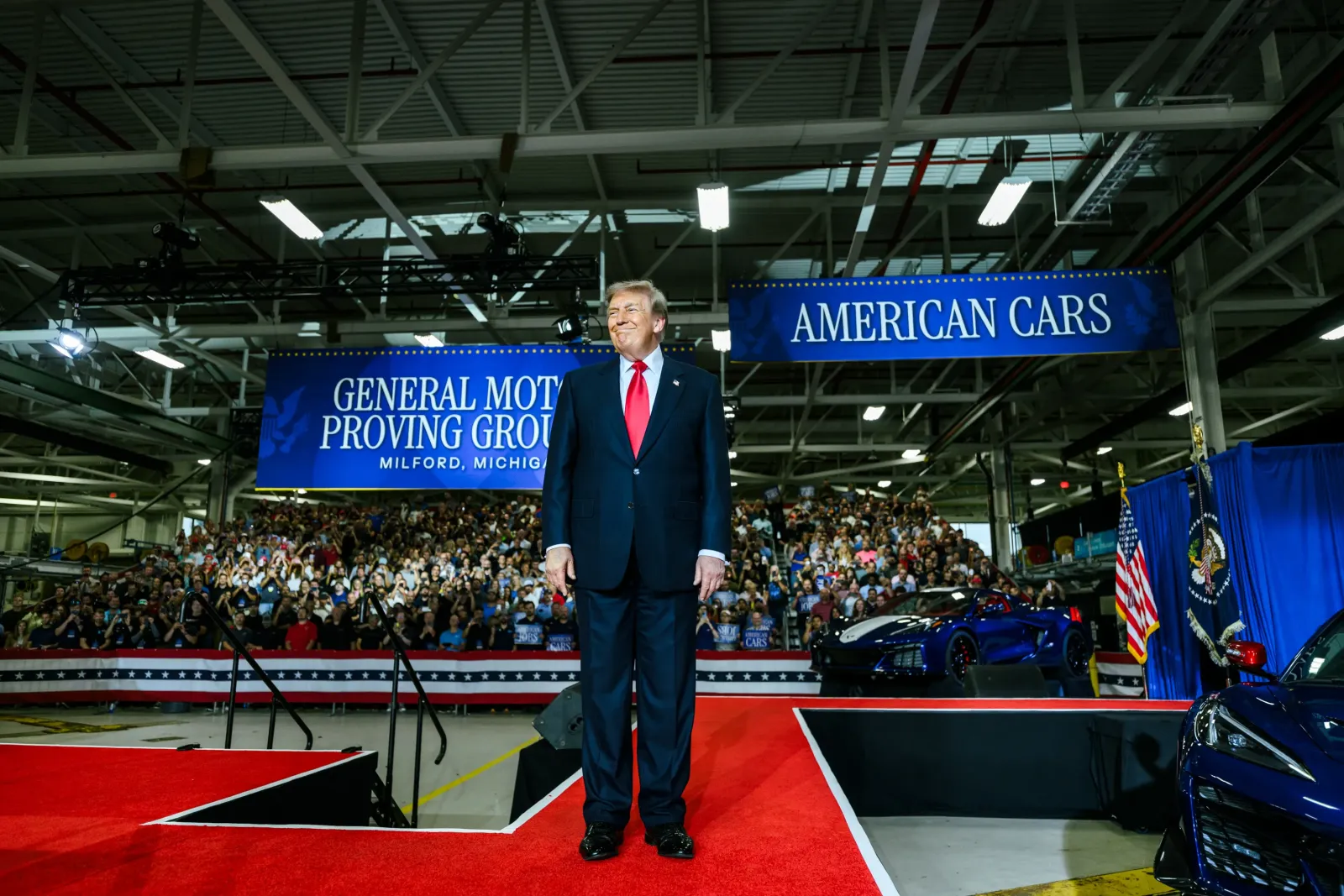

US President Donald Trump visited General Motors‘ Milford Proving Ground in suburban Detroit on Monday, praising the automaker’s domestic expansion and defending the tariff and regulatory policies reshaping the American auto industry.
Trump used the speech to take credit for eliminating the federal EV tax credit, rolling back fuel economy standards and imposing 25% tariffs on imported vehicles and auto parts — all of which he framed as essential to protecting manufacturing jobs in Michigan.
CEO Mary Barra led Trump on a tour of vehicles spanning several decades of GM production, including the Corvette Z06, Cadillac Escalade V and the electric Hummer, before delivering remarks inside a design facility at the site.
“I’ve done more for you than your parents, ok?” Trump told auto workers, declaring himself a President standing up for the industry “at long last.”
Tariffs as Leverage
Trump framed the 25% Section 232 tariffs on imported vehicles and auto parts as the primary driver behind GM‘s domestic investment push.
“The rule is straightforward: build your trucks or cars outside the United States and you’ll pay a fee for the right to sell them here and profit,” the President stated. “Build your plant in Michigan or anywhere else in America and produce the vehicles right here at home, and you’ll face no tariff at all.”
Trump praised GM for increasing truck and SUV output by 20% so far this year and investing $9 billion over two years in US-based manufacturing.
“They’re coming back home because, frankly, when they build here, there’s no tariff,” the US President added.
“It’s amazing what tariffs are doing for GM,” Trump noted after being guided through a display of vehicles from different eras of the automaker’s history. “They’ve come a long way. The rest of the world doesn’t love me, but that’s ok. It’s called ‘America first.'”
Production Shift
Last June, GM announced a $4 billion investment to shift production of the Chevrolet Blazer and Chevrolet Equinox from Mexico to plants in Spring Hill, Tennessee and Kansas City, Kansas, starting in 2027.
An Orion Township, Michigan plant — previously slated for EV production before demand weakened — will instead produce gas-powered full-size SUVs and light-duty pickup trucks.
Combined, the changes give GM capacity to assemble more than two million vehicles per year in the United States.
Days before Trump’s visit, the Detroit automaker reported second-quarter 2026 results that beat estimates, with adjusted diluted EPS of $3.57 versus a consensus of roughly $3.20.
Management raised full-year adjusted EBIT guidance for the second time this year, to between $14 billion and $16 billion, up from a prior $13.5 billion to $15.5 billion range.
Revenue came in at $48 billion.
[gm revenue]
Policy Changes
Trump reiterated his opposition to EV policies established under the Biden administration, despite standing alongside a CEO who oversaw billions in EV investment.
“On day one, I ended Biden’s insane electric vehicle mandate that would have crushed the US auto industry forever,” the President stated on Monday.
Trump argued that electric vehicles require fewer workers to manufacture — a sensitive point in a state where roughly 300,000 jobs depend on the auto sector.
“And I don’t want to say this in front of Mary, because she’ll change your mind, but it takes far fewer people to build an electric car,” Trump said, referring to Barra. “That doesn’t mean they work better, but it takes less.”
According to the President, “if you want an electric car, they make electric cars, too. But if you want to buy a combustion, if you want to buy anything you want, they make.”
Trump also claimed credit for terminating Biden-era Corporate Average Fuel Economy (CAFE) standards.
“I terminated Biden’s disastrous CAFE Fuel Standards,” he said, noting “that was a short road to bankruptcy for every single car company in this country, and a total disaster that would have killed the internal combustion engine.”
To him, “as long as I’m president, that will never happen.”
Biden-era emissions and fuel-efficiency rules did not explicitly mandate EV production.
Automakers could meet tightened fleet-wide standards through a combination of EVs, hybrids and more efficient combustion engines.
Trump signed legislation repealing the rules as part of broader regulatory rollbacks last year.
Trump also promoted a tax deduction for interest paid on automobile loans, available only for vehicles manufactured in the United States — a provision of his One Big Beautiful Bill Act.
It was under the same legislation that Congress terminated the $7,500 federal tax credit for new EVs and the $4,000 credit for used EVs after September 30, 2025.
Impact on GM’s EV Business
The elimination of the credit triggered a rush of purchases in the third quarter of 2025, followed by steep sales declines.
General Motors delivered a record 66,501 EVs in that quarter, but demand collapsed once the incentive expired.
By the second quarter of 2026, however, EV sales had dropped to 3.8% of the automaker’s US deliveries — down from 6.2% a year earlier.
The company itself flags the One Big Beautiful Bill Act among the regulatory risks to its business.
GM has recorded $7.6 billion in EV-related charges since mid-2025, driven by cancelled supplier contracts, unused equipment and a restructuring of its production footprint.
CFO Paul Jacobson said in March the company was working to settle $4.2 billion in cash payments tied to the restructuring by the end of the second quarter.
Management has temporarily idled Factory Zero — GM‘s flagship EV assembly plant in Detroit — twice since October, permanently laying off roughly half the plant’s workforce.
Production was cut from two shifts to one before the remaining shift was paused.
Despite the scale of the restructuring, Barra has maintained the long-term destination is profitable electric vehicle production.
Former Tesla President Jon McNeill, now a GM board member, said in March the company designed its EVs from the ground up rather than converting existing platforms — differentiating GM from Ford and Stellantis, both of which have taken charges of roughly $20 billion each on their own EV pivots.
Canada Trade Tensions
Trump’s visit coincided with an ongoing trade dispute with Canada.
Last week, he signed three proclamations imposing 50% tariffs on a range of Canadian goods — including wine, hockey sticks and cement — under Section 338 of the Tariff Act of 1930.
According to the White House, the provision had not been used in nearly a century. Duties cover roughly $20 billion in Canadian imports and apply regardless of USMCA compliance, with a 30-day implementation window.
Trump described the action as a response to Canadian restrictions on American alcohol, dairy and automotive products.
Canadian Prime Minister Mark Carney called the tariffs unilateral and said Ottawa had already matched them with countermeasures.
Auto manufacturing has been a central friction point between the two countries.
GM cut approximately 500 jobs at its Oshawa, Ontario plant in January, transferring full-size truck production to Fort Wayne, Indiana.
BrightDrop production was halted at CAMI Assembly in Ontario, affecting over 1,000 workers.
Both moves triggered quota reductions from Ottawa under its surtax remission framework.
Barra has criticised Canada’s tariff deal with China, under which up to 49,000 Chinese-built EVs can enter the country annually at a reduced 6.1% tariff rate.
Barra called the agreement a ‘slippery slope,’ arguing it runs counter to building a strong North American manufacturing base. The United States announced it would not renew the agreement on July 1.
The three countries can engage in annual reviews for the next 10 years until the agreement expires on July 1, 2036 or one gives 6 months notice of withdrawal.
Washington has pushed for separate bilateral negotiations with Canada and Mexico — a structure both countries have rejected. Canada has not yet begun substantive text-based negotiations with Washington.