
Polestar is considering lithium iron phosphate batteries as one of three main levers to build a truly climate-neutral car by 2035, its Head of Sustainability Fredrika Klarén told CarExpert.
All Polestar EVs currently use nickel manganese cobalt (NMC) chemistry, she said in the interview, given at the launch of the new Polestar 4 SUV.
“As you know, we have NMC chemistry in our cars still,” Klarén said.
The company is “also exploring going forward to create a climate-neutral car, what kind of battery chemistry is the best one for the car?” she said.
Klarén pointed to LFP as the answer.
“We see that LFP will be much easier to create with a climate-neutral way, and we can get there quicker because, for example, phosphor you can extract from wastewater instead of mining it from Morocco as it is today, and iron you can get from recycled metal,” she said.
She did not say when an LFP battery would first appear in a Polestar car, according to CarExpert.
A Deadline Already Pushed Back
The comments come less than six months after Polestar moved the target for its Polestar 0 project, the effort to build a car with no emissions across its supply chain, manufacturing and end of life without relying on offsets.
Polestar set a 2030 goal when it launched the project in 2021, and said in its 2025 sustainability report, published on April 28, that it had moved the date to 2035 because the task was larger and more complex than first expected.
Progress had been affected by “macroeconomic and political factors, platform strategy changes, and uneven industry engagement,” the report said.
“The Polestar 0 project pushes us into new territory,” Klarén said at the time.
The work runs through Mission 0 House, a research hub in Gothenburg set up in 2025 with close to 100 million Swedish kronor ($10.0 million) of funding over five years, bringing together five Swedish universities and six companies.
Its programs include a pilot for ultra-low-emission steel, battery materials research, bio-based textiles and technologies that turn carbon dioxide into new materials, according to Polestar.
The company said greenhouse gas emissions per car sold had fallen 31% since 2020, to 31.7 tonnes of carbon dioxide equivalent in 2025 from 45.9 tonnes, and it aims to halve them by 2030 and become climate neutral across its value chain by 2040.
Where the Battery Sits
The 100-kilowatt-hour NMC pack in the Polestar 4 SUV accounts for 5.46 tonnes of carbon dioxide equivalent per car, according to the model’s life-cycle assessment, published in June.
That is 25.9% of the dual-motor version’s 21.1-tonne cradle-to-gate footprint and 27.0% of the rear-motor version’s 20.2 tonnes.
Polestar does not name the cell supplier in the report, which says the supplier covers cell and pack production with renewable electricity certificates bought in China.
South Korea’s SK On said in November 2023 that it would supply high-nickel NMC cells for the Polestar 5 grand tourer.
The company has already been cutting emissions within NMC chemistry, saying in March that more than half the cobalt in the batteries of new Polestar 2 and Polestar 3 cars came from recycled sources.
The Phosphate Question
Klarén’s reference to Morocco reflects where most of the world’s phosphate sits.
Morocco holds 50 billion tonnes of the world’s 73 billion tonnes of phosphate rock reserves, about 68%, according to the US Geological Survey.
China mines far more, however, producing 110 million tonnes in 2025 against 36 million tonnes in Morocco, out of a world total of about 250 million tonnes.
China also dominates the processing that turns phosphate into battery material.
LFP cathode materials and their precursors are “still almost entirely concentrated in China,” the International Energy Agency said in its Global EV Outlook 2026.
LFP accounted for more than 55% of electric-car batteries deployed worldwide in 2025 but only a little over 10% of demand in the European Union, where nearly all LFP batteries were imported from China, the agency said.
Morocco has also attracted significant investment in LFP battery and materials production, according to the IEA.
The European Union lists both phosphate rock and phosphorus as critical raw materials under its Critical Raw Materials Act.
Inside the Geely Family
Polestar, which is controlled by China’s Geely, would not be the first brand in the group to use the chemistry.
Volvo Cars offered LFP cells from CATL in single-motor versions of its EX30 small SUV when it unveiled the model in 2023.
Zeekr unveiled its own LFP “Golden Battery” in December 2023, first for its 007 sedan.
Polestar has two new models in its pipeline that could carry a new chemistry.
A new-generation Polestar 2 is due in 2027, followed in 2028 by the Polestar 7, a compact SUV that will be built at Volvo’s plant in Košice, Slovakia, and be the brand’s first European-made car.
Polestar has not disclosed battery chemistry for either model.
Metal and Bio-Based Materials
LFP was one of three measures Klarén described.
The second is a return to metal interior trims, which are easier to recycle than plastics and contain fewer chemicals, according to CarExpert‘s account of the interview.
“We need to do a U-turn,” she said.
The third is materials made entirely from bio-based sources, which Klarén said could even capture carbon emissions.
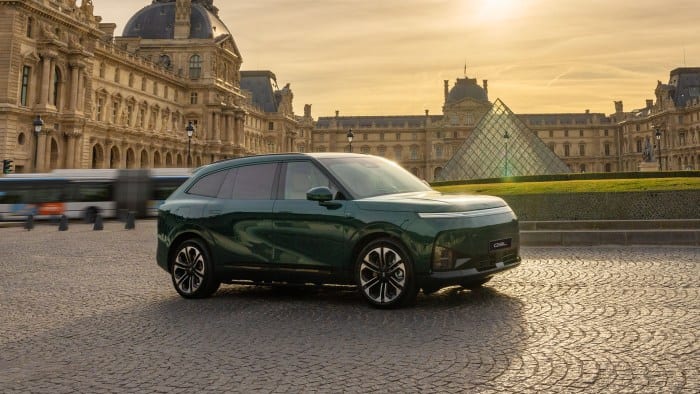
The new Polestar 4 SUV, priced from €57,900 ($64,900) in Germany, is built at Renault Korea’s plant in Busan, with customer deliveries due in the fourth quarter.
Polestar’s retail sales rose about 1% to 14,371 vehicles in the third quarter.