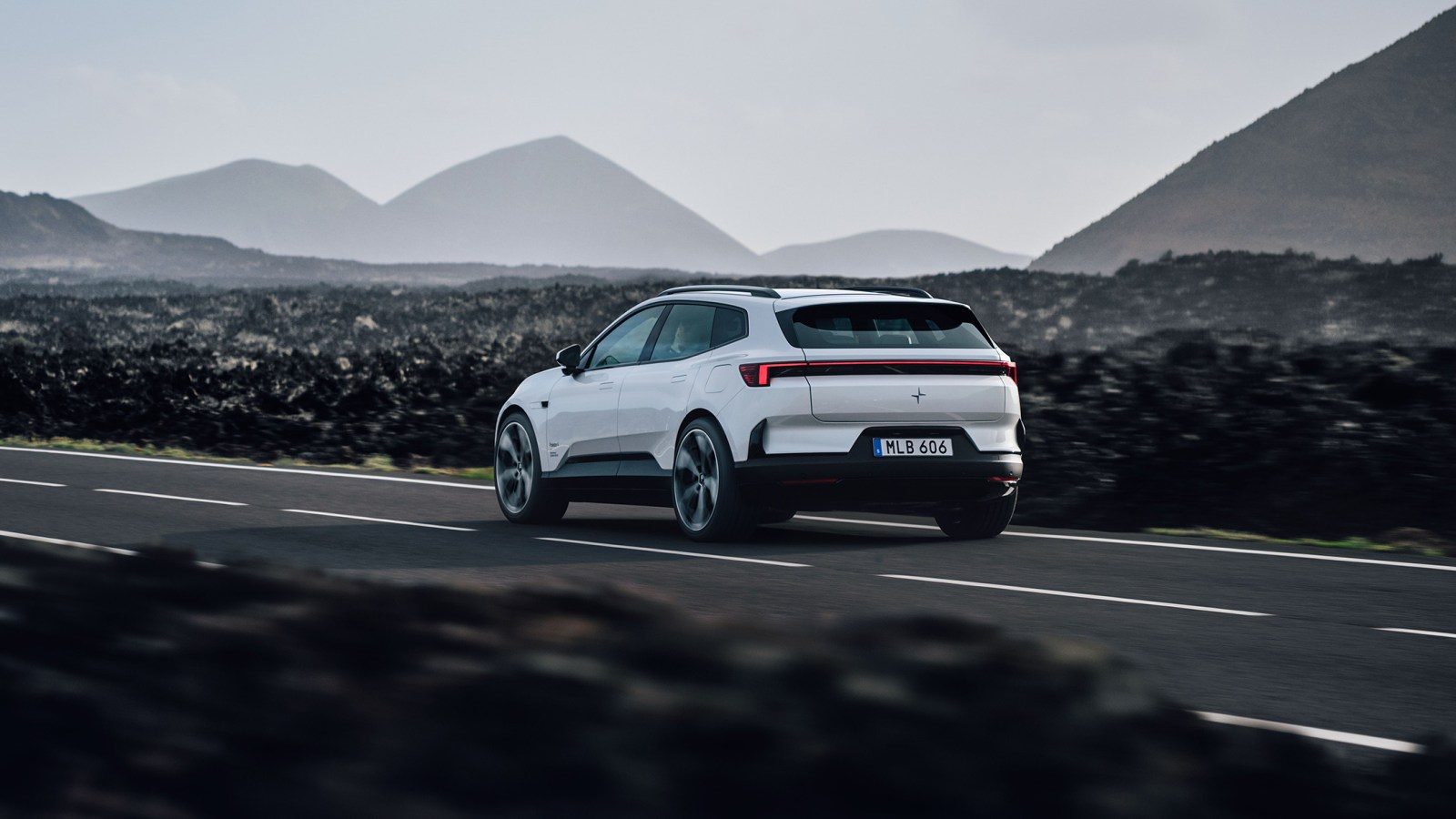

Polestar opened sales of the Polestar 4 SUV on Wednesday, adding a variant of its best-selling model to a lineup the Geely-backed brand is reorienting around Europe after losing access to the United States.
The SUV is built at a Renault Korea plant in Busan, South Korea, where production began in the second quarter alongside the existing Polestar 4 coupé.
First customer deliveries are planned for the fourth quarter of 2026.
Polestar first confirmed the variant in July, describing its introduction as part of what it called the largest model offensive in its history.
German base pricing starts at €57,900 ($67,000) for the Rear motor variant, €65,900 ($76,200) for the Dual motor and €76,300 ($88,300) for the Dual motor with Performance pack — all excluding handover fees and including VAT.
“Polestar 4 SUV broadens the appeal of our most successful model and extends our product offering in one of the industry’s most important segments,” CEO Michael Lohscheller said in a statement.
Powertrain and Range
Built on the same SEA architecture as the coupé, the SUV ships with a 100 kWh battery as standard and supports DC charging at up to 200 kW and AC charging at up to 22 kW in selected markets.
Rear motor versions produce 200 kW (272 hp) and 343 Nm of torque, reach 100 km/h in 7.3 seconds and return up to 630 km (391.5 miles) of WLTP range — the highest in the Polestar 4 family.
Dual motor all-wheel-drive variants deliver 400 kW (544 hp) and 686 Nm, accelerate to 100 km/h in 3.9 seconds and offer up to 600 km (372.8 miles) of range.
For context, the Tesla Model Y — the best-selling SUV globally — carries a WLTP rating of 609 km (378.4 miles) in Germany for its Long Range variant.
Polestar’s Rear motor figure of 630 km puts the 4 SUV above that benchmark.
Google Gemini and V2L
Google Gemini replaces the previous Google Assistant voice control system.
The AI model supports multi-turn dialogue and contextual understanding, handles vehicle queries, and enables hands-free productivity through Gemini Live for brainstorming, trip planning and real-time translation.
Polestar said Gemini is now available across all of its markets.
Vehicle-to-Load (V2L) functionality, coming to all Polestar 4 vehicles, lets the 100 kWh battery supply up to 3.3 kW of AC power to external devices through a certified charging adapter sold separately.
Users can set a minimum battery threshold through the centre display.
A new Camping mode transforms the parked vehicle into a climate-controlled space with access to entertainment, ambient lighting and vehicle controls from both front and rear displays, supported by V2L power, USB-C connectivity and the 12V outlet.
Performance Pack
Buyers seeking sharper dynamics can opt for the Performance pack, which adds recalibrated ZF active dampers, high-performance Brembo brakes with callipers in Swedish gold, and 22-inch wheels fitted with Pirelli P Zero tyres.
Joakim Rydholm, Head of Driving Dynamics at Polestar, said the SUV builds on the foundation of the recently updated coupé.
“With refined chassis tuning and enhanced steering response, it delivers the confidence, precision and driving engagement that Polestar customers expect, in all driving conditions,” Rydholm said.
Drivetrain variants carry distinct visual cues inside the cabin.
Rear motor models feature an all-black interior theme.
Dual motor versions add a golden stripe to the seatbelt and rotary control knob.
Performance pack cars receive full Swedish gold seatbelts and rotary knob.
All Polestar 4 SUV vehicles are manufactured exclusively at the Renault Korea plant in Busan, while the coupé continues production both in Busan and at Geely’s Hangzhou Bay facility in China.
US Market Absent
American buyers will not have access to the Polestar 4 SUV.
As a 2027 model, it falls under the Connected Vehicle Rule that the US Department of Commerce’s Bureau of Industry and Security declined to waive for Polestar in June, barring the Chinese-owned brand from selling connected vehicles in the country from model year 2027 onward.
Polestar sold an estimated 295 vehicles in the United States in August, a 48% decline year over year, according to Motor Intelligence data.
Through eight months of 2026, the brand has moved 2,516 units in the country, extending a streak of year-over-year monthly declines that began in July 2025.
Lohscheller has said Polestar will not appeal the ruling and will sell its remaining 2026-model stock before exiting the market.
Core Business
Europe now represents the core of Polestar’s commercial strategy.
First-half 2026 retail sales reached a record 30,423 cars globally, though growth over the prior year amounted to just 0.4%, a sharp deceleration from the 75.8% year-on-year expansion the brand posted as recently as Q1 2025.
Excluding the US, second-quarter sales still fell 3.9%.
Polestar quietly halved its 2026 growth target earlier this year, guiding for low double-digit volume growth rather than the 30–35% compound annual rate it had previously pledged.
Tuesday’s SUV launch arrives amid heavy leadership turnover.
CEO Thomas Ingenlath was pushed out by Geely in October 2024 and replaced by Lohscheller. Design chief Maximilian Missoni left for BMW the same month.
Polestar replaced its CFO weeks later, swapped out its Chief Commercial Officer in January and lost its head of North America after less than a year in the role.
Head of software Sven Bauer departed in July after more than three years, as Polestar continued to grapple with software issues across all its production models, including persistent system faults, digital key failures and non-functional controls reported by owners.
Last month, Polestar also replaced the Volvo Cars manufacturing executive on its board with a Volvo sales head, losing the only sitting director who held an operating manufacturing role — a swap the company framed as reflecting its shift toward commercial expansion and network development.
Volvo Cars holds approximately 19.9% of Polestar and remains owed roughly $660 million in shareholder loans maturing in 2031, after completing $640 million in debt-to-equity conversions alongside Geely Sweden this year.
The company will report its second quarter select and half-year 2026 unaudited financial results on Thursday (September 3).