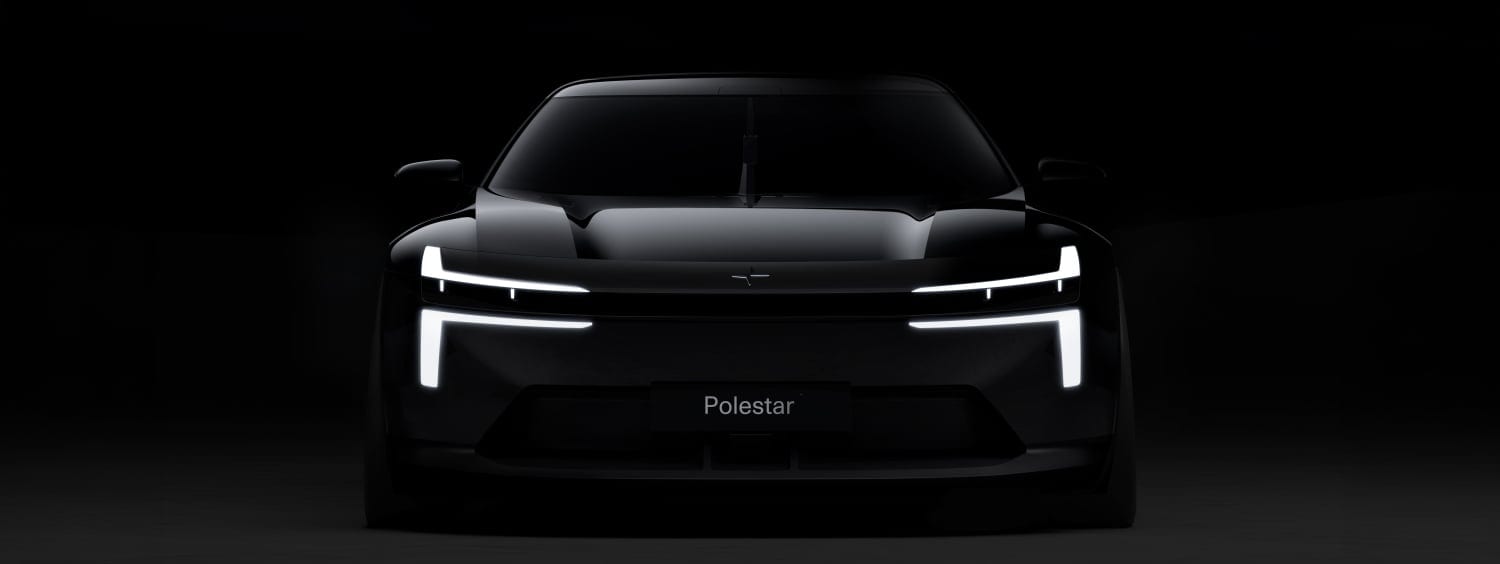

Polestar said on Monday that it will show a concept car called Formula 2030, a name not previously made public, the first design under head of design Philipp Römers, previewing the successor to the Polestar 2 due in 2027 and the Polestar 7 compact SUV due in 2028.
The Geely-backed brand said the concept is “delivered as part of a wider 2030 strategy, executed to continue business growth and drive to profitability,” and will be shown first to investors, retailers and selected customers at a “Formula 2030 strategy event” at its headquarters.
The global debut will take place later this year during the media drive of the Polestar 4 SUV.
The release gave no date for either event, no specification, no financial targets and no image beyond a teaser.
Autocar reported the public reveal is planned for October.
CEO Michael Lohscheller told media in February that he wanted the brand “above 100,000 [annual retail sales] as quickly as we can,” from about 60,000 in 2025.
“Polestar’s design and brand is already so strong, it was obvious we needed a bold evolution not revolution of what came before,” Römers said in the release. “Formula 2030 delivers this, showcasing our future while respecting brand-defining elements like the familiar Dual Blade headlights ensuring it remains recognisably a Polestar with a strong, characterful identity.”
Römers joined from Audi in January 2025 and told Autocar last year that a design revolution “would be bad” for a brand as young as Polestar.
He succeeded Maximilian Missoni, who led Polestar design from July 2018 to October 2024, through the 2, 3, 4 and every concept the brand has shown, and is now vice president of design for midsize and luxury cars and Alpina at BMW.
Thomas Ingenlath, the designer who ran Polestar as CEO until August 2024, returned to Volvo Cars as Head of Design in January.
The single image released on Monday, a head-on view in near darkness, shows the Dual Blade lights redrawn as long horizontal blades that turn down at the outer corners into vertical strokes, an illuminated Polestar emblem above a raised centre section of the bonnet, a full-width lower panel carrying the Polestar wordmark where a grille would sit, and front wheels visibly cambered inward at the top.
The Concept
The two production cars the concept previews are the core of what Polestar calls the largest model offensive in its history: four cars in three years, announced on February 18.
The next-generation Polestar 2, “a completely new successor” to the sedan that built the brand, is planned for launch in early 2027; the Polestar 7, a compact premium SUV entering a segment Polestar has said is contested by the Tesla Model Y, BMW iX1 and Audi Q4 e-tron, is planned for 2028 with production in Europe, which would take the brand’s manufacturing beyond its current sites in China, South Korea and the United States.
Before either arrives, Polestar 4 SUV orders opened on September 2, with production ramping at Busan, South Korea, and first deliveries in the fourth quarter, and the first Polestar 5 grand tourers are due to reach customers “in the coming weeks,” the company said on September 3.
The Polestar 6 roadster remains on the plan without a date.
The Strategy
The strategy event comes four days after second-quarter results that showed the brand still shrinking at the top line.
Retail sales fell 4.0% year on year to 17,296 cars in the quarter and revenue fell 8.1% to $727 million, on lower volumes, price pressure, residual-value guarantee costs concentrated in the United States and lower carbon-credit sales, which dropped to $36 million from $61 million.
First-half retail sales of 30,423 were a record, supported by a 39% expansion of the retail network, and the operating loss fell 43% against a first half of 2025 that carried a large impairment.
Polestar cut its 2026 guidance to “low-to-mid single-digit” retail growth, having guided in March for “low double-digit” growth, itself a retreat from the 30% to 35% compound annual growth rate set in the 2025 strategy update; on the 2025 base of roughly 60,000 cars, the new range implies fewer than 64,000 deliveries this year.
The balance sheet has been rebuilt around Geely: $640 million of shareholder loans were converted to equity by Geely Sweden Holdings and Volvo Cars in the first half, the remaining $660 million Volvo loan was extended from December 2028 to December 2031, a Geely subordinated facility was extended to June 2027, and a trade-finance facility was raised to €450 million, on top of a targeted $1 billion in new equity assembled between December 2025 and March 2026.
Europe accounts for about 78% of Polestar’s retail sales, and the company has restructured its US business after the Bureau of Industry and Security declined it an authorisation that Volvo had secured.
CEO Michael Lohscheller said on September 3 that operational improvements “are starting to show results” while describing the environment as “highly competitive and volatile.”
Polestar has not said whether the Gothenburg event will include financial targets for 2030.