

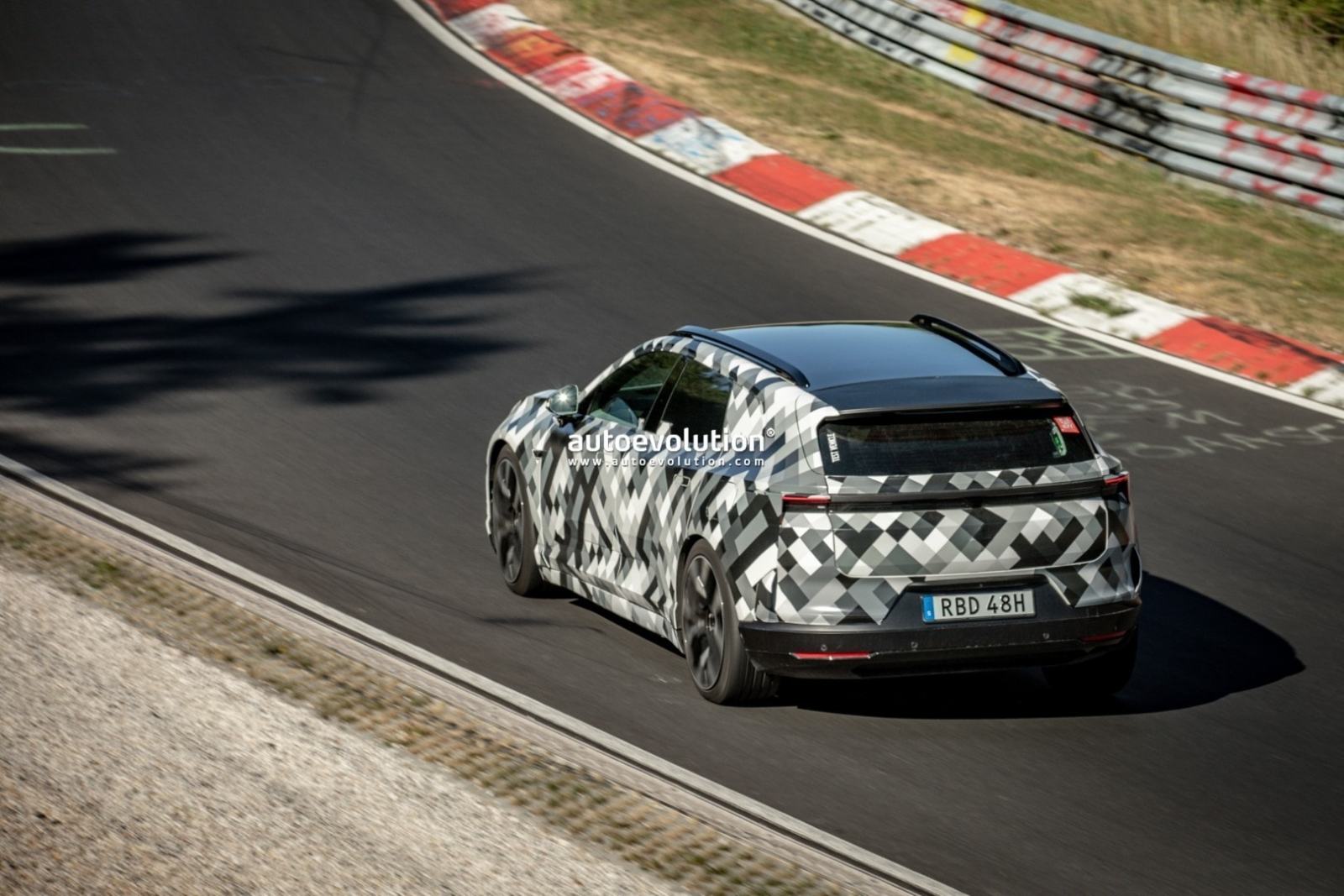

New spy shots of the upcoming SUV variant of the Polestar 4, captured at the iconic Nürburgring racetrack in Germany, show for the first time an undisguised look at the variant.
The upcoming SUV is based on the standard Polestar 4 Coupé and arrives as Polestar seeks to increase the model’s demand.
Polestar confirmed the production in February and formally unveiled the variant last week, announcing that sales would start on September 2, as part of what the brand called the “largest model offensive in its history.”
According to images first shared by Autoevolution, the redesign allows for more direct rear visibility, replacing the camera-only setup used in the coupé.
It also increases cargo space and makes the load area more practical by providing greater vertical storage capacity.
Despite the added utility, the prototype keeps the coupé’s low-slung stance.
Performance-rated tires, as pointed out by the outlet, suggest the trim spotted testing was a Dual Motor unit fitted with a Performance package.
According to Polestar‘s own specifications released with the July 7 announcement, the SUV retains the coupé’s 400-volt architecture.
Rear Motor variants produce 200 kW (272 PS) and 343 Nm of torque, running 0 to 100 km/h in 7.1 seconds, while Dual Motor versions deliver up to 544 hp.
Range for the Rear Motor SUV reaches 630 km (391 miles) WLTP, Polestar said, versus 620 km (385 miles) for the coupé.
The best-selling SUV across the globe, the Tesla Model Y, is rated at 609 km (378 miles) WLTP in Germany, for instance.
In Germany, the Dual Motor Polestar 4 Coupé starts at a base price of €67,900.
The Performance package allegedly spotted on the prototype spied would add €4,500, including Polestar chassis tuning, a gold rotary knob, gold seatbelts, and MicroTech bio-attributed vinyl upholstery in Charcoal.
Busan-Only Production
Polestar‘s press release said only that the SUV “is manufactured in Busan, South Korea,” through the brand’s partnership with Renault Korea, without clarifying whether Chinese output of the coupé would continue alongside it.
A brand spokesperson clarified to EV that the SUV will be built exclusively at the Renault Korea plant in Busan, while the existing coupé continues to be produced both in Busan and at Geely‘s Hangzhou Bay facility in China.
The Busan-only route carries a trade advantage the China-built coupé doesn’t share.
The EU-South Korea free trade agreement eliminates tariffs on passenger vehicles, meaning SUVs shipped from Korea enter the European market duty-free.
Chinese-made Polestar vehicles currently face a combined 28.8% levy in Europe — an 18.8% countervailing duty layered on the EU’s standard 10% import tariff.
As a 2027 model, the SUV won’t be sold in the United States, where Polestar is being barred from new-vehicle sales starting with the 2027 model year under the Commerce Department’s Connected Vehicle Rule.
‘Pretty Straightforward’ US Ban
CEO Michael Lohscheller addressed the ruling directly for the first time late last week, telling the Financial Times that the decision was “pretty straightforward” and confirming Polestar will not appeal.
“The US decision is something we have to accept,” he said, framing it as an industry-wide shift rather than a company-specific setback.
According to Lohscheller, “it just accelerates the regionalization everywhere, not only for us but for the entire industry. The days are over when everything was global.”
The ruling diverges from the outcome for sister brand Volvo, which received its own Connected Vehicle Rule authorization weeks earlier despite sharing the same ultimate parent, Geely Holding Group, and the same South Carolina assembly plant.
The Commerce Department has not detailed the criteria behind the split decision.
With its remaining months in the US now finite, Polestar is running discounts of up to $25,000 on the 2026 Polestar 4 and up to $23,000 on the Polestar 3 through its “Summer of Clarity Event,” which runs to July 31.
Sales Decline
The SUV’s Busan production run is already underway.
Lohscheller said on July 9 that manufacturing of the Polestar 4 SUV had started, with first customer deliveries expected in the fourth quarter — alongside the first deliveries of the Polestar 5 grand tourer, debuted last September.
The update came on the same day Polestar disclosed its first quarterly sales decline since 2024, with retail sales falling 4.0% year-on-year in the second quarter to an estimated 17,296 cars, against the toughest comparison in the brand’s history.
Excluding the US, sales still fell 3.9% to 16,175 cars, showing the softness runs well beyond the American exit.
First-half retail sales reached a record 30,423 cars, but growth over the prior year amounted to just 0.4%, a sharp deceleration from the 75.8% year-on-year growth Polestar posted as recently as the first quarter of 2025.
Hitting the low end of the brand’s 2026 guidance now requires 66,100 deliveries for the year, implying 19.7% growth in the second half against a first half that grew barely at all.


