
Polestar posted a $2.36 billion net loss for 2025 on Friday but crossed into adjusted gross profitability in the fourth quarter, with CEO Michael Lohscheller reaffirming a slower 2026 sales trajectory amid what he called “challenging” geopolitical conditions.
Fourth-quarter revenue reached $887 million, up 54.3% from $575 million a year earlier.
Revenue crossed $3 billion in 2025 for the first time, climbing 50.3% to $3.06 billion on a 34% increase in retail volumes to 60,119 vehicles.
The EV maker, majority-owned by China’s Geely Holding, ended 2025 with $1.16 billion in cash, up from $995 million at the end of Q3.
Q4 Results
Polestar‘s adjusted gross margin swung to a positive 1.9% in Q4 2025 from negative 39.0% a year earlier, a 40.9 percentage point improvement that marks the first quarter of adjusted gross profit since the company’s public debut.
Adjusted gross profit was $17 million, reversing a $224 million loss in Q4 2024.
Q4 net loss narrowed 32.5% to $799 million from $1.18 billion. Adjusted EBITDA loss fell 52.6% to $223 million from $470 million.
Gross margin improved to negative 37.8% from negative 147.1% — a 109.3 percentage point swing — primarily on lower impairment charges of $340 million in the quarter compared to $622 million booked in Q4 2024.
Carbon credit sales contributed $88 million to Q4 revenue, up from $11 million a year earlier, with all $88 million booked within revenue rather than other operating income.
“2025 was a record year for Polestar, with retail sales of over 60,000 cars and revenue surpassing USD 3 billion,” Lohscheller said. “Our strong commercial performance was driven by the expansion of our sales network and strength of our model line-up.”
Full-year results
The $2.36 billion annual net loss widened 15% from $2.05 billion in 2024 despite the operational improvement, with a $1.05 billion full-year impairment charge on tangible and intangible assets accounting for most of the deterioration.
That compared to $622 million in impairments a year earlier.
Full-year adjusted gross loss narrowed to $22 million from $254 million, with adjusted gross margin at negative 0.7% — an 11.8 percentage point improvement and near breakeven.
Adjusted EBITDA loss fell 27.5% to $783 million from $1.08 billion.
Cost of sales rose 42.3% to $4.14 billion, with Polestar flagging higher duties and tariffs — primarily on China-to-EU exports — as a contributor alongside higher volumes.
Selling, general and administrative expenses fell 3.8% to $856 million, while research and development spend more than doubled to $78 million from $38 million.
Full-year carbon credit sales totalled $211 million, up from $11 million in 2024, with another $19 million booked in other operating income.
2026 Guidance
Polestar reaffirmed the “low double-digit” retail volume growth guidance for 2026 that it first outlined on February 18 — implying roughly 66,000 to 69,000 deliveries, roughly 20 percentage points below the 30-35% compound annual growth target set a year earlier.
“In 2026, our operational focus will be on the continued expansion of our sales network, growing our sales points by a planned 20%, to coincide with the largest model offensive in our history, with four new models planned during the next three years,” Lohscheller said.
“While we expect market conditions to become more challenging, amid ongoing geopolitical developments, we will continue to drive financial performance, building on our achievements in 2025, with an improved model mix, sustained cost reduction and financial discipline,” he added.
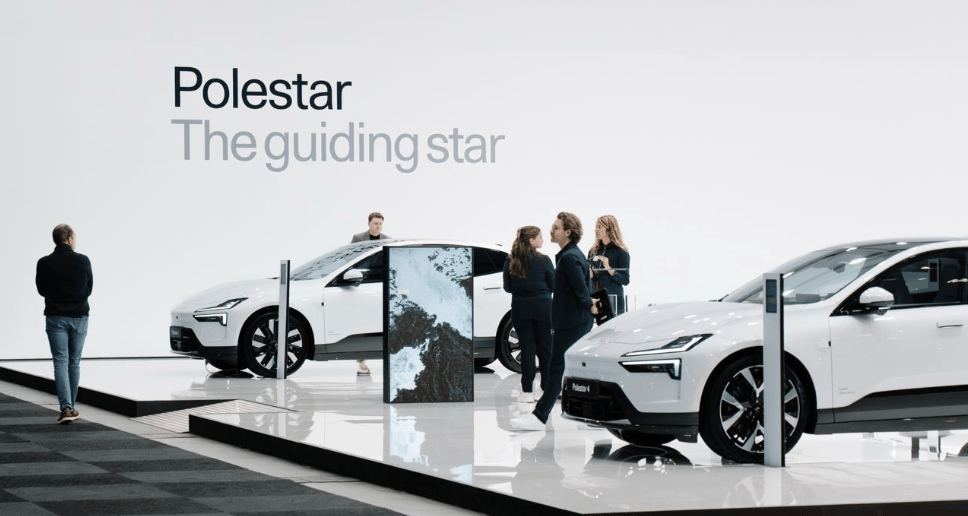
The company said its sales mix will shift further toward the Polestar 4 coupe — described as its best-selling model — complemented by a new Polestar 4 SUV variant launching later in 2026. Polestar did not issue revenue or adjusted EBITDA guidance.
The Q1 2026 run rate of 13,126 retail sales disclosed on April 9 annualises to about 52,500 vehicles, below the midpoint of even the reduced 2026 guidance.
$1.2 Billion Equity Push
Lohscheller framed the filing around a cumulative financing push he traced back to mid-2025.
Since June 2025, Polestar has secured $1.2 billion in equity injections, approximately $600 million in debt-to-equity conversions, and a three-year extension of Volvo Cars’ $726 million shareholder loan.
The equity raises completed in three tranches since December all priced at $19.34 per Class A ADS. Crédit Agricole CIB, Vida Finance, Innovator Limited and Proximastar Holdings contributed $300 million in the March 16 round.
Feathertop Funding Limited, consolidated to Sumitomo Mitsui Banking Corporation, and Standard Chartered Bank (Hong Kong) contributed $400 million on February 2. Banco Bilbao Vizcaya Argentaria and Natixis provided $300 million in December alongside a $600 million subordinated term loan from a Geely Sweden Holdings subsidiary.
The balance sheet work continued on March 31. Volvo Cars agreed to convert $274 million of outstanding shareholder loans into Polestar equity, with a further $65 million conversion expected later in the second quarter to maintain its stake at 19.9% after dilution from Geely Sweden Holdings’ separate $300 million debt-to-equity swap.
The maturity of Volvo’s remaining $726 million shareholder loan was extended from December 2028 to December 2031.
Model Offensive
Polestar committed on February 18 to its largest product push to date, with four new cars planned over the next three years.
The Polestar 5 grand tourer begins deliveries in summer 2026, followed by a new Polestar 4 variant later this year.
A next-generation Polestar 2 is slated for early 2027, with the compact Polestar 7 SUV — to be manufactured at Volvo’s Kosice, Slovakia plant — targeted for 2028.
Polestar and Volvo Cars said on March 31 they intend to consolidate global manufacturing of the Polestar 3 at Volvo’s Charleston, South Carolina plant, ending production of the model at Volvo’s Chengdu, China facility.
The move reduces Polestar’s exposure to US tariffs on China-built EVs, which contributed to a 60% collapse in US deliveries in Q4 2025 to fewer than 1,000 units.
Retail network expansion
Polestar operated 230 retail sales points at the end of Q1 2026, up 50% from 154 a year earlier. The company plans to grow the network by 20% in 2026 to reach approximately 276 locations.
Growth in the first quarter came from key markets including Australia, Germany, Sweden, South Korea and the UK.
Polestar registered 4,151 units in the UK and 1,284 in Germany during the quarter, both up year-on-year.
Management hosts a conference call at 14:00 Central European Time (08:00 US Eastern Time).