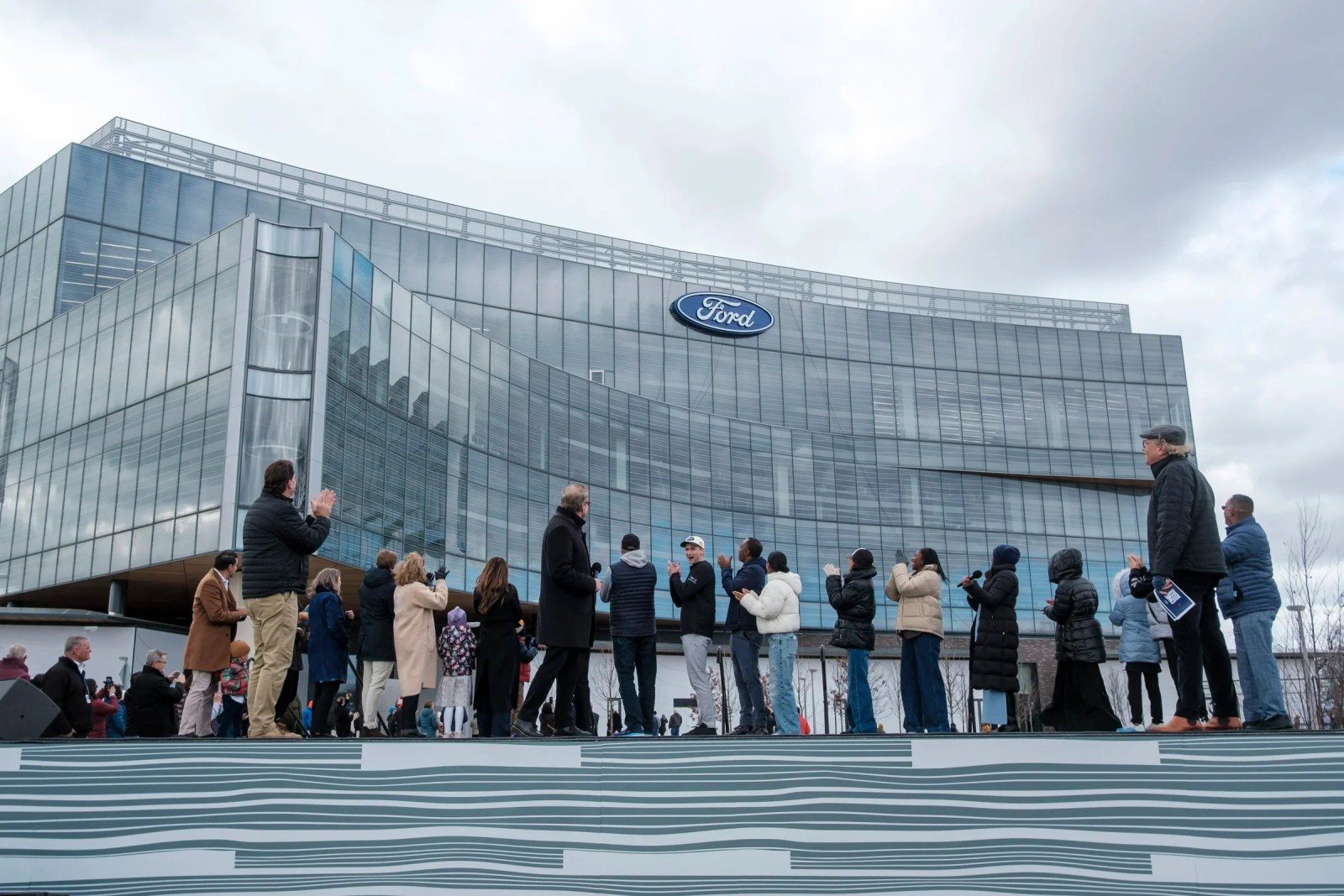

UBS reiterated its Buy rating and $17 price target on Ford on Wednesday, a day after Transportation Secretary Sean Duffy’s letter urging the company to cut its Chinese ties sent the shares lower.
UBS identified the CATL battery licence, which Duffy attacked, as the one item that matters to investors, valuing the Ford Energy storage business that depends on it at about $2 a share, according to a note first obtained by PriceTarget.
“We believe the CATL LFP license is the key issue for investors as that is central to LFP batteries (out of their Marshall, MI facility) for the new upcoming UEV platform and Fathom product as well as their BESS initiative,” wrote Joseph Spak, UBS’s auto analyst.
“We believe Ford feels confident about their CATL arrangement that should allow their BESS product to be both PTC and ITC eligible,” he added, referring to the federal production and investment tax credits for energy storage. “We assign ~$2 of value to BESS in our Ford PT.”
The $17 target implies about 21% upside from Tuesday’s closing price.
The Stock
Ford fell as much as 5.1% on Tuesday afternoon after the Department of Transportation released the letter, and closed down 4.2% at $14.00.
Tuesday’s move was not entirely the letter’s as the National Highway Traffic Safety Administration opened a probe into about 500,000 older Ford Edges the same day.
On Wednesday the shares opened at $13.96 and traded between $13.94 and $14.16, standing at $14.03, up 0.2%, at 11:26 a.m. Eastern time.
The stock remains up 6.9% this year and 22.9% over twelve months, with a market value of just under $56 billion.
What UBS Is Defending
UBS’s note summarised the letter’s four charges in Spak’s words: “1) their CATL battery license, 2) Geely European JV, 3) delayed plans to reshore Lincoln to the US from China, and 4) reported discussion with BYD over hybrid components. Duffy urged Ford to reduce its dependence on foreign technology.”
It noted that “lawmakers and the US auto industry have pushed for restrictions on China involvement in the US auto market” and quoted Ford’s reply that the letter was a “wrongheaded attempt to capture headlines.”
The bank’s $17 target, raised from $14 on June 8, rests in part on Ford Energy, the stationary-storage business Ford announced in December around the CATL lithium iron phosphate licence, with about $2 billion of investment, capacity centred on its Glendale, Kentucky plant and shipments from 2027.
UBS wrote in June that the US licence for CATL’s technology is difficult for competitors to replicate, and Spak had earlier upgraded Ford to Buy in April on a path to more than $2 of earnings per share in 2027.
Marshall, the Michigan cell plant at the centre of the letter, “has commenced production and assembled initial” LFP cells for the mid-size electric truck Ford calls Fathom and the Universal EV platform beneath it, in the words of Duffy’s own letter.
UBS does not say the licence is safe from Washington.
Its position is narrower: that Ford believes the arrangement leaves its storage systems eligible for the two federal credits, and that the bank values the business on that basis. Whether licensed Chinese technology satisfies the foreign-entity rules attached to those credits is contested, and the note does not settle it.
Ford’s Position
Ford’s statement, issued within hours of the letter on Tuesday, called it “a wrongheaded attempt to capture headlines at the expense of a company that has done more for American manufacturing than virtually any other in the nation’s history.”
The Detroit automaker described the CATL deal as “a limited technology-licensing and services agreement, not a joint venture or foreign-owned manufacturing operation,” and said the letter “also contains factual errors. Ford has not proposed a joint-venture framework as described in the letter.”
It cited Commerce Secretary Howard Lutnick’s praise a month earlier for its plan to move Lincoln production to the US, and closed: “Had Secretary Duffy reached out before issuing his letter to the press, we would have been happy to share more details about Ford’s U.S. commitment.”
CEO Jim Farley amplified the statement on Wednesday by reposting on X the post in which Chief Communications Officer Mark Truby had published it when sharing the statement.