Rivian said on Wednesday that it has expanded its partnership with Redwood Materials to cover the full life of its batteries, with the recycler taking Rivian’s manufacturing scrap and retired vehicle packs on top of an energy storage project at its Illinois plant.
Redwood will collect packs that are no longer suitable for vehicle use through Rivian’s service center network across the United States. It will then assess each pack and either repurpose it for stationary energy storage, at Rivian sites or elsewhere, or recycle it.
Redwood will also recycle battery scrap from Rivian’s manufacturing operations.
The companies did not give volumes, financial terms or a timeline for the expanded agreement.
“Every Rivian battery pack that comes back to us is a potential source of domestic grid energy storage,” said JB Straubel, Redwood’s Founder and Chief Executive Officer and a co-founder of Tesla.
How Rivian Gets Paid
Under the agreement, Rivian can be paid for the remaining value of the minerals recovered from a battery when it is recycled, or for its value as second-life storage, which the company prefers.
“This is what circularity looks like in practice,” Chris Brown, Rivian’s Director of Product Sustainability, told the magazine.
Redwood says its process recovers more than 95% of the lithium, nickel, cobalt and copper in batteries.
The Illinois Project
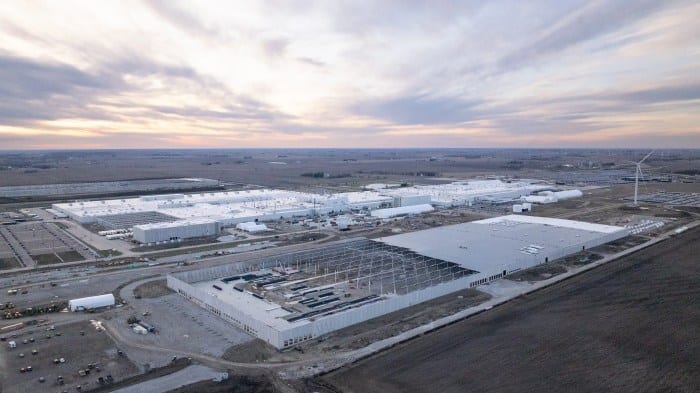
The deal builds on an agreement announced in April to install an initial 10 megawatt-hours of storage built from more than 100 second-life Rivian packs at the automaker’s plant in Normal, Illinois.
“EVs represent a massive, distributed and highly competitive energy resource,” Scaringe said at the time, while Straubel said electricity demand was “accelerating faster than the grid can expand, posing a constraint on industrial growth.”
Redwood integrates the packs into a Redwood Energy system run by its Pack Manager technology, and the companies called it the largest repurposed battery storage system at a US automotive manufacturing plant.
The system will sit behind the meter, Andrew Peterman, Rivian’s Director of Advanced Energy Solutions, told Design News in April, and the outlet reported that it would cut the plant’s peak demand by 2.5 megawatts and come online by early 2027.
Peterman said the first packs would likely come from test, engineering or decommissioned vehicles, some with a state of health close to 90% or 100%.
The project is now in design, planning and permitting, and Rivian aims to have it operating as soon as the third quarter of 2027, Peterman told Inc.
Following GM
Rivian’s expansion mirrors a deal Redwood struck with General Motors in June, when it called GM the first automaker to partner with it across every stage of the battery lifecycle.
That arrangement covers manufacturing scrap from GM’s Ultium Cells venture, end-of-life recycling and a 7.2-megawatt-hour storage system built from about 100 GM packs at one of its Michigan plants, which Redwood said would save the plant more than $3 million in electricity costs over its life.
Redwood said it had received more than 28,000 metric tons of material from GM and Ultium Cells for recycling, and about 10,000 GM packs are lined up for reuse.
Redwood’s other partners include Toyota, Ford, Volkswagen Group of America and Caterpillar.
Redwood’s Pivot to Storage
Straubel founded Redwood in 2017 to recycle batteries, and the Nevada-based company has increasingly turned to energy storage as power demand from AI data centers rises.
It launched Redwood Energy in June 2025 with a 63-megawatt-hour microgrid of second-life packs and solar powering Crusoe data centers in Sparks, Nevada.
Redwood said in March that the microgrid had achieved 99.2% availability since deployment and that the campus would add 20 more Crusoe modular data centers, nearly seven times the original compute capacity.
Redwood raised $425 million in a Series E round that closed in January, with Google joining investors including Eclipse and Nvidia‘s venture arm at a valuation above $6 billion, according to TechCrunch.
It expects to deploy 20 gigawatt-hours of grid-scale storage by 2028, the outlet reported.
Redwood cut about 10% of its workforce, or about 135 jobs, in April to focus on the storage business.
Redwood had earlier walked away from a $2 billion conditional Department of Energy loan for its first battery materials campus in Nevada, Axios reported in May 2025, after a three-year wait.
It has since hired former Tesla finance chief Deepak Ahuja as Chief Financial Officer and named Cal Lankton Chief Operating Officer.
Redwood had earlier hired Timothy Bei, Rivian’s VP of Investor Relations, who left Rivian in March 2025 to become Redwood’s Senior Vice President of Finance.
Rivian’s Energy Push
The Redwood deal is one of several moves by Rivian to use its batteries beyond driving.
The pool of Rivian batteries is growing, with the company delivering 19,248 vehicles in the third quarter as it ramps up the R2, which it began delivering in June.
Rivian reaffirmed its 2026 delivery guidance of 65,000 to 70,000 vehicles and will report third-quarter results on October 29.
The EV maker said in June it would let owners enroll their vehicles in utility-managed charging programs run by ChargeScape, without giving a timeline.
Scaringe said in 2020 that Rivian was “already planning and designing for those batteries, after the vehicle, to be connected to a second-life use.”
“We are sitting on this domestic resource that can be enabled and deployed,” Peterman told Inc., referring to retired EV batteries.