
Ford is months away from opening pre-orders for the Fathom, the $28,350 midsize electric pickup on which it has staked the recovery of its loss-making EV business, but CEO Jim Farley has warned that getting it into mass production will be hard.
“It’s going to be a heck of an effort to launch this at scale, at cost, on time,” Farley said at the Automotive News Congress in Detroit on Tuesday. “We haven’t landed the plane on mass production of UEV yet,” he said, referring to the Universal EV Platform that underpins the truck.
Ford says pre-orders and the truck’s full reveal will come in early 2027, with customer deliveries later that year.
The Fathom is the first vehicle on the new platform, and Ford’s main bet for returning its Model e division to profit by 2029 after years of multibillion-dollar losses.
A $28,350 Truck
Ford named the truck on August 6, giving it a starting price of $28,350 for the standard-range version, excluding taxes and fees.
A $1,595 destination charge brings the starting cost to $29,945, according to Ford’s website, just under the “about $30,000” target Ford set when it unveiled the platform in August 2025.
In Canada, Ford lists a starting price of C$38,690 ($27,200) after a C$4,000 ($2,800) federal incentive, with pre-orders on the same early-2027 schedule.
“We built our new midsize electric truck for a person we spent years getting to know,” said Kay Hart, General Manager of Ford Model e.
The name refers to an old measure of the span of a person’s outstretched arms, which sailors used to gauge water depth, Ford said.
Ford says the five-seat truck has more passenger room than the latest Toyota RAV4, along with a front trunk, bidirectional charging and its next-generation BlueCruise hands-free driving system.
Ford has not published range or battery capacity, and its website says the EPA range estimate is “not yet available.”
The base truck will use a smaller battery, with at least two pack sizes planned, Clarke said in an August interview with GreenCars.
“Some customers will want to see an EPA-estimated range of around 300 miles and we will have an option for that customer,” Ford said.
Ford plans to introduce new driver-assistance hardware and software on the UEV platform from 2027, and expects Level 3 “eyes-off” driving to be “road ready in 2028,” Doug Field, Chief EV, Digital and Design Officer, wrote in January.
Ford has described its 2027 plan as a “Model T moment,” a phrase Farley used on the company’s earnings call in July 2025.
Built a Different Way
Ford is spending about $5 billion on the program, nearly $2 billion of it to retool its Louisville Assembly Plant in Kentucky and about $3 billion at its battery plant in Marshall, Michigan, the company said in August 2025.
The platform uses 20% fewer parts than a typical vehicle, 25% fewer fasteners and 40% fewer workstations, with assembly 15% faster, according to Ford.
Instead of a single moving line, the truck will be built in separate sub-assemblies that come together near the end, a system Ford calls an “assembly tree.”
Large single-piece aluminum castings replace dozens of smaller parts, and the battery pack doubles as the vehicle’s structural floor.
“The radically simplified aluminum unicastings condense over 146 parts into 2,” Farley wrote on X in February.
The truck switches from a 12-volt to a 48-volt low-voltage system and combines functions into five main modules in place of more than 30 electronic control units, Clarke wrote in a Ford post in February.
That makes the wire harness 4,000 feet shorter and 22 pounds lighter than in one of Ford’s first-generation EVs, he said.
More than half of the truck’s aerodynamics team came from Formula 1, and Ford priced every design change in battery cost, with 1 millimetre of extra roof height worth $1.30 of battery, according to Ford’s posts.
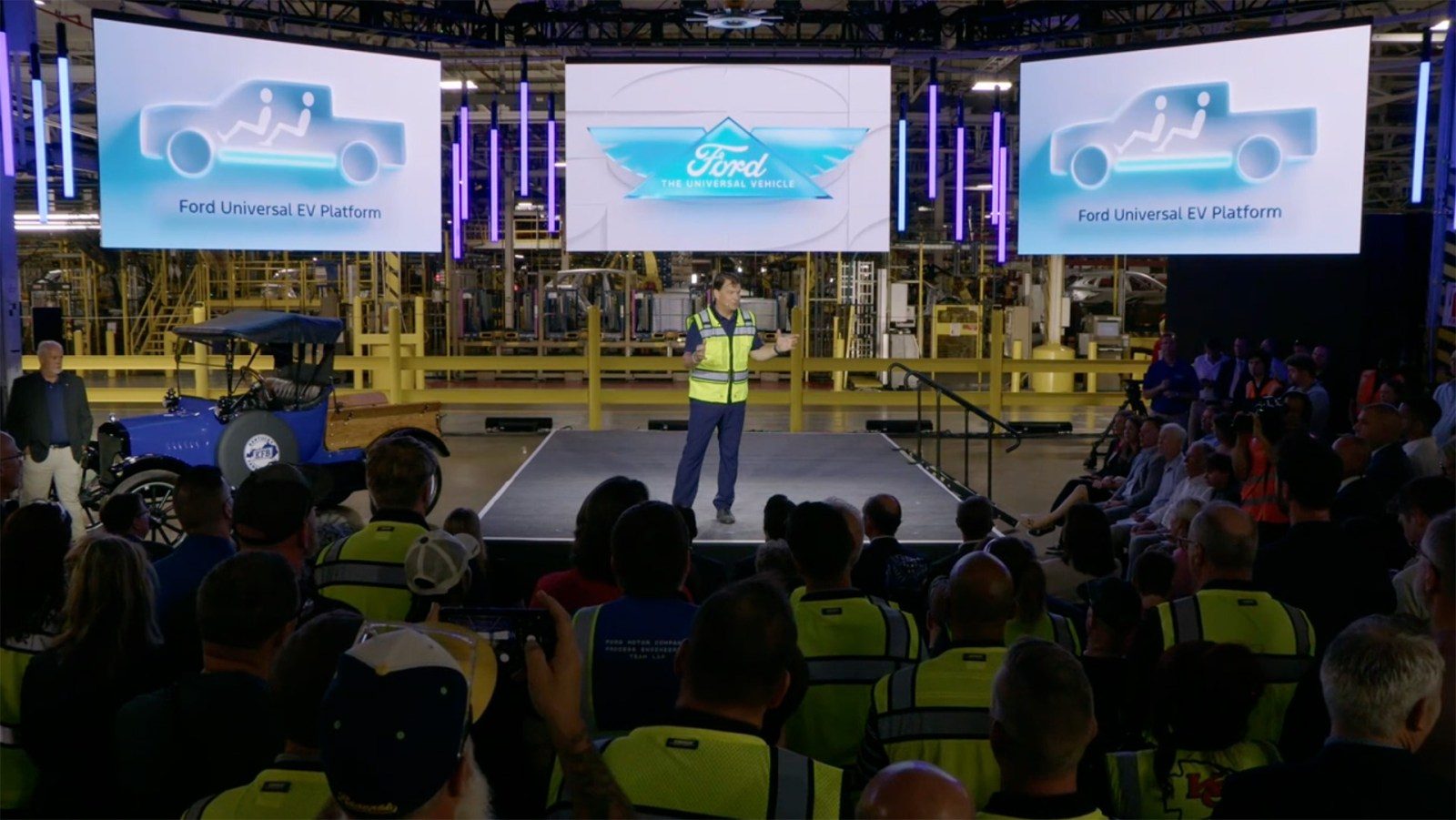
“From Day 1, we knew there was no incremental path to success,” Farley said at the August 2025 launch event.
Louisville ended production of the Ford Escape and Lincoln Corsair in December 2025, and “by February 2026, only the empty shell of LAP remained,” Ford said in August.
“We’ve engineered an 84% reduction in reaching over the fender,” Bryce Currie, Ford’s Chief Manufacturing Officer, said in the same update, which also described a station that loads the latest software into modules before they are installed.
The truck was designed by a small team in Long Beach, California, led by Alan Clarke, Vice President of Advanced Development Projects and a former Tesla executive, which Ford opened to media in May.
“It’s through a lot of pain is the main answer,” Clarke said in a video interview in September when asked how Ford reached the price. “It’s incredibly hard.”
“We had to use new suppliers that Ford hasn’t used before,” Clarke said in the same interview. “We had to come up with new designs.”
Ford also cut features it judged buyers did not need, he said: “We’re going to delete it.”
The Timeline Has Moved
Ford had planned to show the truck and take orders in 2026.
“We’re right on track to share our plans with dealers and take customer orders later this year,” Andrew Frick, President of Ford Blue and Ford Model e, said on the company’s first-quarter call in April.
When Ford named the Fathom in August, it pushed pre-orders and the reveal to early 2027.
Ford said on August 13 that its teams were on track to begin prototype builds with production-qualified parts in the first quarter of 2027.
“Customer deliveries will begin next year,” Farley said on Ford’s second-quarter call in July.
Ford has not given a date for the start of mass production, and Farley’s remarks on Tuesday did not set a new one.
The Wall Street Journal reported in September, citing people familiar with the matter, that Ford is targeting 100,000 sales in the truck’s first year, a figure Ford has not confirmed.
The best-selling EV in the US last year other than Tesla‘s Model Y and Model 3 was Chevrolet‘s Equinox EV, with 57,945 units, General Motors said.
Losses Narrow, Revenue Shrinks
Model e lost $4.8 billion before interest and taxes in 2025, after losses of $5.1 billion in 2024 and $4.7 billion in 2023, Ford’s filings show.
Including a $2.1 billion loss in 2022, the unit’s first reported year, Model e has lost about $16.7 billion over four years.
The unit lost $919 million in the second quarter, narrower than a year earlier, but revenue fell 56% to $1 billion as wholesales dropped 53% to 28,000 vehicles.
That works out to a loss of about $32,800 per vehicle wholesaled, up from about $22,200 a year earlier, though the total includes spending on vehicles not yet on sale.
Ford expects a Model e loss of about $4 billion this year, including about $1 billion of extra investment in the UEV platform and its new Ford Energy storage business.
“Ford Model e now expected to reach profitability by 2029 with improvements beginning in 2026,” Ford said in December, when it targeted breakeven in 2029.
Ford has not said how much of that improvement depends on the Fathom. Farley said at the 2025 launch event that the business “had to be a strong, sustainable and profitable” one.
A Reset Around One Truck
The Fathom survived Ford’s December 2025 overhaul of its EV plans, which brought about $19.5 billion in special items.
Production of the battery-electric F-150 Lightning ended, and Ford said the next-generation Lightning would switch to an extended-range electric design.
A planned large electric truck in Tennessee was replaced by gas trucks, and Ford split from its BlueOval SK battery joint venture with SK On, converting a Kentucky plant to energy storage.
“The first vehicle from the Universal EV Platform will be the fully connected midsize pickup truck assembled at Louisville Assembly Plant starting in 2027,” Ford said at the time.
Ford also delayed the platform’s rollout in Europe, turning to partners there instead.
Ford’s US EV sales have fallen since the federal tax credit ended on September 30, 2025, with the Mustang Mach-E now its main electric model.
The company sold 15,484 Mach-Es in the US in the first eight months of 2026, down 54.9%, and 4,770 Lightnings, down 75%.
Batteries and China
The Fathom will use lithium iron phosphate (LFP) cells from Ford’s Marshall plant, which Ford said in December “remains on track to begin manufacturing LFP prismatic battery cells in 2026.”
“We are building prototype cells already in Marshall, Michigan,” Farley said in July.
The plant uses technology licensed from China’s CATL, which has drawn criticism in Washington.
US Transportation Secretary Sean Duffy urged Ford to cut ties with China in a letter released on September 8, citing the CATL licence.
Ford’s analysis at one point found that a BYD EV would hold a cost advantage of about 20% over the Fathom’s battery, prompting changes to motors, gearboxes and inverters so it could use smaller packs, Farley said on Tuesday, according to reports of his remarks.
“We’re also going to compete with them directly with UEV,” Farley said of Chinese carmakers at the same event.
Farley told employees in July that Ford was preparing for the possibility that Chinese carmakers could enter the US market within five to 10 years, Reuters reported.
US EV sales fell 46.9% year on year in August to 78,895, a 5.7% share of the market, according to Cox Automotive.