
Rivian is partnering with ChargeScape, the automaker-backed vehicle-grid integration platform, to enroll its electric vehicle batteries in utility-managed charging programs across North America.
Under the agreement, Rivian drivers will be able to opt in to ChargeScape’s network of utility programs, which allows them to reduce charging costs while making their vehicles available as flexible grid assets during periods of peak electricity demand.
“These solutions demonstrate how electric vehicles can help reduce electricity costs and support a more resilient energy grid for everyone, whether you own an EV or not,” Rivian‘s Director of Advenced Energy Solutions Andrew Peterman stated.
According to Roland Berger’s EV Charging Index 2025, private home charging accounts for 65% of all EV miles driven in North America, making managed home charging programmes a significant lever for utilities seeking to reduce peak demand without building new grid infrastructure.
What is ChargeScape
ChargeScape is a software platform that connects EVs to the power grid, managing the flow of electricity in line with real-time grid conditions.
The company traces its roots to the Open Vehicle-Grid Integration Platform (OVGIP), an industry collaboration launched in 2014.
BMW, Ford, and Honda officially formed the company as a joint venture in September 2023.
Commercial operations began a year later, with Joseph Vellone appointed as its first CEO.
Nissan joined as an equal 25% investor in October 2024, making the platform a four-way ownership structure.
Beyond its four owners, the platform is also utilized by automakers like Tesla and Stellantis. Rivian also joins ChargeScape as a participating automaker rather than an equity owner.
ChargeScape works with multi-state utilities including Duke Energy, Xcel Energy and Eversource Energy, and offers two types of grid services: smart charging (V1G), which temporarily reduces charging demand when the grid is constrained, and vehicle-to-grid (V2G), which sends stored battery energy back to the grid during peak demand.
The extension to Rivian vehicles is a significant step forward in aligning automakers around a common platform and charging standard,” CEO Joseph Vellone stated.
Rivian and ChargeScape have not provided a timeline for when the integration would be completed or when customers would be able to enroll.
On ChargeScape’s website, the integration of the EV maker’s vehicles is listed as “coming soon.”
Rivian’s Growing Grid Strategy
ChargeScape is the second vehicle-grid integration partner Rivian has signed this year.
In February, the company partnered with EnergyHub, the Alarm.com subsidiary that operates virtual power plant technology for utilities.
Under that arrangement, Rivian vehicles can automatically shift charging to off-peak hours — typically overnight or in the early morning — when electricity demand and prices are lower.
Drivers can participate in passive programmes, where the vehicle charges at smarter times automatically, or active programmes, where the utility can temporarily adjust or pause charging to manage grid demand.
Rivian has also moved to use its battery expertise in stationary storage.
In April, the company partnered with Redwood Materials to deploy a battery energy storage system at its Normal, Illinois, manufacturing plant using retired EV battery packs — a project described as the largest repurposed battery storage system at a US automotive facility.
Battery Size as a Grid Asset
Rivian‘s vehicle lineup gives ChargeScape access to unusually large battery capacities compared to the broader EV market.
The second-generation R1T pickup and R1S SUV are offered with three pack sizes: a 92.5 kWh Standard pack, a 109.4 kWh Large pack and a 141.5 kWh Max pack.
The Max configuration provides some of the highest usable energy storage in the consumer EV segment.
The company’s newer R2 midsize SUV, which entered saleable production in late April, carries an 87.9 kWh battery pack — smaller than the R1 range but still larger than most competitors in its segment.
EPA filings disclosed the R2’s battery as a three-module lithium-ion pack with nickel cobalt aluminium chemistry, usable energy of 86.8 kWh and a rated capacity of 260.8 amp-hours.
A separate filing referenced lithium iron phosphate chemistry, suggesting Rivian may be planning a second battery variant for a lower-priced trim expected in late 2027.
As R2 production scales alongside existing R1 volumes, the total pool of Rivian battery capacity available to grid programmes is set to expand.
A CARB filing shows the company targets 5,000 R2 sales in California alone for 2026, with a guidance of 20,000 to 25,000 units of the mid-size SUV across North America.
Rivian’s Charging Network
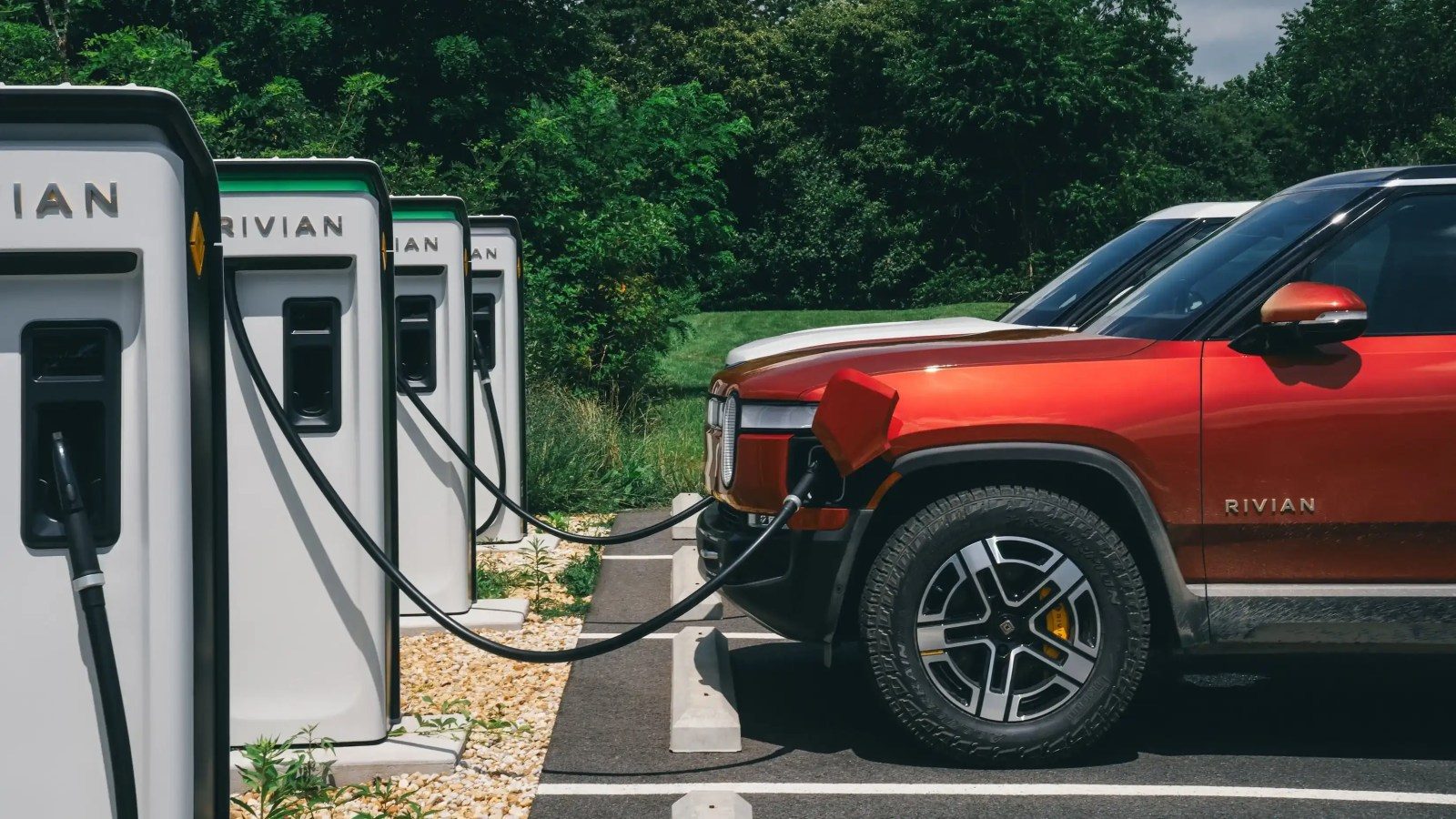
Rivian has been expanding its proprietary charging infrastructure alongside its grid-integration push.
The Rivian Adventure Network (RAN) currently operates over 1,000 stalls across nearly 150 sites in the United States, with 98% average uptime reported in 2025.
Over 90% of those stations are open to non-Rivian electric vehicles, and the company said non-Rivian drivers accounted for more than 40% of charging sessions in December 2025.
Founder and CEO RJ Scaringe recently detailed plans for a next-generation Power Cabinet 2.0 — the hardware unit behind each station that converts grid AC power to high-voltage DC — which he said would trigger a major acceleration in site deployment once it replaces the current design.
The company’s long-term target is to grow the Adventure Network to more than 3,500 fast chargers across over 600 sites in the US and Canada.
Beyond the RAN, Rivian owners have access to approximately 227,000 chargers across North America, including about 50,000 DC fast chargers and over 21,500 Tesla Superchargers.
The company has been transitioning from CCS to NACS connectors — the R2 comes with a native NACS port, while R1 models use a free adapter — and partnered with Electrify America and Ionna last year to integrate third-party station data into its mobile app.