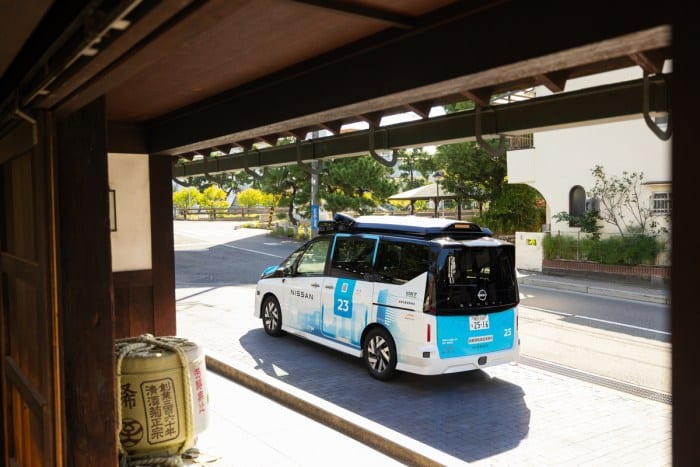
Nissan will expand its autonomous mobility pilot in Kobe’s Nada Gogo sake-brewing district in December, adding on-demand smartphone booking and a wider service area, the company said on Wednesday.
The pilot will run on weekdays from December 8 to December 18 using Serena-based autonomous development vehicles, with a safety driver on board at a level equivalent to SAE Level 2.
Nissan did not say how many vehicles it will deploy, how many pick-up points the service will have or what its operating hours will be.
Applications opened on Wednesday for about 100 trial riders aged 18 or older, who can ride free of charge.
Applications close on November 13, and Kobe City will notify the winners of a lottery in late November if demand exceeds places.
The Nada Gogo Sake Brewers Association will provide pick-up and drop-off locations and explore links between the service and its breweries, while Kobe City runs the overall project and Moplus supports operations.
Moplus, a mobility and EV energy services company set up in March 2025, is owned equally by Nissan and Mitsubishi Corporation.
The Nada Gogo district spans Kobe and neighboring Nishinomiya, and Kobe City describes it as one of Japan’s largest sake-brewing areas.
Nissan aims to start paid operation in parts of the area in the fiscal year beginning April 2027 and commercial operation in fiscal 2030.
Last Winter’s Test
The December pilot builds on a five-day trial in January, when a single Leaf-based vehicle drove a roughly 20-minute loop past four sake breweries and museums without intermediate stops.
The vehicle completed 49 of 50 planned dispatches and carried 97 riders on a 5.35-kilometer route, all in Level 2 mode with a safety driver aboard and no accidents, according to a Kobe City report dated February.
About 92% of surveyed riders viewed the service positively after their trip, up from about 54% before it, and nearly 90% said it would make them more likely to visit the area.
Respondents most often said they would use such a service for everyday trips, such as getting to hospitals or lessons, followed by sightseeing, and about 70% expected to ride between once a week and once or twice a month.
They said the service would mainly replace private cars and taxis, and some voiced concern about fully driverless operation, the city said.
The report noted a manual intervention when the vehicle was steered around roadside pruning work.
One Control Room
The Kobe vehicles will be monitored in real time from Nissan’s remote operations center in Yokohama, which will also oversee its pilot in the Minato Mirai and Kannai districts there.
Nissan said testing whether several service areas can be monitored from one location could make future services more efficient and reduce the burden on host communities.
Its Yokohama pilot, which began on October 1 and also ends on December 18, uses 10 Serena-based vehicles and 28 pick-up points, up from five vehicles and 26 points last year.
Nissan is recruiting about 500 trial riders in Yokohama, with partners including Moplus, KDDI, Premier Aid and taxi operator Kokusai Motorcars.
The Road to Driverless
Nissan said in February 2024 that it planned to commercialize autonomous mobility services in Japan from fiscal 2027, with services in three to four municipalities, including rural areas, using tens of vehicles.
In Yokohama, it aims to launch services with remote-monitored, driverless vehicles equivalent to SAE Level 4 from 2027 onwards.
Kobe’s timeline is longer.
The city’s roadmap calls for an application for Level 4 vehicle approval in December 2027, a partial Level 4 demonstration from June 2028 and the launch of Level 4 service from April 2030.
It also foresees applications for a specified automated operation permit in November 2028 and a passenger transport license in April 2029.
Nissan has said it is also considering autonomous vehicles for community public transport in Kobe, such as in the city’s new towns.
Both pilots are part of a Digital Agency program for the early commercialization of autonomous driving services and draw on a transport ministry subsidy for regional public transportation.
Nissan’s Bet on Autonomy
Nissan has tested autonomous ride services in Japan since launching its Easy Ride project in 2018, initially in Yokohama.
The Kobe and Yokohama pilots now run alongside its work with Wayve.
Nissan signed definitive agreements in December 2025 to use Wayve’s software in its next-generation ProPILOT system, with the first model due in Japan in the fiscal year starting April 2027.
Wayve and Uber plan to add the Nissan Leaf, running the Wayve AI Driver on Nvidia DRIVE Hyperion, to a robotaxi service in Tokyo later this year.
Nissan said in April that the new Elgrand would adopt next-generation ProPILOT “with end-to-end autonomous capability by the end of fiscal 2027.”
It said in September, when it reshaped its Japan business, that Japan would serve as “a proving ground for advanced technologies, including next-generation ProPILOT and mobility services.”
In the United Kingdom, Nissan is leading a research project called ADventure in Cambridge, backed by 3 million pounds ($4 million) of government funding.
Nissan faces competition at home from Waymo, which aims to launch what would be Japan’s first commercial driverless taxi service in Tokyo during 2027 with taxi operator Nihon Kotsu and the GO ride-hailing app.