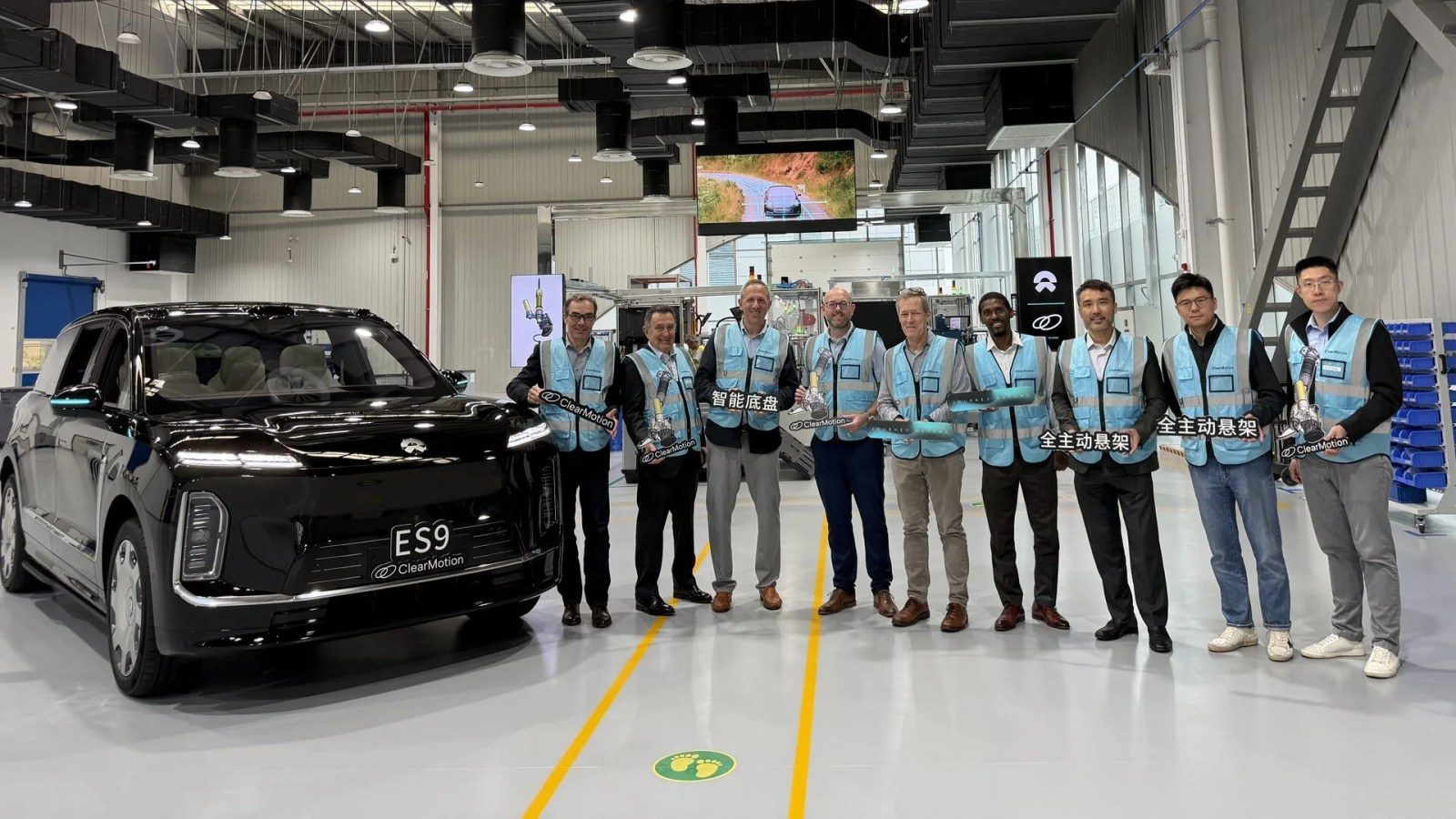

ClearMotion, the US-based active-suspension supplier backed by Nio‘s venture arm, Nio Capital, said Monday that more than 10,000 electric vehicles are now equipped with its fully active suspension system.
The technology currently equips two models — the Nio ET9 executive flagship sedan and the newly launched ES9 flagship SUV, as the first models from the German brand Porsche have not yet reached the market.
“No one in the world has matched this number, and we’re only just getting started,” the company wrote in a LinkedIn post.
ClearMotion described the achievement as the result of years of development and credited its team for reaching a threshold that no competitor has matched.
Nio x ClearMotion
ClearMotion has benefited from Nio‘s dual role as both an investor and its largest customer.
Nio Capital, the venture arm co-led by the EV maker’s founder and CEO William Li and managing partner Ian Zhu, led a $39 million Series E round in September 2022 and participated in subsequent funding rounds.
In December 2023, ClearMotion announced a landmark production order from Nio covering three million CM1 units.
Reuters reported the deal as spanning roughly 750,000 vehicles over the lifetime of the ET9 platform — a figure consistent with four actuator units per vehicle.
The agreement covered next-generation Nio EVs, with the ET9 as the first model and the ES9 now confirmed as the second.
ClearMotion opened its first production plant in Changshu, China, in April 2024, with capacity to produce up to 1.5 million CM1 units annually.
Shortly after, the company announced a partnership with Porsche AG for validation, licensing of CM1 hardware and its RoadMotion predictive software, and potential future integration.
No Porsche production model currently uses the system in series production, however. Nio remains the only automaker that has taken the technology to volume.
The Technology Behind SkyRide
ClearMotion‘s CM1 is a hydraulic fully active suspension actuator capable of processing information and responding within one millisecond, according to Nio.
Unlike conventional adaptive or semi-active dampers that can only resist motion, the fully active system can push and pull each wheel independently, cancelling road-induced vibrations and body movements in real time.
ClearMotion says the technology reduces unwanted vibration by up to 75%.
Nio markets the system under the SkyRide brand as part of a broader intelligent chassis that integrates the ClearMotion fully active suspension with steer-by-wire and rear-wheel steering.
SkyRide debuted on the ET9 and carries over to the ES9, which shares the same core ClearMotion hardware and software for real-time wheel-by-wheel control.
Each equipped vehicle requires four CM1 actuator units, one per corner, which is why the 10,000-vehicle milestone corresponds to more than 40,000 CM1 units delivered.
ET9: The Launch Platform
The Nio ET9 was the first production vehicle in the world to use ClearMotion‘s fully active suspension system.
Deliveries began in late March 2025, and the SkyRide chassis is standard on every ET9 configuration — there is no base trim without it.
The sedan starts at 768,000 yuan ($107,500) with the battery included and targets the ultra-luxury segment.
Monthly ET9 volumes have remained modest, reflecting the model’s positioning at the top of the Chinese EV price spectrum.
At the same time, Nio launched several editions of the flagship executive sedan, in an aim to revive demand.
Volumes continued at a similar cadence into 2026, with 128 units in April and 155 in May — 153 in China and two outside the country.
Cumulative ET9 deliveries from late March 2025 through May 2026 totalled 3,272 units.
ES9: Scaling the Technology
The Nio ES9 flagship SUV, launched on May 27 with deliveries starting May 28.
Unlike the ET9, the ES9 does not include the SkyRide system on all trims.
The entry-level Executive Premium Edition, priced at 498,000 yuan ($73,400) with the battery, uses a more conventional air suspension setup.
ClearMotion‘s fully active suspension is reserved for the Executive Signature Edition at 558,000 yuan ($82,500) and the Horizon Edition at 628,000 yuan ($92,800).
Nio said the proportion of orders for the two higher-priced SkyRide-equipped trims far exceeded its internal expectations.
That skew is visible in current wait times: customers ordering the entry-level ES9 face a delivery wait of three to four weeks, while the SkyRide trims carry wait times of 16 to 17 weeks, according to the Nio app.
Nio delivered approximately 3,100 ES9 units in just four days of May, based on the May 28 delivery start date.
The company had pre-built an inventory of at least 6,000 ES9 units ahead of the launch to speed initial nationwide handovers.
What the Numbers Reveal
ClearMotion‘s 10,000-vehicle milestone, announced as of last week, offers a lens into the ES9’s early delivery mix.
With cumulative ET9 deliveries at 3,272 — all of which carry the ClearMotion system — the remaining balance of roughly 6,700 ClearMotion-equipped vehicles would be ES9 units fitted with the SkyRide chassis on mid- and top-tier trims.
Since the entry-level ES9 does not include the system, total ES9 deliveries by that point would be somewhat higher than the ClearMotion-equipped count alone.
The data aligns with the trajectory flagged by Nio‘s VP of Branding and Communications Ma Lin — who projected late last week that the ES9 would surpass 10,000 cumulative deliveries later this month.
Nio‘s second-quarter delivery guidance calls for between 110,000 and 115,000 total group deliveries, with management positioning the ES9 alongside the Onvo L80 as the two models expected to drive the strongest sequential growth.