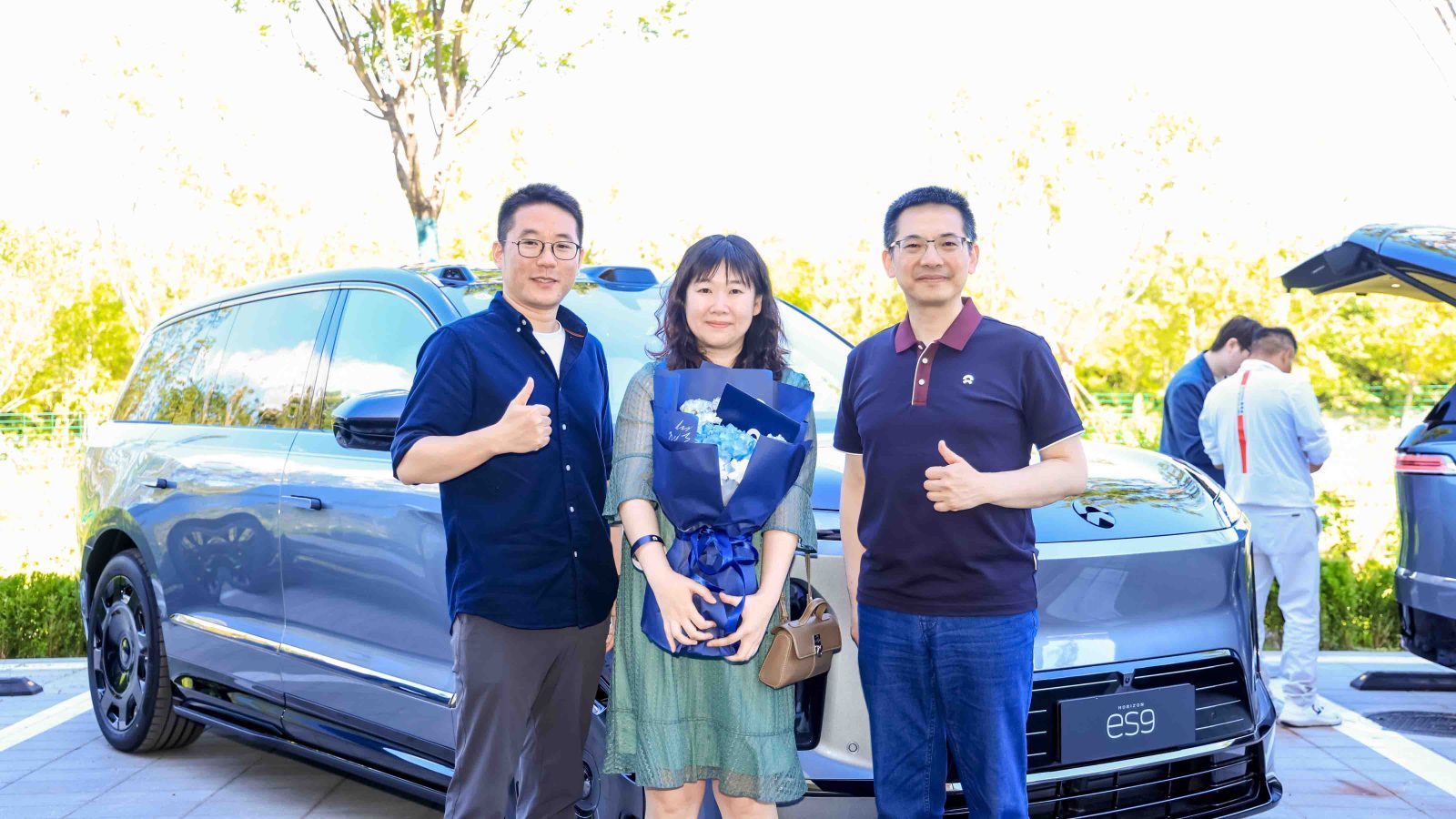

US-listed shares of Nio soared more than 8% on Monday, hours after the company reported its best sales month of the year in May, even without including significant volumes from the newly launched ES9 SUV.
Buyers of Nio‘s ES9 flagship SUV in China face sharply different delivery waits depending on which trim they choose, with the two most expensive versions carrying queues four times longer than the entry model.
The configurator on Nio‘s Chinese website showed estimated waits of 16 to 17 weeks from order lock for the two top trims as of Monday, against three to four weeks for one configuration of the cheapest version.
The gap inverts the usual pattern, in which a carmaker’s entry trim, ordered in the highest volume, tends to carry the longest queue.
For the ES9, the opposite holds, with the wait lengthening as the price rises.
The disclosure echoes the launch of the ES8 last September, when Nio also began publishing per-order delivery times in its app a few days after the event, then showing waits of up to 26 weeks.
As of press time, the stock was trading 8.13% higher at $6.06, after its Hong Kong-listed shares closed 6.68% higher earlier Monday.
The Numbers by Trim
The ES9 is sold in three trims, each a six-seater offered in either a center-console layout or an aisle layout, giving six configurations in total.
As of Monday, the range-topping Horizon Edition, priced from 628,000 yuan, showed an estimated 16 to 17 weeks to delivery after configuration lock in both its center-console and aisle layouts.
Horizon Edition’s trim is distinguished by a two-tone body, a horizon-themed beltline, 22-inch forged wheels, full active suspension and a “river and mountain” embroidery motif.
The mid-tier Executive Signature Edition, from 558,000 yuan, showed the same 16-to-17-week estimate in both layouts.
It carries the full active suspension, steer-by-wire with rear-wheel steering, 22-inch wheels, smart dimming privacy windows, the NOMI Mate 3.0 assistant and a 9.2.4.8 immersive sound system.
The entry Executive Premium Edition, from 498,000 yuan, was markedly quicker, and the only trim whose two layouts diverged.
Its center-console layout showed an estimated three to four weeks, the fastest configuration on offer, while its aisle layout showed eight to nine weeks.
The Premium trim features dual-chamber air suspension with external-valve CDC dampers, steer-by-wire with rear-wheel steering, twin 16-inch NIO Link rear screens, zero-gravity executive seats, and power-sensing doors with a powered running board.
Based on the configurator, the cheapest trim’s center-console layout is available in under a month, its aisle layout in roughly two, while either layout of the two costlier trims runs to four months.
The estimates are measured from the moment a buyer locks the configuration, not from the initial order, and reflect what the official configurator displayed on Monday afternoon.
The split within the entry trim points to layout-level build sequencing, as its center-console version cleared faster than the aisle version of the same model, while the two upper trims showed no layout difference.
Two Readings
Longer waiting time hints at stronger demand for the premium trims, leaving a longer backlog for the Horizon Edition and Executive Signature editions while the entry model clears faster.
Nio has not published trim-level order figures, leaving the configurator estimates as the clearest public signal of where the backlog sits.
When Nio launched the third-generation ES8 last September, it began showing per-order delivery times in its app the day after the event, the same pattern now seen with the ES9.
At the time, new ES8 orders faced a wait of 24 to 26 weeks, meaning a customer ordering then would not receive the vehicle until around March 2026, six months out.
Nio attributed that backlog to order demand rather than production limits, saying it had sold out the model’s 40,000-unit annual capacity and that the factory would ramp toward 15,000 units a month by December.
Against that benchmark, the ES9’s 16-to-17-week peak is shorter than the ES8’s launch-period wait, though both flagships show the same front-loaded demand pattern in their opening months.
At the time, the EV maker awarded waiting customers loyalty points from the eighth week without delivery and covered any purchase-tax increase for orders that slipped into the following year.
A Launch-Benefit Deadline
The wait times matter against a fixed promotional cutoff.
Nio‘s app states that customers who lock an ES9 order through July 31, 2026, qualify for a set of limited-time launch benefits.
Those include a zero-down-payment promotional financing plan, a Feihang executive accessory set, an ES9 delivery gift box, and five years of free use of the company’s NOP+ assisted-driving system.
Nio had earlier paired the launch with aggressive financing, including a 60-month plan offering zero interest for the first two years and a 84-month option, terms aimed at converting reservations into locked orders.
Because the delivery clock starts at configuration lock, a buyer locking a top trim near the July 31 deadline would not take delivery until around November, given the 16-to-17-week estimate.
A buyer choosing the entry trim’s faster configuration could receive the vehicle within roughly a month.
The benefit window is a launch-period promotion and is separate from the model’s standard ownership terms, which the app lists as a six-year or 150,000-kilometer vehicle warranty, a 10-year unlimited-mileage warranty on the battery, motor and electronics, lifetime free roadside assistance in mainland China, and six years of connectivity service.
Pricing and Positioning
The ES9 is Nio‘s flagship executive SUV and sits at the top of the main brand’s lineup, above the third-generation ES8.
Nio has described the full-size model as the culmination of more than a decade of development, positioning it in the executive segment against established combustion-engine rivals.
At the launch, Nio said it would deploy more than 1,000 new battery swap stations this year and begin large-scale rollout of its fifth-generation stations in the third quarter, infrastructure it ties directly to the case for a battery-electric flagship.
The current prices of 498,000, 558,000 and 628,000 yuan are each 30,000 yuan below the pre-sale figures Nio showed before launch, consistent with the company’s practice of trimming pricing at the final order-lock stage.
Nio formally launched the ES9 on May 27 in Beijing and began deliveries across China on May 28, with the configurator now showing live estimates for new orders.
Under the company’s Battery-as-a-Service scheme, which leases the battery separately for a monthly fee, the three trims start at 390,000, 450,000 and 520,000 yuan, a flat 108,000-yuan reduction from the full-purchase prices.
All three trims share the SkyRide intelligent chassis, built around what Nio calls the world’s first 48-volt integrated hydraulic fully active suspension, with steer-by-wire and rear-wheel steering that cut the turning radius to 5.4 meters.
The model runs on a 900-volt architecture supporting 5C ultra-fast charging and three-minute battery swaps, with up to 620 km of range and 0-to-100 km/h acceleration in 4.3 seconds.
At 5,365 mm long on a 3,250 mm wheelbase, the ES9 is the largest battery-electric SUV developed in China, seating six with 816 liters of storage and a 216-liter front trunk.
Nio equips it with the NX9031, which it bills as the world’s first 5-nanometer automotive-grade smart-driving chip, a 47-speaker LYRA sound system, and 31 sensing units for its NOP+ assisted-driving suite.
The company says the ES9 carries more than 40 industry-first technologies and frames it as the culmination of 11 years of development.
The ES8 reached 11,475 deliveries in May, helping lift the main Nio brand and the wider group, which delivered 37,705 vehicles across Nio, Onvo and Firefly in the month.