
BYD‘s Canadian evaluation programme extends beyond its own badge to at least one of its sub-brands, according to photographs taken this week in Ontario and Quebec and posted to the r/EVCanada forum.
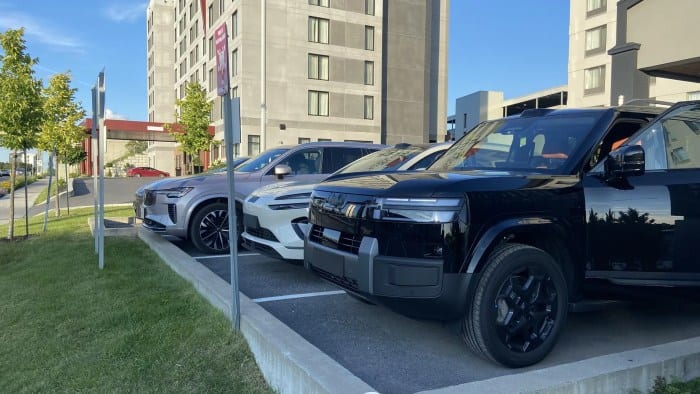
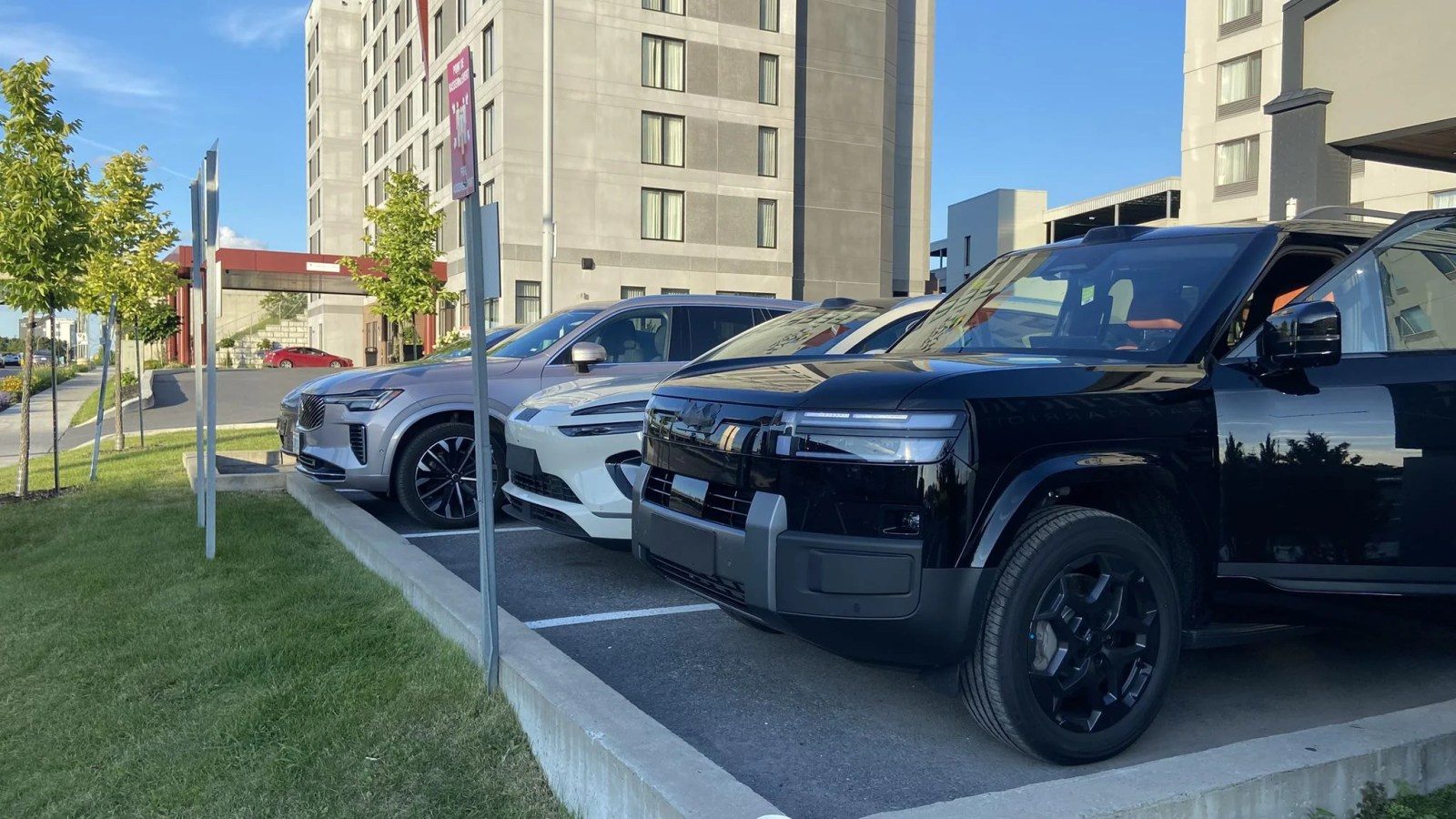
A Fangchengbao Ti7, the boxy plug-in off-road sport utility vehicle BYD sells through its rugged sub-brand, was photographed alongside a BYD Sealion 7 in a hotel car park outside Montreal.
A separate vehicle with its badges taped over and an Ontario manufacturer plate was photographed at a shopping centre in Markham, the municipality where BYD Canada Company Limited is registered.
Neither the company nor Transport Canada has said which vehicles are in Canada, or under what authorisation.
BYD has announced no Canadian launch date, no models and no prices, and no sub-brand has a stated Canadian plan.
The Chinese giant added a coming-soon notice to its Canadian website this week and is advertising eleven management roles, as EV reported on Tuesday.
The Montreal Pair
The Quebec photographs were posted by user ‘SimplyGregsterEV.’
The black vehicle is a Fangchengbao Ti7 — 4,999 millimetres long on a 2,920-millimetre wheelbase, a range-extended five-seat off-roader with a 1.5-litre turbocharged petrol generator driving one or two electric motors.
The deep, open, slatted grille visible in the photograph is consistent with that layout rather than with a battery-electric car.
Fangchengbao markets it in the Titanium series alongside the Ti3; Gulf dealers list it as the Leopard 7 or Bao 7.
The white vehicle is a BYD Sealion 7, a mid-size battery-electric crossover measuring 4,830 millimetres on a 2,930-millimetre wheelbase, with the company’s Ocean Aesthetics front.
The SUV features a sealed grille-less nose, razor-thin headlights and C-shaped daytime running lights wrapping the corner intakes.
The Models
BYD‘s Shenzhen and Xi’an plants are listed in Transport Canada’s Appendix G pre-authorisation registry for passenger cars.
Reuters reported in June that the company had begun compliance procedures for two passenger models, one from each plant, without naming them.
The Sealion 7 is assembled at Xi’an and at Changzhou in Jiangsu. It could travel on a listing BYD already holds, and a Xi’an-built battery-electric crossover is a plausible candidate for one of the two models in compliance.
The Ti7 is built at none of the listed sites. Fangchengbao assembles it at Changsha in Hunan, Hefei in Anhui and Jinan in Shandong.
The detail matters as Appendix G operates at plant level.
A vehicle from an unlisted plant cannot ride on an existing registration. It requires either a new entry — and Transport Canada paused new Appendix G applications for passenger vehicles last year — or the case-by-case approval route, which demands review at the vehicle identification number level and cannot scale to volume.
The presence of a Ti7 in Quebec is therefore harder to explain as launch preparation than as a one-off evaluation import.
As EV‘s audit of the registry found, Denza, Yangwang and Fang Cheng Bao hold no separate listings of their own.
Testing a sub-brand vehicle also says something about intent that a Sealion 7 does not.
The Ti7 competes with the Toyota Land Cruiser Prado, a segment Canada buys heavily and one absent from every reported account of BYD‘s Canadian plans, which have consistently described passenger cars.
The Ontario Sighting
The Ontario images were posted on Wednesday.
They show a mid-size SUV with a coupe roofline named Sealion 06. Black tape covers the bonnet emblem, the tailgate emblem and the model script beneath it.
The rear plate reads 395MPB with the prefix MFR — an Ontario manufacturer plate, a category separate from a dealer plate.
BYD Canada Company Limited is registered at 60 Travail Road, Markham. Dealer Solutions Mergers & Acquisitions, the consultancy engaged to identify dealership sites, is also in Markham.
First Markham Place, where the car was photographed, is a Chinese-Canadian retail centre in the same municipality.
What Came Before
One BYD-badged vehicle had been documented in Canada before this week, and the distinction is the plate.
In July, the same Montreal creator published a road test of what coverage described as the first BYD Shark 6 in the country, a plug-in hybrid pickup with a 29.6-kilowatt-hour battery.
That truck was a private import on ordinary registration. BYD has never confirmed the Shark 6 for Canada.
Chery vehicles on manufacturer plates appeared on Toronto streets in April and May.
Geely EX2 and EX5 units were photographed arriving at Toronto Pearson. Dongfeng displayed six vehicles at Montreal’s Old Port on July 14.
Where the Company Actually Is
Advisory firm DSMA told Automotive News Canada in March that BYD, Chery and Geely were preparing entry by the end of 2026, with preparations well underway but none ready to ship and months of certification still ahead.
Industry Minister Mélanie Joly has confirmed meeting BYD and Chery.
Executive VP Stella Li’s verified position comes from a March Bloomberg interview, in which she said a joint venture would not work for BYD in Canada, that the company was studying a wholly owned plant, and that it was open to acquiring a legacy automaker’s capacity.
The Timing
The first quota window closes on Monday.
Canada repealed the 100% surtax effective March 1, replacing it with a 6.1% most-favoured-nation rate applied to 49,000 vehicles a year.
The quota covers battery-electric, hybrid and plug-in hybrid vehicles, so a range-extended Ti7 would fall inside it.
A Global Affairs Canada utilisation report executed on August 21 showed 15,063 permits used, or 61.5%, leaving 9,437.
At August’s pace the window closes with close to 7,000 unused, and under clause 3.5.2 of the governing notice that volume rolls into the second half, which will open with roughly 31,000 permits available.