
BYD is building a design studio in Milan dedicated to making Denza and its other vehicles look and feel more European, with design chief Wolfgang Egger — a veteran of Alfa Romeo, Audi and Lamborghini — leading the effort on the doorstep of his former employers.
The Chinese automaker is scaling up its new European headquarters in the city, where a standalone design facility will work to align BYD‘s output with local tastes rather than exporting a single global look.
Speaking to Autocar, Egger described the studio as the group’s base for design research, tasked with reading European tastes and trends and feeding them into future Denza and BYD models.
Egger believes Denza can make its case against legacy automakers due to its technology, arguing that hardware alone won’t be enough.
“We can compete with traditional [brands] with innovation and new designs,” he stated in the interview.
He believes the Milan studio can sharpen Denza‘s design, material quality, personalisation options and brand familiarity, closing gaps that spec-sheet advantages don’t touch.
Denza sold 19,196 units globally in July, against Fang Cheng Bao’s 41,213 and Yangwang’s 485
Pricing and Competition
BYD‘s premium brand Denza is the first Chinese volume-premium marque to launch in the region.
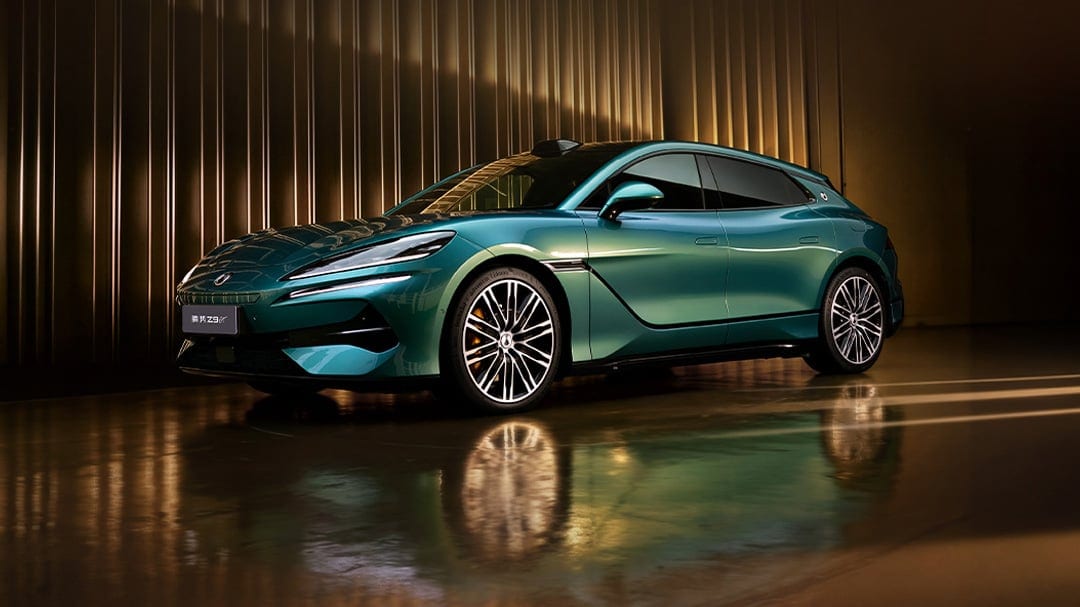
The Z9 GT is officially available for order in Germany, with the fully electric version available for €115,000 ($133,200) and the plug-in hybrid (PHEV) starting at €103,500 ($119,900).
The shooting brake, which targets the Porsche Panamera, is priced around £100,000 ($135,400) in the UK.
The newer Denza Z, an EV pitched at the Porsche 911 Turbo, starts above £150,000 ($203,100).
BYD is spending about €2 billion on flash-charging stations in Europe, targeting 3,000 by 2027.
Luxury Placement
Denza‘s European debut was staged at last year’s Milan Design Week, an event whose exhibitor list included Prada, Gucci and Fendi, reinforcing the brand’s intent to be read alongside those names rather than against them.
Establishing its design headquarters in Milan allows the team to “create contacts at the most important fashion houses.”
Italy’s supply base was the other draw.
Egger pointed to the country’s standing as a top-tier source for premium and luxury materials, leather among them, as well as newer and recycled materials that BYD wants to bring into future interiors.
European Sales Growth
The design push is landing as BYD‘s European sales numbers are moving fast enough to justify the investment.
The company more than doubled its share of the EU, EFTA and UK market in the first half of 2026, reaching 2.4% and drawing level with Tesla for the first time, according to ACEA data.
However, much of that growth is still coming from outside Denza.
BYD‘s mainstream lineup now spans more than a dozen nameplates, from the sub-€25,000 Dolphin Surf to the Han sedan above €69,000 in Germany, and the group has started rolling out models built specifically with European buyers in mind.
The first of these, the Dolphin G plug-in hybrid, launched a month ago — joining volume sellers like the Seal U DM-i and Atto 2 DM-i that have carried much of BYD‘s PHEV growth in the region.
The automaker sold 419,211 new energy vehicles globally in July — a 21.8% increase from a year earlier and a third consecutive month of annual growth.
Sales outside China reached a record 179,841 units, a 124.3% increase from a year earlier.
The Chinese giant has leaned on overseas demand to offset a shrinking home market for most of the year.
BYD has guided to full-year sales of 5.0 million to 5.5 million new energy vehicles, implying growth of 9% to 20% on the 4.60 million units sold in 2025.
Local Production
Localization is following the same strategy as design.
BYD is moving to build vehicles closer to its European customers, a shift that also softens the impact of the EU’s countervailing duties on Chinese-made EVs.
The company currently faces a 17.0% duty on top of the standard 10% import tariff, though that levy currently applies only to fully electric models and not to the PHEVs driving much of BYD‘s recent volume.
The Szeged plant in Hungary — the centerpiece of BYD‘s local production strategy — is however working through a series of delays.
BYD‘s first passenger-vehicle plant in the European Union began trial production in late January after missing an original target of starting operations by the end of 2025.
Executive VP Stella Li has since confirmed that full vehicle assembly is now expected only in the fourth quarter of 2026, roughly a year behind the original schedule.
The plant is designed for an eventual annual capacity of up to 300,000 vehicles, though the company has signaled it will run well below that level for at least its first two years, building only a fraction of that number in 2026.