
Chinese automaker BYD is closing in on the launch of its Subang factory in West Java, Indonesia, with mass production expected to begin as early as the third quarter of 2026.
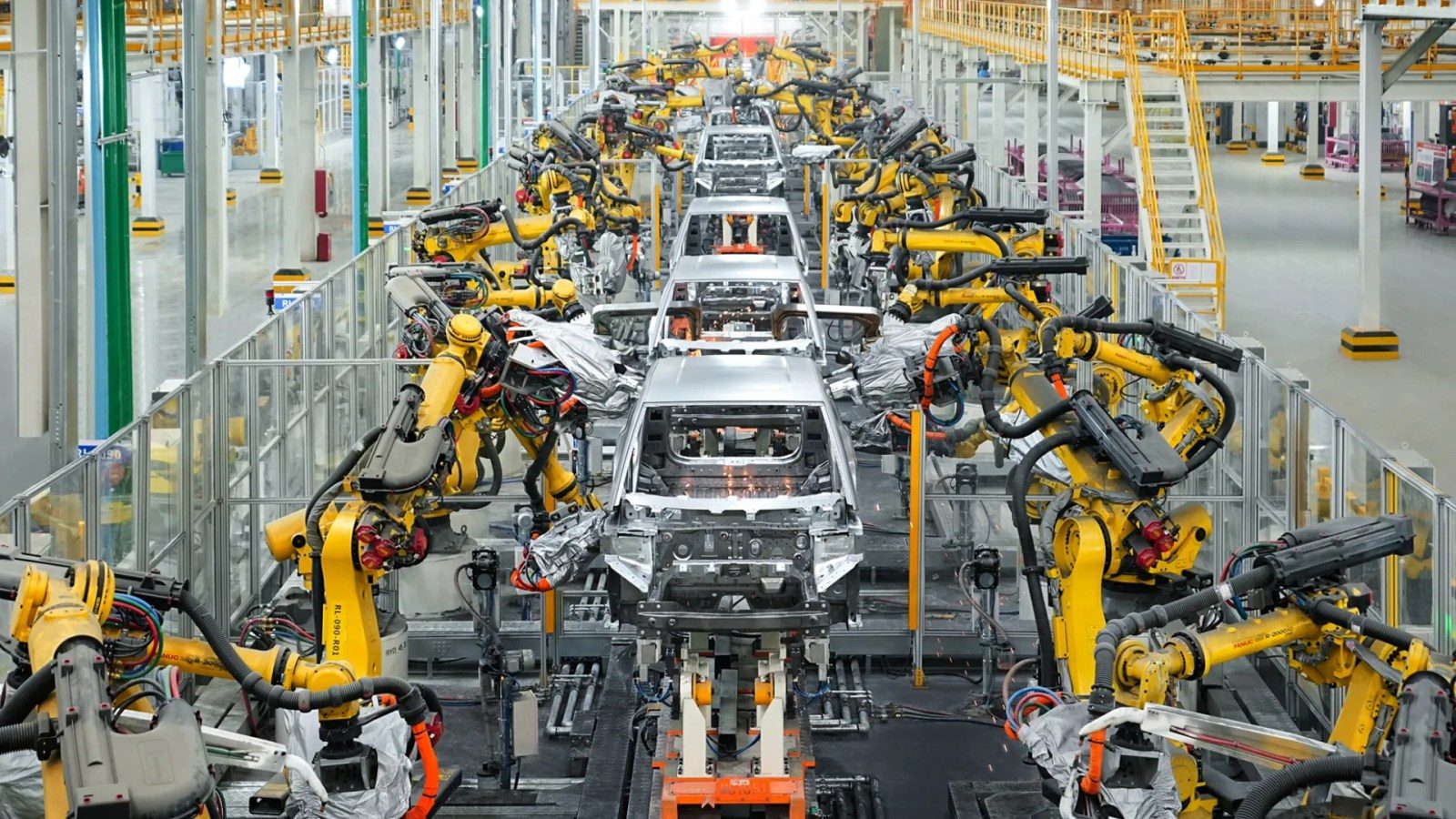
Construction at the site is largely complete and has entered the final finishing stage, with equipment integration, production-line system connection, and full-scale trial production now the remaining steps before official series output.
The latest milestone was reached on Monday, when 130 vehicle production line stamping dies — weighing approximately 2,489 tons in total — were loaded onto the cargo vessel Haoyang 1 at Xiaomo International Logistics Port in Shenzhen’s Shenshan Special Cooperation Zone, bound for Jakarta.
The dies were manufactured at BYD‘s Shaoguan factory and will serve as critical tooling for building and commissioning the vehicle production line at the Indonesian plant.
According to local media outlet Shenzhen Business Daily, the shipment also marks the official launch of the new “Xiaomo Port–Jakarta” foreign trade breakbulk shipping route.
Shenzhen authorities have positioned the route as a logistics channel for “Made-in-China” automotive exports across the Maritime Silk Road, reaching ASEAN markets via key shipping passages such as the Strait of Malacca and the Lombok Strait.
The Shenzhen Municipal Transportation Bureau’s Shenshan Administration coordinated with Shenshan Port Investment Company to assess lifting-operation risks in advance and optimise loading procedures based on cargo specifications and centre-of-gravity distribution data.
On the same day, the vessel Fuli 308 loaded 360 sets of new energy vehicle knock-down (KD) parts at Xiaomo Port, to be transported to Guangzhou Port for transfer onto international mainline shipping routes bound for Indonesia.
That movement inaugurates a parallel container route, “Xiaomo Port–Guangzhou–Indonesia,” creating what local officials described as an efficient logistics corridor linking the Guangdong-Hong Kong-Macao Greater Bay Area hinterland with international markets for vehicle exports.
Xiaomo Port itself is positioned as the core growth engine of the “Eastern Wing” in Shenzhen Port’s “One Body, Three Wings” development strategy.
The first phase of the international deep-water port — officially opened on December 28, 2021 — has a designed annual throughput capacity of 4.5 million tons and is described as a national first-class open port focused on automobile parts and vehicle roll-on/roll-off import and export businesses.
Factory in Final Integration Stage
The Subang facility is designed with an annual production capacity of 150,000 vehicles and sits on a 126-hectare site that BYD has framed as Southeast Asia’s largest new energy vehicle base.
The facility has a total investment of $1 billion and is planned to create more than 18,000 local jobs.
BYD Indonesia’s Head of Public and Government Relations Luther T. Panjaitan stated last month that the plant is currently completing equipment integration and testing.
“We have reached the final stages in order to begin mass production as soon as possible,” Luther said.
The representative also explained that equipment integration is the most time-consuming part of the current phase because it directly affects product quality.
“In the manufacturing process, especially when integrating equipment, it takes quite a long time,” he noted, adding that “we must ensure that the products produced at our facility meet quality standards 100%.”
Luther said that the timeline depends on trial outcomes from the manufacturing division but that progress is “nearing completion.”
BYD has already obtained the IKD certificate for the vehicles to be produced at the site, along with the LCEV certificate and additional manufacturing-eligibility certifications, he said.
Recruitment is being concentrated on the production line at this stage to support 2026 output targets, with additional hiring planned across office operations, sales, and distribution as the plant ramps.
The Subang plant is structured around a full industrial chain closed loop in Indonesia, leveraging the country’s nickel reserves — which account for roughly 23% of the global total — to integrate nickel ore processing, Blade Battery production, and vehicle assembly within the same national footprint.
BYD has indicated a localization rate of 50% to 60%, reducing overall costs by more than 30%, with the site also intended as a right-hand-drive export hub serving ASEAN, the Middle East, and Africa.
EV Policy
The local production push is also a response to a shifting policy environment.
“Local production is part of our commitment to Indonesia, not just because incentives are ending. This is a long-term strategy to address industry challenges,” Luther previously said.
Indonesia’s current incentive scheme — which provides import-duty exemptions, a reduced 2% VAT, and a 0% luxury-goods tax (PPnBM) on fully imported electric vehicles (CBU) — is set to end by the close of 2025.
BYD entered Indonesia in January 2024 and rapidly became the dominant player in the country’s battery electric vehicle (BEV) segment.
The company is also weighing entry into Indonesia’s plug-in hybrid segment if government incentives shift in that direction, having already registered models such as the Denza D9 and DX9 locally as a preparatory step.
Without those incentives, prices for imported EVs would rise sharply.
Part of a Broader Overseas Push
The Subang ramp is part of BYD‘s broader overseas expansion.
The Chinese automaker has guided to overseas sales of 1.5 million units in 2026 — a 50% increase from approximately 1.05 million vehicles exported in 2025 — with management indicating potential upside risk given robust demand.
Overseas volume already accounted for around 42.8% of BYD‘s April total, after reaching a record 134,542 passenger vehicles and pickups outside China.
[byd overseas]
BYD currently operates overseas plants in Thailand, Brazil, Indonesia, and Uzbekistan, and began trial production at its first European passenger vehicle factory in Szeged, Hungary, in January.
Indonesia is also drawing investment from other Chinese automakers chasing the same localisation logic.
XPeng recently acquired a 90.1% controlling stake in PT Era Industri Otomotif (EIDO), a manufacturing entity under Indonesia’s Erajaya Group, through its Hong Kong international holding subsidiary.