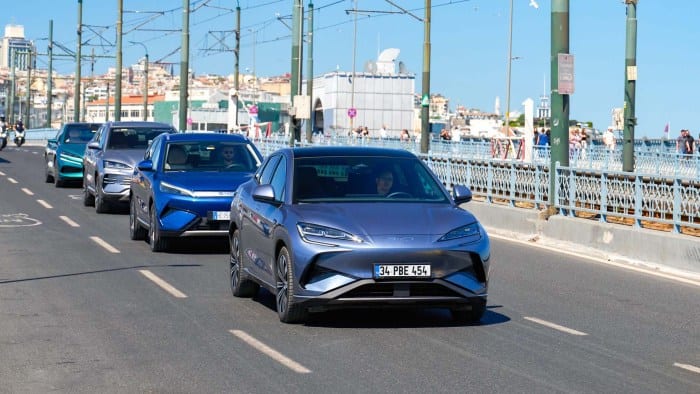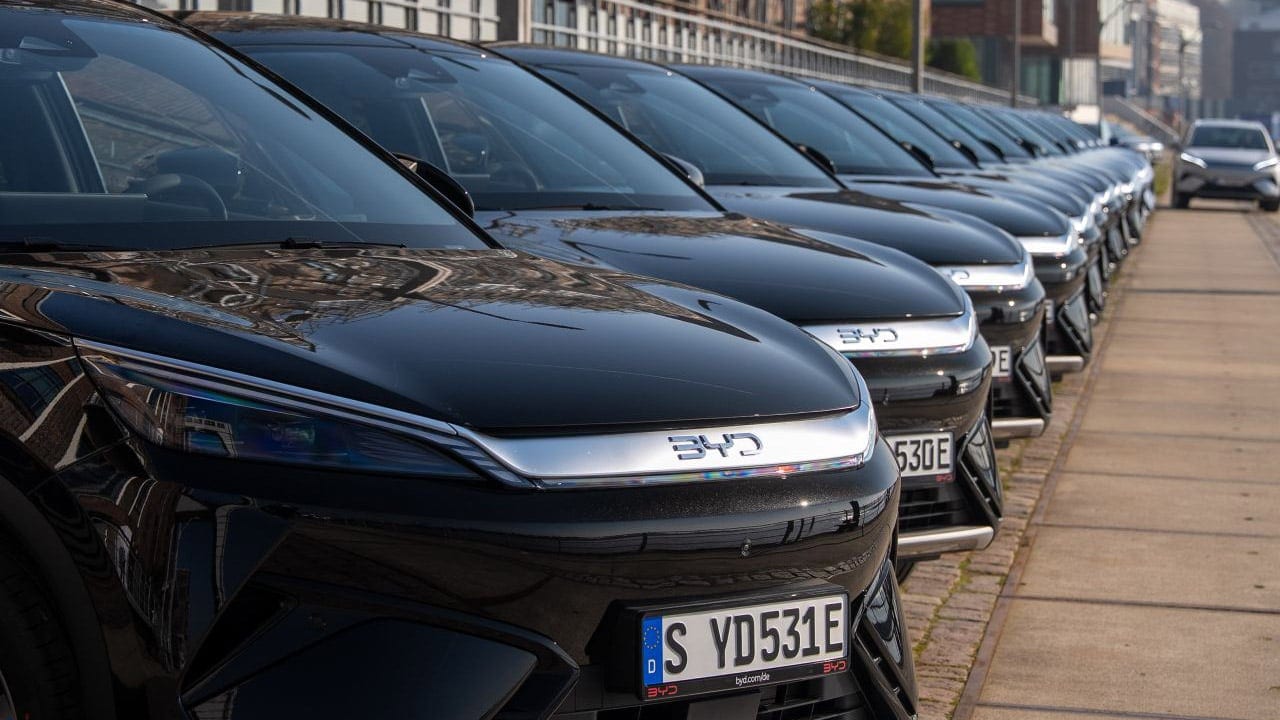

BYD aims to sell more than 2.5 million vehicles overseas in 2027, Deutsche Bank analysts said in a research note first cited by CnEVPost on Monday.
The target was disclosed by BYD’s management on a post-earnings call, according to the team led by analyst Wang Bin.
The Shenzhen-based automaker also raised this year’s overseas sales guidance to 1.9 million–2.0 million vehicles, up from 1.5 million units.
The latest figure sits well above the 1.5 million target set in March and reiterated in May, which itself was already an increase from the 1.3 million set in January.
The pace of revision reflects an export machine that has consistently outrun management’s own projections, a pattern that has accelerated as domestic sales contract.
Export Record
Overseas sales rose 85.7% year over year to 1,162,260 vehicles in the first eight months of 2026.
August alone accounted for a record 189,466 units — more than doubling from a year ago and representing the fifth consecutive monthly record.
Exports took 43% of the group’s total new energy vehicle volume in August, well above the 25% rate management had flagged at the beginning of the year.
Overseas share has exceeded 40% in each of the past five months.
Meeting the new full-year guidance of 1.9 million–2.0 million requires BYD to average about 184,000–209,000 overseas sales per month across September through December. August’s 189,466 already sits within that range.
Domestic passenger sales worked in the opposite direction, however.
BYD delivered 1,505,755 vehicles inside China through August, down 32.7% year on year. Total group sales fell 6.8% to 2,668,015 units.
Last year, BYD has established a long-term target of having half of total sales come from outside China by 2030. At the current pace, the company is tracking ahead of that trajectory.
Shipping and Manufacturing
According to Deutsche Bank, BYD management told investors that shipping capacity constrained overseas sales this year and that volumes could have been higher.
BYD plans to support the 2027 target with a larger dedicated vehicle carrier fleet, market-share gains and increased local production abroad.
The company’s Indonesian plant has started production, while its Brazilian plant is ramping toward annual capacity of 300,000 vehicles.
BYD’s Hungarian plant — the company’s first European passenger vehicle factory — is expected to begin assembly in November or December, Deutsche Bank noted.
Management is evaluating additional overseas manufacturing locations, including others in Europe, where it is negotiating with local automakers — including Stellantis — to take over underutilized and idle manufacturing capacity.
Local production reduces the shipping bottleneck while lowering exposure to import tariffs.
BYD faces a combined 27.0% duty on Chinese-built battery electric vehicles entering the European Union — a 17% countervailing rate on top of the standard 10% — and remains locked out of the United States, where duties on Chinese-built EVs sit at over 100%.
Profitability Abroad
Overseas expansion is also supporting margins.
Management said profit per vehicle sold abroad ran at about 20,000 yuan ($3,000) in the first half, a figure the company expects to hold broadly stable in the near term.
Gains from higher volumes will be offset by continued investment in sales networks and the ramp-up of new factories.
First-half overseas revenue of 181.3 billion yuan ($27.0 billion) against domestic revenue of 163.2 billion yuan ($24.3 billion) placed more than half of BYD’s turnover outside China for the first time.
The company reported its first quarterly profit increase in more than a year in the second quarter, though the rebound still missed analyst consensus by 12%.
Net profit fell 20.5% for the first half to 12.33 billion yuan on revenue down 7.1%.
Flash Charging
In China, BYD is counting on flash charging technology and its supporting network to drive sales.
Management said the order backlog for flash charging-compatible vehicles stood at about 250,000 units.
Supply shortages of the second-generation Blade Battery are expected to be fully resolved in the first quarter of 2027.
BYD reiterated a target of building 20,000 flash charging stations in China by the end of 2026, followed by 30,000 additions in 2027 and 40,000 in 2028, bringing the total to 90,000.
BYD also plans 6,000 stations overseas.
Li Yunfei, BYD’s General Manager of Branding and Public Relations, said in July those would include 3,000 in Europe, 2,000 in the Americas and 1,000 in Asia-Pacific, with completion expected by March 2027.
Management said domestic market share had increased in successive months and outlined a target of about 25% of the Chinese market, without specifying a timeline.