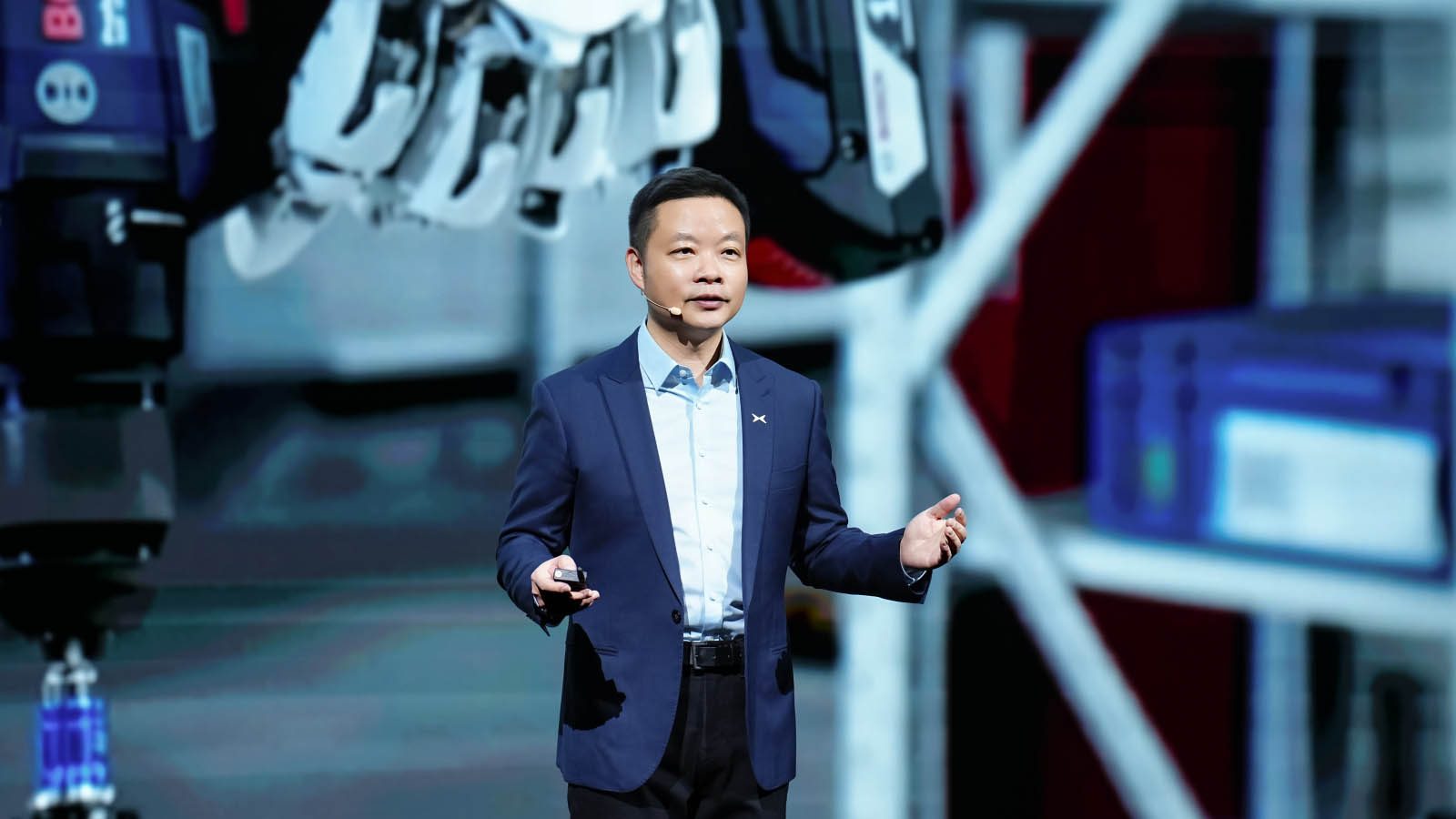

XPeng‘s founder and CEO He Xiaopeng said on Friday that he now believes an early form of fully autonomous driving could appear by the end of the decade — a timeline he once considered impossible within his own lifetime.
Speaking at the 2026 Xuanyuan Automotive Bluebook Forum in Guangzhou, He said the probability of achieving Level 4 autonomous driving software capabilities by 2028 is “extremely high,” and that an initial prototype of Level 5 autonomy could emerge around 2030.
The remarks represent a notable shift in He Xiaopeng’s outlook.
XPeng‘s CEO admitted that he previously believed L5 autonomy would not be achievable in his lifetime, noting that rapid progress in artificial intelligence has dramatically altered that view.
“The core competitive factors in the automotive industry are undergoing a fundamental transformation,” He said at the forum, adding that AI and data capabilities are becoming the decisive competitive advantages in the sector.
Level-4 and Level-5
The distinction between Level 4 and Level 5 autonomous driving is defined by a framework developed by SAE International in collaboration with the International Organization for Standardization (ISO) — which classifies driving automation into six levels, from Level 0 (no automation) to Level 5 (full automation).
The standard has been adopted by the US Department of Transportation and is used globally by automakers, regulators, and insurers as the common reference point for discussions around vehicle autonomy.
Under the framework, the first three levels — L0, L1, and L2 — are classified as “Driver Support Systems,” which indicate the human driver remains responsible for the driving task at all times.
Levels 3 through 5 are classified as “Automated Driving Systems” — where the vehicle itself takes on the primary driving role under certain or all conditions.
Level 4, classified as “high automation,” refers to a system capable of performing all driving tasks without human intervention within a defined operational domain — which can be limited by geography, road type, speed, or weather conditions.
If the system encounters a situation it cannot handle, it must be able to bring the vehicle to a safe stop on its own — the driver is not required as a fallback.
Waymo‘s driverless robotaxis, which operate within geofenced areas of cities like Phoenix and San Francisco, are a widely cited example of Level 4 deployment in the real world.
Level 5, classified as “full automation,” removes those geographic and conditional constraints entirely.
A Level 5 vehicle would be capable of operating anywhere a human driver could, under all road and environmental conditions, with no steering wheel, pedals, or any requirement for human intervention at any point.
No commercially available vehicle has reached Level 5 to date, with the technology remaining largely theoretical.
AI as the Catalyst
He Xiaopeng attributed his newfound optimism to a deeper understanding of how AI development compounds at scale.
The executive revealed it was only last year that he fully grasped the “flywheel effect” created by using data as fuel for autonomous driving development.
After restructuring XPeng‘s AI research and development framework, He said the evolution speed of the company’s autonomous driving technology improved roughly sixfold.
The breakthrough, he explained, has significantly compressed internal timelines for deploying advanced self-driving capabilities.
His comments align with XPeng’s broader strategic pivot toward AI.
Earlier this year, the company reported that it invested 9.5 billion yuan ($1.4 billion) in R&D throughout 2025, of which 4.5 billion yuan ($652 million) was allocated specifically to AI.
XPeng plans to increase that figure to 7 billion yuan in AI-related R&D spending in 2026.
“Pushing the boundaries of physical AI is very exciting for my team and me,” the CEO said during the company’s fourth-quarter earnings call in March. “We’re more committed than ever to intensifying our R&D investments.”
The company has also been scaling its second-generation VLA autonomous driving system, expanding the on-vehicle model from 10 billion to 20 billion parameters and targeting a 5 to 10x improvement in safety disengagement mileage.
Management said at the time that VLA 2.0 would receive at least one major over-the-air update per quarter, with coverage expanding beyond highways and city roads to include smaller roads, parking lots, and campus environments.
Robotaxi and International Ambitions
The autonomous driving timeline also feeds into XPeng‘s robotaxi ambitions.
The company announced plans last November to launch three robotaxi models in 2026 — a 5-seater, a 6-seater, and a 7-seater — powered by a vision-only solution and four in-house Turing AI chips delivering up to 3,000 TOPS of compute power.
Manned pilot operations with safety drivers are set to begin in the second half of this year, with fully driverless operation targeted for early 2027.
Separately, Volkswagen Group has agreed to adopt XPeng’s VLA 2.0 autonomous driving solution, expanding the two companies’ collaboration beyond software co-development for VW’s China lineup.
XPeng is also preparing to begin gradual beta testing and deployment of VLA 2.0 across overseas markets by the end of this year into early 2027.
He Xiaopeng said initial international tests had been encouraging, even without local road data.
From Electrification to Intelligence
He also used the forum to explain the reasoning behind the company’s recent renaming from XPeng Motors to XPeng Group.
The Chief Executive said the decision reflects a reassessment of the company’s business boundaries over the next decade, as automobiles and robotics move toward deeper integration.
A group-based structure better reflects the company’s increasingly diversified business layout, he argued.
He described modern electric vehicles as evolving from traditional physical products into hybrid entities that combine both the “physical world and digital world” — a shift that he said directly drove changes to XPeng‘s internal organizational structure.
More broadly, He emphasized that the auto industry is moving beyond simple electrification into a stage defined by intelligence and robotics, fundamentally reshaping the future competitive landscape.
The 18th Xuanyuan Automotive Bluebook Forum, under the theme “Inflection,” is being held in Guangzhou from May 15 to 17.