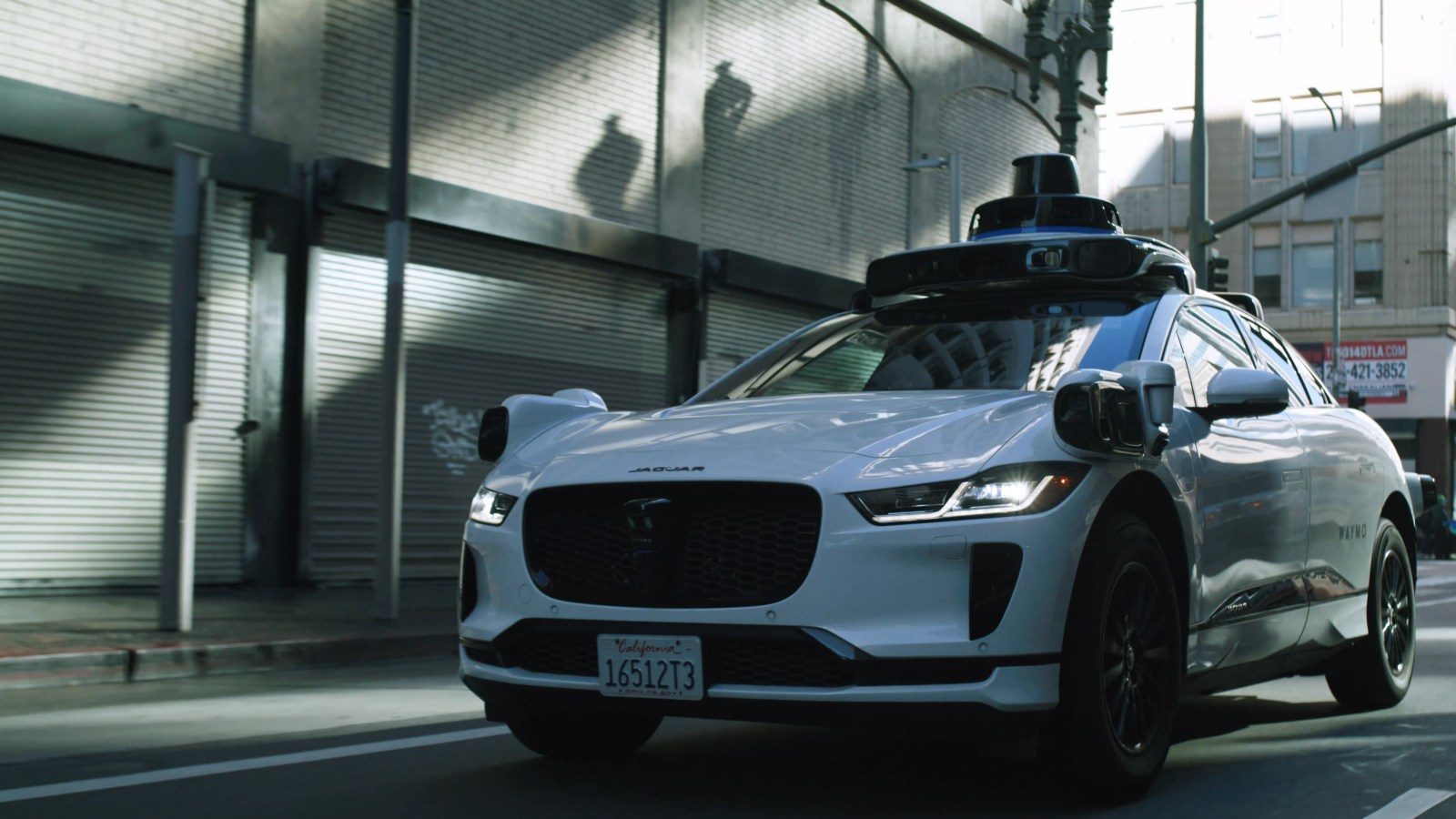

A dashboard reading from a Waymo Jaguar I-Pace, posted on X on Monday, showed the robotaxi using more than six times the energy per mile of Tesla‘s purpose-built Cybercab.
X user Grayson Brulte posted a photograph from the cabin of a Waymo I-Pace showing an energy-consumption reading of 104.4 kWh/100 miles.
The figure comes from a single vehicle’s trip computer and represents one of the highest readings observed to date in a Jaguar vehicle with 111,917 miles on the odometer.
While not necessarily representative of Waymo’s fleet average, it illustrates the upper end of consumption possible under real-world robotaxi conditions.
Waymo currently uses Jaguar I-Pace electric vehicles to provide its fully autonomous ride-hailing services across more than 10 major cities in the US.
The Alphabet-backed company has only now began to introduce the purpose-built, autonomy-ready Ojai robotaxis in the service.
Jaguar‘s I-Pace model carries an EPA-rated consumption of roughly 44 kWh/100 miles.
Retrofitted with the autonomy stack needed to perform the robotaxi service, the consumption is estimated to go up by at least 10 kWh.
The reading on this particular Waymo vehicle, however, sits more than twice that baseline — and roughly 6.3 times higher than the Cybercab’s EPA-certified 16.5 kWh/100 miles, the most efficient figure ever recorded for a production electric vehicle.
Previous estimates had placed typical real-world consumption for Waymo-modified I-Paces in the 50–60 kWh per 100 miles range.
The 104.4 kWh reading therefore appears to be an outlier, likely influenced by factors such as high ambient temperatures, heavy air conditioning use, short urban trips, and vehicle age.
Purpose-Built vs. Retrofitted
The gap is rooted in a fundamental design-philosophy split.
Tesla‘s Cybercab is a clean-sheet, two-seat robotaxi with no steering wheel, no pedals, and no driver controls.
Every element — body shape, powertrain, weight, and sensor architecture — was optimized from the outset for autonomous fleet duty.
Waymo‘s Jaguar I-Pace fleet, by contrast, consists of a mid-size luxury SUV originally engineered for private ownership and later fitted with Waymo‘s fifth-generation sensor suite: 29 cameras, five LiDAR units, multiple radars, server-grade processors, and dedicated cooling hardware.
Tesla‘s VP of Vehicle Engineering Lars Moravy confirmed the Cybercab’s efficiency rating in May, calling it “the most efficient EV that has ever been certified and built.”
By then, the executive noted that 165 Wh/mile represents roughly half the consumption rate of the original Model S — a model discontinued later in the first quarter.
The EPA Certificate of Conformity, filed under test group TTSLV00.0L1A and dated May 26, confirmed the rating alongside the vehicle’s core specifications.
Weight Differences
The Cybercab tips the scales at 3,113 pounds, making it one of the lightest EVs on the US market — roughly 700 pounds lighter than the lightest Model 3 configuration.
A Jaguar I-Pace weighs approximately 4,718 pounds before any autonomy hardware is added.
Waymo‘s sensor suite, compute modules, roof-mounted LiDAR array, cabling, and structural reinforcements push that figure closer to 5,000 pounds, though Waymo has not disclosed an exact curb weight for its modified vehicles.
The Cybercab achieves its low mass through a minimalist two-seat cabin, a compact ~47.6 kWh battery pack — roughly half the I-Pace’s 90 kWh unit — and the absence of driver controls.
A single front-mounted 163 kW permanent-magnet motor drives the front wheels, a layout that prioritizes efficiency over performance.
The gross vehicle weight rating stands at 3,730 pounds, leaving about 617 pounds of payload capacity.
The I-Pace, meanwhile, runs a dual-motor all-wheel-drive system producing 394 hp and carries a battery pack nearly twice the size of the Cybercab’s.
Those components served a luxury SUV designed for spirited driving, not the low-speed urban routes that define robotaxi duty cycles.
Autonomy’s Energy Toll
Beyond weight, Waymo‘s sensor suite draws continuous power that further erodes range and efficiency.
Sam Abuelsamid, principal analyst at Guidehouse Insights, has estimated that total system power consumption for most autonomous vehicles runs between 1.5 and 3 kW, encompassing sensors, onboard computers, and their cooling systems.
Andrew Farah, formerly GM’s chief technology architect for autonomous systems, previously put the draw on Cruise robotaxis at 3 to 4 kW.
For a vehicle running short urban trips with frequent stops and starts, a fixed parasitic load of that magnitude becomes a dominant factor in per-mile consumption.
Autonomous hardware can reduce an EV’s effective range by around 25% — figures cited by industry analysts and even Ford CEO Jim Farley in a 2021 interview.
The effect is amplified in stop-and-go traffic where the vehicle covers fewer miles per hour of operation while the sensor stack runs continuously.
The 104.4 kWh/100-mile figure captured on Brulte’s photograph likely represents a trip-computer average rather than a controlled test result, and several variables could push the reading higher than a fleet-wide norm.
Climate control in warm-weather markets, short-trip cycles where fixed loads dominate over distance traveled, and individual vehicle condition all play a role.
The Cybercab aims to sidestep much of that penalty.
Tesla‘s vision-only autonomy system relies on cameras and a proprietary inference computer, avoiding the weight, aerodynamic drag, and power draw of roof-mounted LiDAR arrays and multiple radar units.
Waymo’s Shift With Ojai
Waymo has acknowledged the limitations of retrofitting consumer vehicles.
Last May, the company began offering rides in its purpose-built Ojai robotaxi to select riders in San Francisco, Phoenix, and Los Angeles.
The Ojai is built by Zeekr in Ningbo, China, and shipped to Waymo‘s Mesa, Arizona facility for installation of its sixth-generation autonomous hardware.
The van-style vehicle features a 93 kWh LFP battery, an 800-volt architecture, and a rear-mounted 268 hp motor — specifications designed for rapid charging cycles and sustained fleet duty.
The sixth-generation Waymo Driver cuts sensor count by 42% relative to the fifth-generation system used on the I-Pace, reducing cameras from 29 to 13, LiDAR units from five to four, and trimming radar units.
Waymo has said the hardware cost target is under $20,000 per unit, compared with an estimated $75,000-plus for the previous generation.
All-in vehicle cost for a completed Ojai robotaxi is estimated at $50,000 to $55,000, roughly a third of the approximately $150,000 to $200,000 each fully equipped I-Pace cost.
Waymo plans to keep roughly 1,000 I-Pace robotaxis in service alongside the Ojai rollout, but the direction is clear: the I-Pace era, and the efficiency penalties that came with it, is winding down.
Fleet Economics at Scale
Energy cost is one of the largest variable expenses for a robotaxi fleet running nearly continuously.
ARK Invest’s Big Ideas 2026 report estimated that a Waymo vehicle will cost about $0.40 per mile in 2030, while the Tesla Cybercab could reach roughly $0.20 per mile at production scale.
Tesla CEO Elon Musk has called that estimate “probably true.”
The Cybercab’s smaller battery also carries a recharging advantage.
At 53.365 kWh from the wall — including roughly 12% charging losses — the vehicle can return to full charge far faster than a 90 kWh I-Pace, enabling higher daily utilization.
Tesla has received FCC approval for the Cybercab’s wireless inductive charging system, which would allow fleet vehicles to recharge at designated pads without human intervention.
Production of the Cybercab began at Giga Texas in February, and the company recently began engineering tests of production units on public roads in Austin without steering wheels or pedals.
Musk has targeted volume production rates of one Cybercab every ten seconds at full capacity, with an eventual target price below $30,000 per unit.
The efficiency data visible on a single Waymo dashboard captures in miniature the cost challenge that robotaxi operators face at fleet scale.
For every mile a retrofitted I-Pace covers, the Cybercab covers the same distance on a fraction of the energy — an advantage that grows significantly when multiplied across thousands of vehicles operating 24/7.