Tesla‘s robotaxi network could match Waymo‘s U.S. autonomous mileage in the second half of 2027 with an active fleet of about 18,000 vehicles, JPMorgan said on Monday, as it kept its ‘Neutral’ rating and $430 price target on the stock.
Analyst Rajat Gupta said the “rapid ramp” of Tesla’s robotaxi fleet and ride-hailing service, including the weekend launch of Cybercab sales to customers, “is starting to present early validation” of what he called Tesla’s “unique advantage in physical AI.”
He pointed to Tesla’s “deep vertical integration across software, manufacturing, and compute.”
The $430 target implies 10.2% upside from Friday’s close of $390.22.
Closing In on Waymo in Texas
Tesla had about 1,306 registered robotaxi vehicles in Texas as of November 14, against 1,321 for Waymo, the Alphabet unit, by JPMorgan’s count.
The Texas Department of Motor Vehicles listed 1,303 vehicles under Tesla Robotaxi LLC’s automated vehicle authorization on Saturday. Of those, 573 were Cybercabs and 730 were Model Ys, up from 544 and 507 in late October.
Cumulative unsupervised mileage had reached about 5.3 million miles as of Monday morning, the bank estimated. That compares with about 1.4 million at the end of the third quarter and about 0.4 million at the end of the second.
Mileage has compounded at about 15% a week since mid-October, with a recent pace of about 635,000 miles a week, according to the note.
Austin has emerged as “the clearest proof point,” Gupta wrote. JPMorgan estimates Tesla accounts for about half of the combined autonomous miles driven there, with a service area of about 440 square miles against Waymo’s roughly 150.
Tesla reached that position despite launching unsupervised service about 10 months after Waymo, the bank said.
Tesla expanded its Austin service area by 171 square miles to 443 on November 9, according to Tesla shareholder Sawyer Merritt.
From Registrations to Rides
Closing the national mileage gap now depends mainly on putting registered vehicles into service, JPMorgan said.
It estimates about 700 Tesla robotaxis are active nationally, against about 1,400 seen in the fleet to date by the tracking site robotaxitracker.com.
Gupta wrote in August that Tesla had told JPMorgan it was deliberately holding back Model Y units from its robotaxi fleet as it prepared to scale the Cybercab.
Keeping utilization up as service areas widen, and winning regulatory access to larger coastal markets, are the other two tests, the bank said.
Tesla’s current access in Texas, Florida, Arizona and Nevada covers about 20% of the U.S. population, which JPMorgan said “provides ample demand capacity for the initial ramp.” Approvals in California and the Northeast become more relevant into 2028, according to the note.
Fleet productivity, service reliability and customer adoption will determine “whether TSLA can sustain the early Austin trajectory across less dense geographies,” Gupta wrote.
Tesla’s Robotaxi service now runs around the clock in eight U.S. cities, five in Texas and three in Florida, the company said last week. It added San Antonio on November 9 and Fort Worth on November 2.
Earnings Contribution
JPMorgan expects robotaxis to add little to earnings during the initial build-out.
A fleet of 5,000 vehicles, which the bank expects Tesla to reach by the end of the first half of 2027, would represent less than 1% of its 2027 revenue estimate and less than 2% of operating profit, excluding spending on launches in other markets.
Revenue should inflect into 2028 as the fleet grows and utilization and unit economics move toward long-term targets, Gupta wrote.
Over the longer term, lower autonomous fares could lead people to travel more miles, rather than just replacing ride-hailing trips, he said. That would widen Tesla’s revenue sources across its own fleet, owners’ cars, personal autonomous vehicles and its Full Self-Driving software.
Cybercab Sales Open
Tesla started taking orders for the Cybercab for personal use on Friday evening, pricing the two-seat robotaxi at $29,990 plus a mandatory $299 monthly subscription. Chief Executive Officer Elon Musk said hours later that the fee was “too high.” It should be “more like ~$115/month,” in line with Tesla’s Full Self-Driving and connectivity charges, he wrote.
The order page shows estimated delivery in December 2026, and buyers must take delivery in one of five Texas cities. The car works only inside Tesla’s service areas.
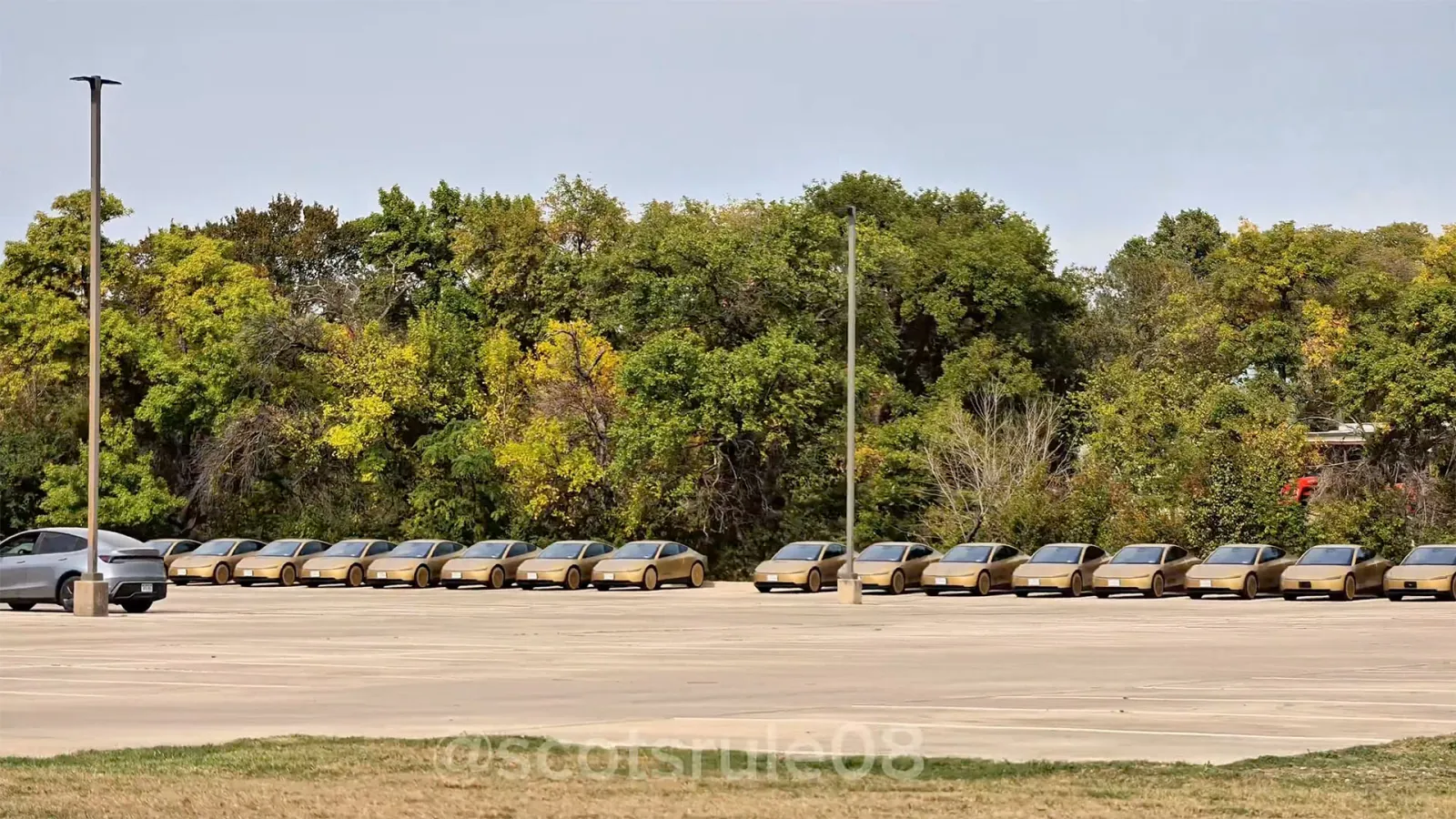
On Saturday, dozens of Cybercabs were filmed parked in Dallas, where Tesla has not yet announced Cybercab rides.
SpaceX Talk Keeps Shares Volatile
JPMorgan said talk of a merger with SpaceX, and the use of SpaceX’s shares as acquisition currency, are likely to keep Tesla’s stock volatile.
Musk said on October 20 that Tesla and SpaceX had each formed a special committee of independent directors to discuss combining the companies. “The special committees have not reached agreement on the terms of any transaction,” he said.
Even so, Gupta called robotaxi progress “a key fundamental support” for the stock. About 40% of Tesla’s value in JPMorgan’s sum-of-the-parts model for 2035 depends on its ability to grow in that market, the note said.
Third-Quarter Results
Tesla’s third-quarter operating income fell 56% to $718 million as research and development spending rose 69% to $2.76 billion. Revenue was flat at $28.05 billion.
Adjusted earnings were $0.48 a share. Deliveries fell 2% from a year earlier to 486,532 vehicles.
Tesla shares were down 0.87% at $386.81 in premarket trading as of publication time. The stock closed at $390.22 on Friday, down 13.2% this year from $449.72 at the end of 2025.
It has risen 30.8% from its 2026 closing low of $298.32 on July 29. It gained 8.9% last week after a 10.8% fall on November 5.
From ‘Underweight’ to ‘Neutral’
Price Target, a sister publication of EV, archives Wall Street analysts’ research on the electric vehicle, artificial intelligence and semiconductor sectors.
Gupta’s ‘Neutral’ rating replaced a long-running ‘Underweight’ call at JPMorgan. Ryan Brinkman, who previously covered the stock for the bank, reiterated ‘Underweight’ and a $145 target on April 6, warning that he continued to see “large -60% downside.”
Gupta assumed coverage of Tesla on May 11 with an ‘Underweight’ rating and a $145 target, then upgraded the stock to ‘Neutral’ on June 5, lifting his December 2027 target to $475.
“TSLA is at the forefront of physical AI, entering uncharted TAMs, and their ability to execute will be key to accelerating adoption,” he wrote at the time.
He kept the target on July 6, then cut it to $445 on July 23 and to $415 on September 28. He held $415 on October 16, after the unveiling of the second-generation Roadster, before raising it to $430 on October 22.
Gupta called the third-quarter results positive overall, citing a better-than-expected automotive gross margin, and tied the higher target partly to a greater probability of a SpaceX merger, dpa-AFX reported at the time.
Other firms have turned more positive since Tesla’s third-quarter results.
Barclays upgraded Tesla to ‘Overweight’ with a $450 target on October 26, the same day Cantor Fitzgerald kept ‘Overweight’ and $485, and BNP Paribas upgraded the stock to ‘Neutral’ on October 22.
Separately, JPMorgan Chase cut its own Tesla holding by 21.1% in the third quarter to 33,111,574 shares, the smallest since September 2024, according to its latest 13F filing.
Most of the reduction came from J.P. Morgan Investment Management, the asset-management arm, whose holding fell to 20,997,567 shares from 28,457,705 at the end of June.