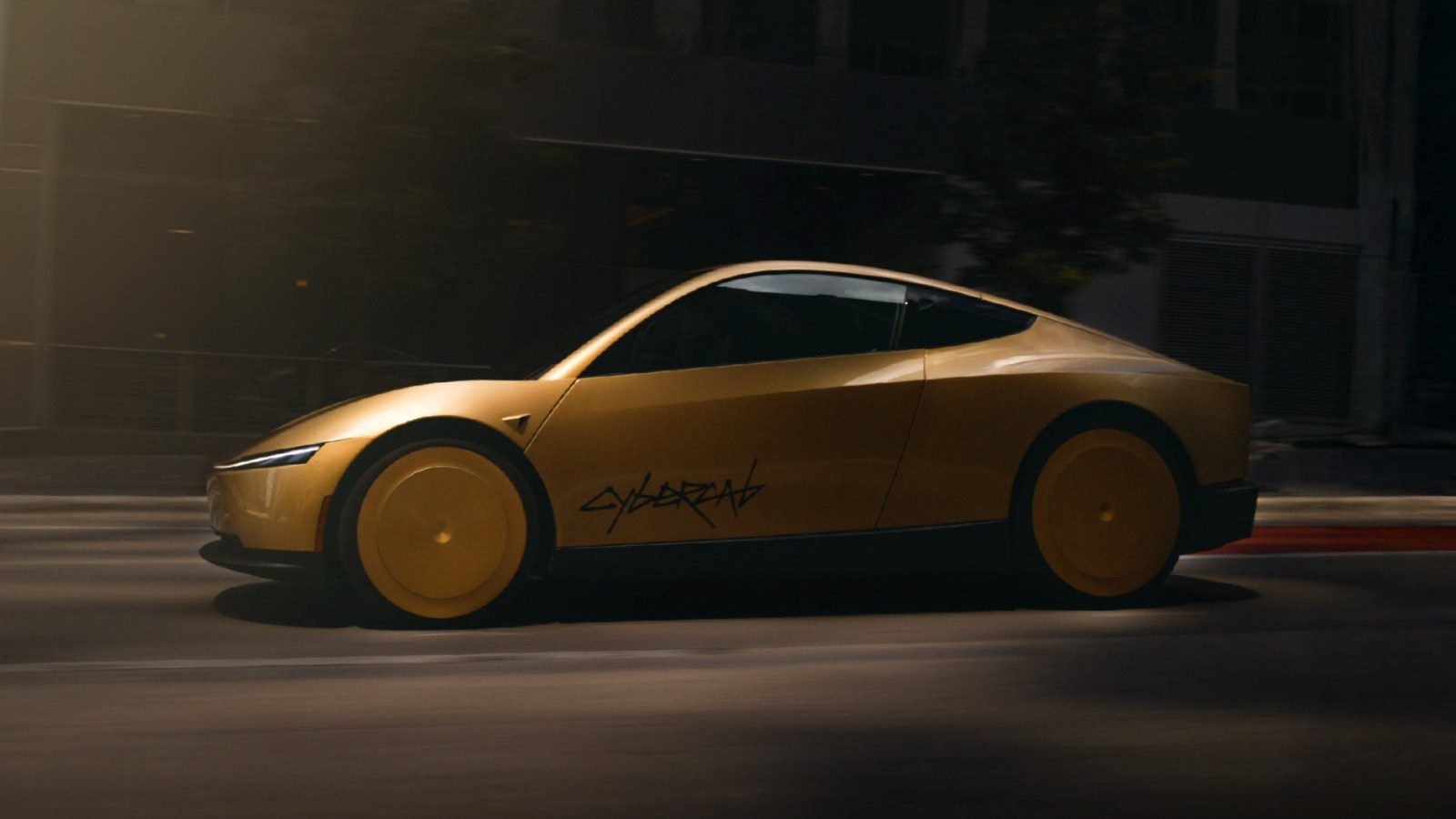

Tesla‘s production Cybercab is running a more capable Full Self-Driving computer than the consumer vehicles, NotaTeslaApp reported on Thursday, citing “a very reliable source.”
According to the source, its computer holds more memory than the Hardware 4 setup, marketed as AI4, in those cars.
The report did not say how much more, and Tesla has not detailed the computer.
A standard AI4 unit pairs two chips with 16GB of memory each, for 32GB — a ceiling the Cybercab clears.
Why the memory matters
The 32GB limit has become a constraint.
Tesla‘s driving models have grown larger as it works toward full autonomy, and bigger neural networks need more memory to run; the company’s engineers have reportedly reached the ceiling on consumer hardware.
Tesla flagged the fix earlier this year. On its first-quarter 2026 earnings call it announced AI4+, a computer that roughly doubles the package to about 64GB.
Fitting the robotaxi with that grade of hardware before the wider fleet would give the driverless cars years of headroom for models still to come.
Which chip
NotaTeslaApp did not identify the silicon and set out three possibilities.
The Cybercabs could carry a pre-production AI4+ computer, pair two current-generation AI4 boards in one configuration, or — least likely — run an early build of the AI5 chip, which is not due for mass production until 2027 as the report noted.
Hardware ahead of the software
Tesla has not confirmed the computer, and no specific FSD software version has been publicly tied to the Cybercab.
The Robotaxi service still runs FSD v14.3-generation software on modified Model Y cars, and Tesla has framed its next architecture as a separate milestone yet to arrive. The hardware, for now, is ahead of the software meant to use it — and the car’s main hurdle remains a driving stack ready for unsupervised use, plus the approvals to run it.
A cabin with no controls
The extra memory matches how the car is built to operate. Tesla‘s first-responder documentation classifies the Cybercab as an SAE Level 4 vehicle, able to handle the entire driving task with no one aboard inside its defined operating area.
The production design drops the steering wheel and pedals altogether; a Cybercab fitted with them, the same guide notes, is an engineering or test vehicle rather than the intended product.
The document also details the car’s safety package: at least ten airbags, an active hood that lifts during certain pedestrian impacts, and exterior microphones and speakers on the B-pillars that let emergency crews speak with remote Robotaxi Support staff.
Tesla began road-testing those control-free units on public roads in Austin last week, with a safety monitor aboard the engineering vehicles.
From reveal to ramp
Tesla unveiled the Cybercab on 10 October 2024 at its “We, Robot” event on a Warner Bros. lot in Burbank, California, where prototypes without controls gave short rides to attendees.
The first production unit left the line at Gigafactory Texas on 17 February 2026, roughly six weeks ahead of the timeline the company had reaffirmed. Volume output followed in April as Tesla moved the line to steering-wheel-free builds.
Musk has cautioned that the early ramp would be slow, telling investors on the first-quarter call that initial Cybercab and Semi output would be “very slow” before climbing later in the year. He has likened the process to consumer electronics, repeating a target of one unit every ten seconds at full capacity and an eventual rate near two million a year across multiple plants.
Drone operator Joe Tegtmeyer, who photographs the site, reported this week that the outbound lot had thinned to roughly 50 to 60 units as cars were hauled away, while vehicles wearing “Cybercab” logos ran autonomously on a dedicated test track. Older wrapped engineering cars, he added, had gathered on a temporary lot and may be headed for scrapping.
What regulators have revealed
Much of what is known about the car has surfaced through filings rather than the company. An EPA certificate showed a roughly 48-kilowatt-hour battery, a single front motor rated at 163 kilowatts, or 219 horsepower, a 3,113-pound curb weight and an unadjusted range of 418 miles, with an introduction-into-commerce date of 29 May.
Front-wheel drive marks a departure for Tesla, whose other models use rear- or all-wheel-drive layouts, in a choice that favours cost and efficiency over performance. Vice-president Lars Moravy has described the vehicle’s certified 165 watt-hours per mile as the most efficient of any production EV.
The certificate clears the Cybercab for sale on emissions grounds but grants no approval for autonomous operation, which remains the program’s central obstacle.
This week the Texas Department of Public Safety added “Tesla Cybercab Robotaxi” to its Connected Autonomous Vehicles first-responder page, alongside Nuro, Waymo, Zoox, May Mobility, Aurora and Avride.
The network it is meant to scale
The service the Cybercab is built to expand began in Austin in June 2025 with safety monitors, then started folding in unsupervised cars early this year.
Tesla reached Dallas and Houston in April and widened the driverless zone to the whole Austin metro in early June.
Coverage has at times outrun the fleet, with independent trackers estimating only around 20 cars across the expanded Austin area even as the map grew. The first push beyond Austin opened with a single vehicle in each new city before the count rose.
The service still runs entirely on Model Y cars, which the Cybercab is meant to replace as the fleet’s highest-volume vehicle.
Tesla has guided to robotaxi operations in roughly a dozen US states by the end of 2026, naming Phoenix, Miami, Orlando, Tampa and Las Vegas among the first-half markets.
Regulatory path
Tesla has taken a route that differs from rivals running purpose-built autonomous vehicles. Moravy has said the Cybercab is not subject to the National Highway Traffic Safety Administration’s 2,500-vehicle annual exemption cap because the company self-certified the model against existing federal safety standards.
Texas amended its law on 28 May to let companies self-certify autonomous systems as SAE Level 4 or higher for commercial driverless transport, and NHTSA moved in late June to propose dropping the federal requirement for manual brake pedals in fully autonomous vehicles.
Each change eases the path for a car with no manual controls, though a federal investigation into Tesla‘s camera-only approach in low-visibility conditions remains open.
Musk has also pledged a consumer version priced below $30,000 before 2027.
The end-of-2026 target for a dozen states is the deadline against which the more powerful computer will be measured — provided the software, and the regulators, are ready to meet it.