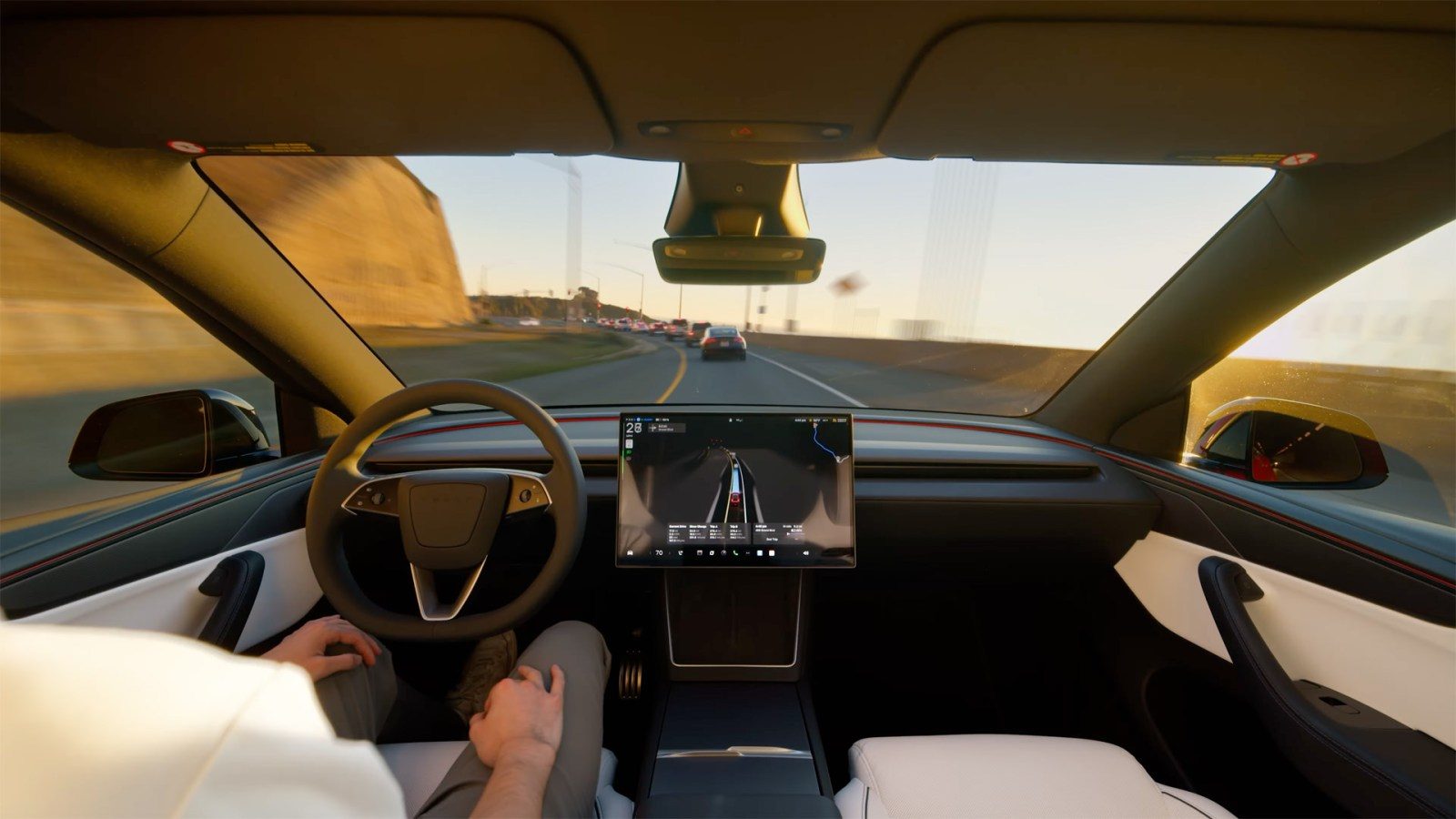

Tesla‘s Full Self-Driving (Supervised) fleet crossed 10 billion cumulative miles on Sunday, matching the data threshold chief executive officer Elon Musk had set in January as the volume needed for safe unsupervised self-driving.
The company announced the milestone in a post on X. “Over 10 billion miles driven on FSD Supervised,” Tesla wrote.
The latest safety report puts the total at 10,010,684,206 miles, with 3,761,203,620 of those accumulated on city streets.
The fleet is now adding approximately 28.8 million miles per day to the dataset.
Acceleration Pattern
The pace of accumulation has compressed sharply with each successive billion-mile increment.
Tesla crossed 7 billion cumulative miles on December 27, 2025, then surpassed 8 billion on February 18, 2026 — a 53-day gap.
The fleet then hit 9 billion on April 2, 2026, an interval of 43 days.
The most recent billion miles, taking the total from 9 billion to 10 billion, were added in just 31 days.
The implied daily run rate has accelerated from approximately 18.9 million miles per day during the 7-to-8 billion phase to 32.3 million miles per day during the 9-to-10 billion phase — a 71% acceleration over four months.
The fleet logged its first billion miles of 2026 in just the first 50 days of the year, and is now on track to add 11 to 12 billion additional miles in 2026 alone at the current daily run rate.
Annual Growth Trajectory
Annual FSD (Supervised) miles have compounded steadily since the system reached widespread deployment.
The fleet logged approximately 6 million miles in 2021, rising to 80 million in 2022, 670 million in 2023, 2.25 billion in 2024, and 4.25 billion in 2025, according to data shared by Tesla and tracked by industry analysts.
The 2026 trajectory implies a year that could exceed the cumulative output of all prior years combined.
Musk’s Goalpost
The 10 billion mile milestone matches the threshold Musk publicly cited on January 8, 2026 as the data volume needed for safe unsupervised self-driving.
“Roughly 10 billion miles of training data is needed to achieve safe unsupervised self-driving,” Musk wrote on X in January. “Reality has a super long tail of complexity.”
The figure represented a revision from prior commitments.
Tesla‘s Master Plan had identified roughly 6 billion miles as the data volume needed for full autonomy.
Musk’s January post raised the bar to 10 billion miles after Tesla failed to deliver unsupervised FSD by the end of 2025 — a deadline he had previously committed to publicly.
Q4 2026 Pushback
The 10 billion mile milestone hit on Sunday does not appear to have changed Musk’s near-term deployment timeline.
On the Q1 2026 earnings call on April 22, the chief executive officer pushed unsupervised FSD for consumer Tesla vehicles to the fourth quarter of 2026 at the earliest, citing residual technical and geographic challenges.
“I think we would release unsupervised gradually to the customer fleet, as we feel like a particular geography is confirmed to be safe,” Musk said on the earnings call.
He pointed to “complex intersections,” “unsafe intersections or bad road markings,” and “weather challenges” as factors slowing the rollout.
When asked whether v14.3 of the FSD software was the final piece needed for unsupervised deployment, Musk initially said yes — then walked the answer back.
“I think it’s not going to make sense for us to deploy unsupervised FSD at large scale when we know that there are major architectural improvements to the software” that would improve safety, the chief executive officer added.
That framing implies any consumer-vehicle unsupervised deployment would wait for a v15 architecture rather than the current v14.3 stack.
On the robotaxi side, Musk said unsupervised FSD or robotaxi revenue “will not be super material this year” but would be “material, probably in a significant way, next year.”
He said he hoped to have unsupervised operations running in “a dozen or so states” by the end of 2026.
Highway-City Mix
The 10,010,684,206-mile total is still skewed toward highway driving, with city miles accounting for 3,761,203,620 — or roughly 37.6% of the dataset.
The remaining 6.25 billion miles were logged on highways and other non-urban roads.
City driving — featuring intersections, cyclists, unpredictable pedestrians, and construction zones — is widely considered the harder problem for autonomous systems.
FSD Subscription Take-Rate
Tesla‘s active FSD subscription base reached 1.28 million by the end of the first quarter of 2026, up from 1.1 million in the fourth quarter of 2025 — a 51% year-over-year increase.
The take-rate now represents approximately 14% of Tesla‘s 9.2 million-vehicle global fleet.
Tesla discontinued the upfront purchase option for FSD in North America in February 2026, moving exclusively to a monthly subscription model priced at $99 per month.
The shift to recurring revenue creates a more predictable monetization path while moving the company toward Musk’s stated long-term goal of 10 million active FSD subscriptions.
Geographic Expansion
The Netherlands approved Tesla’s FSD (Supervised) system in April, marking the first European country to clear the system for use.
Musk said on the Q1 2026 earnings call that Tesla expects to receive full FSD approval in China by the third quarter of 2026.
Geographic expansion adds to the fleet’s mile-accumulation rate, though approvals to date remain limited relative to Tesla‘s global vehicle footprint.
Software Cadence
Tesla‘s FSD v14.3 introduced a rewritten artificial intelligence compiler and runtime using MLIR, delivering what the company described as a 20% faster reaction time.
V14.3.1 was first spotted in Tesla vehicles on April 14.
Musk’s reference to “major architectural improvements” still in the pipeline points to a v15 release that would reset the architecture before consumer-vehicle unsupervised deployment.
A Decade of Moved Targets
The 10 billion mile milestone arrives against a decade-long pattern of revised autonomy timelines.
Musk promised full autonomy by 2018, a million robotaxis by 2020, and unsupervised FSD by June 2025.
He moved the data threshold to 10 billion miles in January 2026 after the 2025 deadline passed without an unsupervised release.