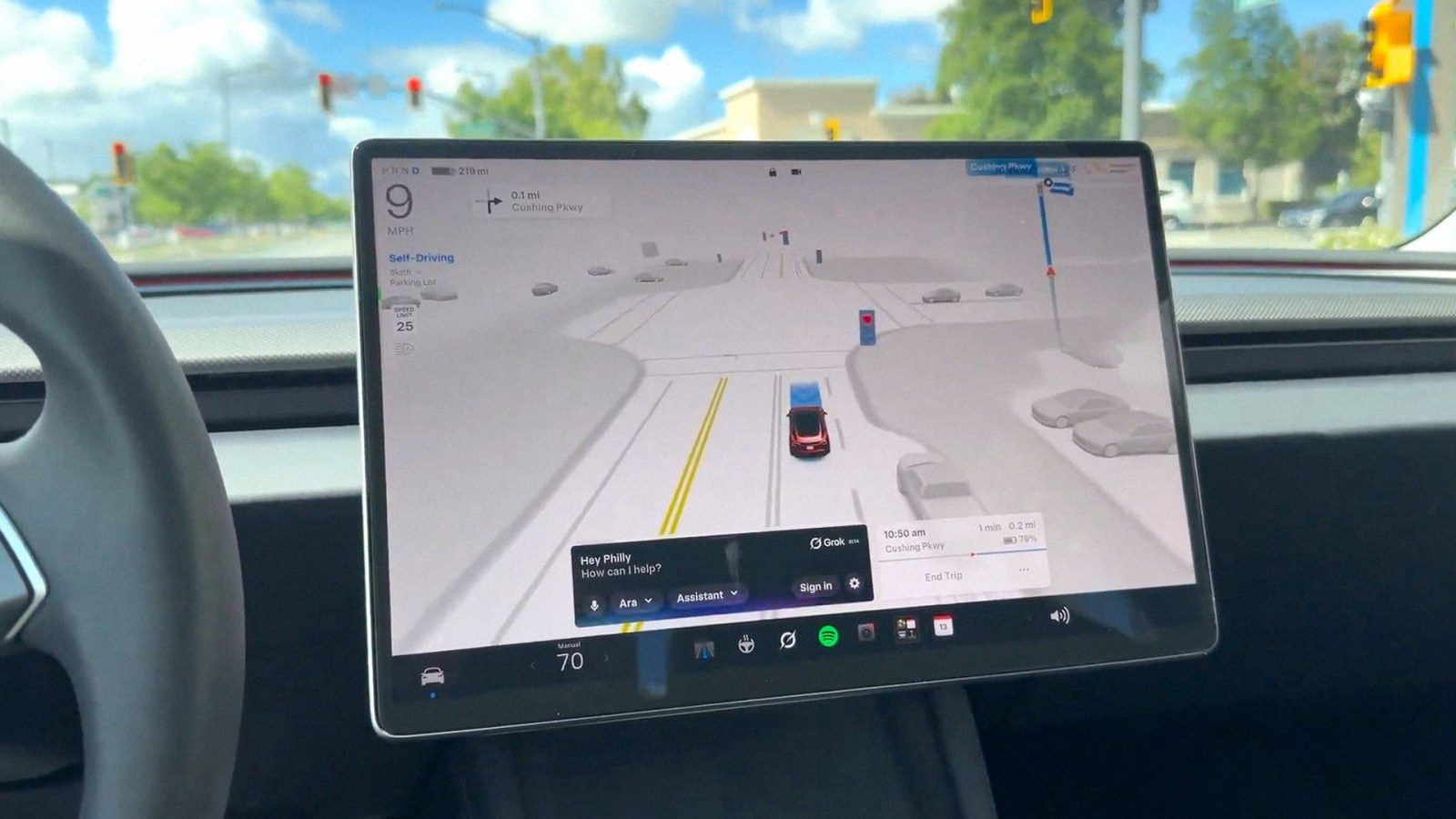

Tesla drivers will be able to give voice commands to the company’s Full Self-Driving (FSD) system through the xAI-developed “AI companion” Grok within about three months.
Additionally, upcoming releases will allow the vehicle to remember the driver’s parking preferences at frequent destinations, CEO Elon Musk said on late Wednesday.
The feature was confirmed in response to a post from X user ‘KHdimples,’ who suggested that Tesla owners should be able to converse with FSD the way a passenger talks to an Uber driver.
The user offered sample commands such as “Hey Grok, turn right here,” “Drop us off right here, we’ll walk due to traffic,” and “Drop at entrance first, then park far away.”
Tesla‘s chief replied that “this functionality will be there in about 3 months or so.”
In February, Musk had already confirmed this type of parking-specific voice control was in development, after responding with “Coming” to a user highlighting FSD’s inability to take verbal parking instructions.
The feature would represent the deepest integration yet between xAI’s conversational AI and Tesla‘s autonomous driving stack.
xAI, the artificial intelligence company founded by Musk in 2023, was acquired by SpaceX earlier this year and now operates as part of a broader AI division within the $2.5 trillion market cap company.
Last week, SpaceX went public in a record IPO, with the surge in its valuation pushing Musk’s net worth above $1 trillion — making him the world’s first trillionaire.
Several media reports and Wall Street analysts have suggested that Tesla could eventually merge with SpaceX next year.
From Navigation Assistant to Driving Co-Pilot
Grok first arrived in Tesla vehicles in mid-2025 as a beta conversational assistant, capable of answering questions and handling basic queries.
At the time, Tesla explicitly noted that Grok did not issue commands to the vehicle and that existing voice controls remained unchanged.
The Spring Update 2026, announced in April, expanded the integration meaningfully.
Owners of vehicles equipped with AI4 hardware in the US gained a hands-free “Hey Grok” wake word, location-based reminders, and the ability to set or adjust navigation destinations through natural-language requests.
The feature started being rolled out across the globe in subsequent updates.
Grok could add waypoints, find Superchargers, and reroute trips on the fly, all without the driver touching the screen.
The assistant cannot influence how the car actually drives — lane changes, braking, speed adjustments, and parking manoeuvres all remains within FSD’s autonomous decision-making loop, untouched by voice input.
The traditional “Hey Tesla” system continues to handle climate, media, and other core vehicle controls separately.
What Musk described on Wednesday goes a step further.
The proposed capability would allow Grok to pass high-level driver intent directly into FSD’s planning layer, enabling instructions like “turn right at the next block” or “park near the entrance” to alter the vehicle’s real-time behaviour.
The function would mark the first time voice input has had a direct influence on FSD’s driving and parking decisions.
Parking Remains the Biggest FSD Pain Point
Musk’s comment came alongside a separate post, in which the Tesla CEO addressed what he identified as the system’s most persistent weak spot.
“Upcoming releases of FSD will remember your parking preferences, so that the car goes to the right location at your home, office, school drop off, etc.,” Musk wrote.
According to the Chief Executive, “destination parking is by far the biggest reason people now intervene with FSD,” while “critical safety interventions are extremely rare.”
The statement aligns with longstanding user feedback.
Tesla‘s FSD (Supervised) has made significant progress in highway and urban driving — community-tracked data showed version 14 averaging 1,454 miles between critical disengagements when it launched in late 2025.
However, the final moments of a journey remain a friction point.
Autopark defaults to whatever space the vehicle’s sensors deem most efficient, with limited regard for whether the driver needs trunk access, a specific garage orientation for a home charger, or proximity to a building entrance.
Safety Testing as a Prerequisite
Tesla‘s VP of AI Software Ashok Elluswamy has acknowledged earlier this year that full voice control over the vehicle is on the company’s roadmap.
However, he has cautioned that safety validation must come first.
While Tesla would eventually have “fully integrated voice control commands that can control the vehicle,” he added that “it’s just a bit too early for that.”
“It opens up an entire area of testing that we have to do. For example, you shouldn’t be able to tell the car to crash, and it shouldn’t crash,” Elluswamy said during a conference in January.
The comment underscores a challenge that goes beyond simple feature development.
Allowing natural-language instructions to influence real-time vehicle behaviour introduces a new class of edge cases, including misheard commands, ambiguous phrasing, adversarial inputs.
Early user reports have indicated that Grok occasionally acknowledges a navigation command but fails to execute it correctly.
Grok’s Role in Tesla’s AI Stack
The voice-command timeline arrives as Grok’s involvement in Tesla‘s autonomous driving programme extends beyond the in-car assistant.
Late last month, Tesla senior staff engineer Yun-Ta Tsai publicly confirmed that xAI’s Grok Build tool has been used extensively in the development of both FSD and the upcoming Cybercab autonomous vehicle.
The disclosure, made through a post on X, marked the first time a named Tesla AI engineer went on record about the depth of Grok’s role in active vehicle software development.
Separately, at the CVPR in Denver, Elluswamy presented Tesla‘s approach to foundation models for robotics — a framework that covers architecture, multimodal training, end-to-end control, and deployment across both FSD and the Optimus humanoid robot programme.
The presentation offered one of the clearest public windows yet into how Tesla is thinking about a unified AI layer that could, in principle, process voice instructions alongside camera feeds and sensor data.
V14.3 and Unsupervised FSD
The voice-command promise lands against the backdrop of the release of v14.3.4, currently rolling out to AI4 vehicles.
The version includes a complete rewrite of Tesla‘s AI compiler and runtime using Multi-Level Intermediate Representation (MLIR), which the company says delivers roughly 20% faster reaction times.
The update also brings an upgraded reinforcement learning stage for broader driving scenarios, an improved vision encoder for low-visibility conditions and traffic sign recognition, and refinements to parking behaviour and Smart Summon.
Last month, Musk described v14.3.3 — the previous release — as a “banger” and called v14.3 the landing of “the final big piece of the puzzle” for major autonomy advancements.
On the unsupervised front, Musk projected during a May appearance at the Samson International Smart Mobility Summit that unsupervised FSD would become widespread in the United States by the year end.
During Tesla‘s first-quarter earnings call in late April, he estimated consumer-vehicle unsupervised FSD would arrive “probably in the fourth quarter.”
European Launch
Tesla‘s FSD (Supervised) launched in the Netherlands in April.
Lithuania, Estonia, Denmark — and, as of late last week, Belgium — have since followed.
The EU-wide path remains uncertain, however.
The Technical Committee on Motor Vehicles deferred a harmonization vote at its June 30 agenda, opting for further discussion rather than a qualified-majority decision.
Tesla has separately presented FSD safety data to European regulators that Reuters reported contained misleading comparisons.
FSD (Supervised) is available in the United States at $99 per month. In the Netherlands, the system is priced at €99 per month, while in Denmark the subscription begins 750 DKK — equivalent to $111.