
Construction at Rivian‘s future Stanton Springs plant in Georgia is ramping up, with one local official saying there are “more people up at the site than I’ve seen in a year.”
The facility will play a key role in the Irvine-based EV maker’s expansion plans — supporting production of the recently launched R2 SUV, as well as the upcoming R3 and R3X models.
According to local outlet The Covington News, crews are now grading roads, installing water and sewer infrastructure, and setting up construction staging areas across the property.
Speaking during a Tuesday meeting of the Joint Development Authority (JDA) of Jasper, Morgan, Newton, and Walton counties, Morgan County representative Bob Hughes said activity at the site has accelerated significantly.
“There’s more excitement going on. There are more people up at the site than I’ve seen in a year,” Hughes said, noting that “it looks like they’re grading roads and installing water and sewer.”
Rivian’s Second Plant
Rivian is building a major production site at Stanton Springs North, an industrial development along the I-20 corridor about 45 miles east of Atlanta.
The project involves a $5 billion investment across a roughly 2,000-acre site, with the facility spanning approximately 9 million square feet when fully built.
The plant will primarily produce vehicles on Rivian‘s midsize platform — the R2 SUV, the R3 crossover and its performance-oriented R3X variant — alongside up to 50,000 R2-based robotaxis for Uber.
The facility is expected to create approximately 7,500 jobs by 2030, supported by over $1.5 billion in state incentives.
Georgia funded a four-lane frontage road with a dedicated I-20 exit ramp leading directly into the site, and a railway runs alongside the property.
Rivian has also set up its East Coast headquarters, creating up to 500 jobs, which include teams working on artificial intelligence and autonomous driving.
The company partnered with five Georgia universities and institutions late last year, including Georgia Tech and the University of Georgia, to build scholarship and training programs ahead of the plant’s opening.
Timeline
Plans for the Georgia facility were first announced in late 2021, with the state of Georgia assuming the project site in early 2022.
The 2,000-acre plot was originally zoned for agricultural and residential use, and several nearby landowners filed lawsuits challenging the project.
The state bypassed a potentially contested rezoning vote by taking direct ownership of the land before leasing it to the local joint development authority, which in turn leased it to Rivian.
Courts ultimately dismissed the challenges, ruling that government-owned land is exempt from local zoning ordinances, but the litigation delayed the project significantly.
In March 2024, Rivian paused development of the Georgia plant to conserve cash and shifted initial R2 production to its existing plant in Normal, Illinois — a decision the company said would save approximately $2.25 billion and pull the R2 launch forward to the first half of 2026.
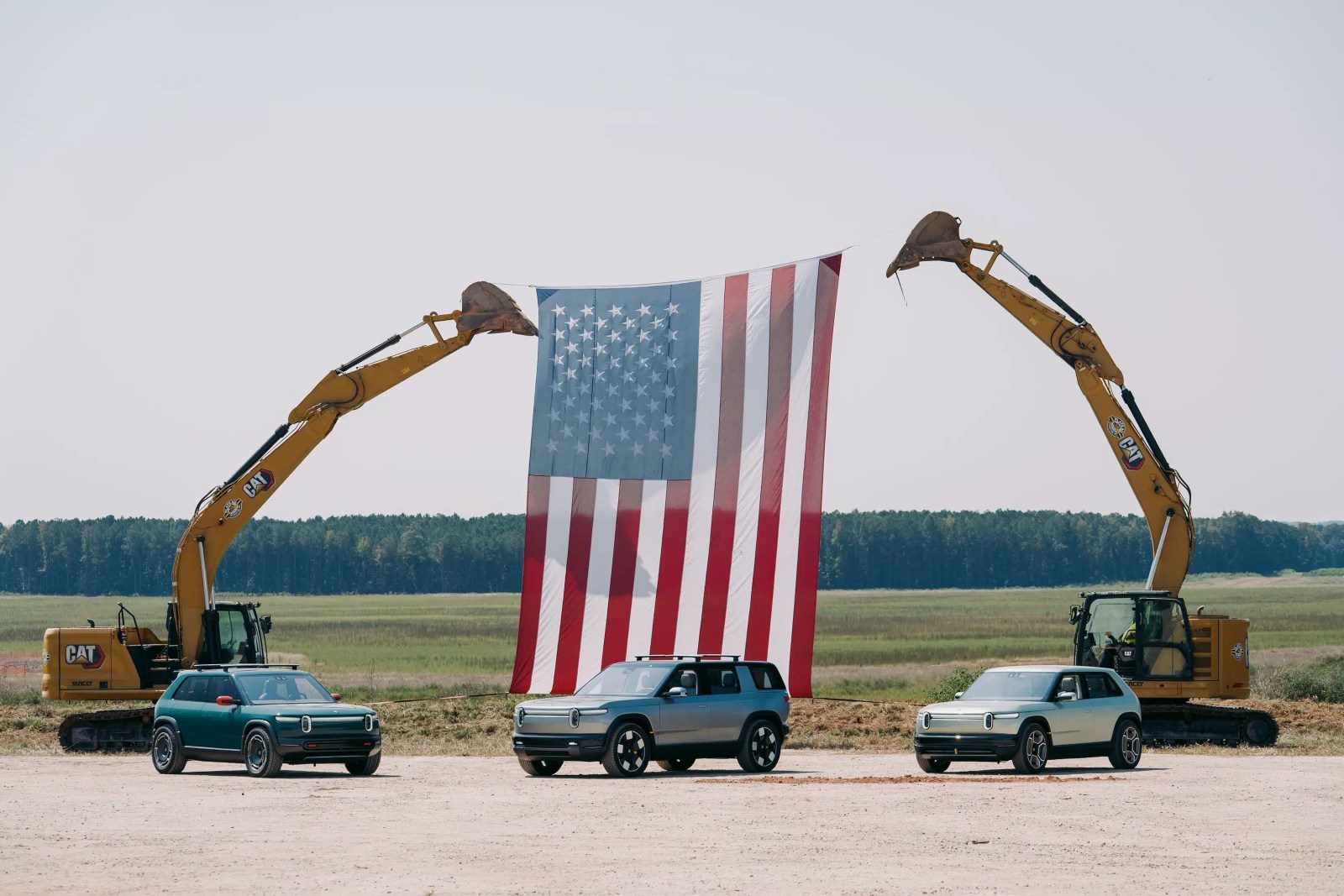
The Georgia project was revived in mid-2025, and Rivian held an official groundbreaking ceremony on September 16, 2025, with founder and Chief Executive RJ Scaringe and Georgia Governor Brian Kemp.
Site development and early construction activities have been ramping since.
Rivian has stated that vertical construction — the raising of steel and concrete framework — will begin by year-end, with partial operations projected for late 2027 and customer vehicle production targeted for late 2028.
Scaringe reaffirmed the timeline on the company’s first-quarter earnings call on April 30, saying that the company remains “on track for the production of our midsized vehicle platform to begin in Georgia in late 2028.”
DOE Loan
In late 2024, Rivian secured conditional approval for a loan of up to $6.6 billion from the US Department of Energy to finance the Georgia plant.
The company closed the loan agreement in January 2025.
However, earlier this year the loan was renegotiated under the current administration, with the EV maker disclosing during its latest earnings report that it had been trimmed to $4.5 billion from the original $6.57 billion.
The revised amount consists of approximately $4 billion of principal and approximately $500 million of capitalized interest.
CFO Claire McDonough told analysts that the loan “provides low-cost financing for our 300,000-unit capacity greenfield expansion in Georgia, bringing Rivian to meaningful scale.”
McDonough added that Rivian expects to draw on the loan by early 2027, earlier than previously expected.
Additionally, 2026 capital expenditure guidance of $1.95 billion was upped to $2.05 billion, now including spending on “kicking off construction of our greenfield plant in Georgia.”
During the last earnings call, Rivian‘s CFO was pressed by UBS analyst Joseph Spak on whether the loan would cover future expansion beyond the initial 300,000-unit phase.
According to McDonough, the current $4.5 billion is for the initial phase only.
She noted that the Georgia site’s full first-phase build will occupy the upper pad, leaving the lower pad “entirely untouched greenfield for future expansion.”
Future phases could be funded organically or through new capital sources.
Earlier this week, Rivian announced a 75-million-share sale — of which proceeds would fund general corporate purposes and equity contributions required under the amended DOE loan agreement.
Georgia Capacity
Alongside the DOE loan revision, Rivian increased Phase 1 capacity at the Georgia plant by 50% to 300,000 units per year.
Combined with the Normal plant’s 215,000-unit annual capacity, the Georgia facility would bring total production to 515,000 vehicles per year.
McDonough said on the Q1 call that ramping both plants “is what takes Rivian to free cash flow positive in the future.”
The company raised its full-year delivery guidance last week after second-quarter deliveries of 12,194 vehicles exceeded the company’s own outlook.
Rivian has consistently said the Georgia facility will also produce the R3 crossover and its performance-focused R3X variant, both of which share the R2’s midsize platform.
The two models were unveiled as a surprise alongside the R2 at the March 2024 reveal event.
Scaringe has said the R3X — a tri-motor variant with rally-inspired styling — will launch before the standard R3, and told The Drive recently that it is “a couple of years away,” tying its arrival to the Georgia factory timeline.
The R3 is expected to be priced “notably lower” than the R2.
On the first-quarter call, Scaringe framed the Georgia capacity increase as a foundation for the broader midsize lineup, saying it “sets up a wonderful foundation for us as we think about further capacity on this platform, both for R2 as well as R3 and variants of those vehicles out of the Georgia facility.”
The CEO has said Rivian’s product plan extends to “five or six different vehicles,” with the R4 and R5 following the R2 and R3.
He told Reuters in May that the company is also working on additional R2 variants, including a potential R2X. “What we’re building in Georgia allows for different variations,” he said.