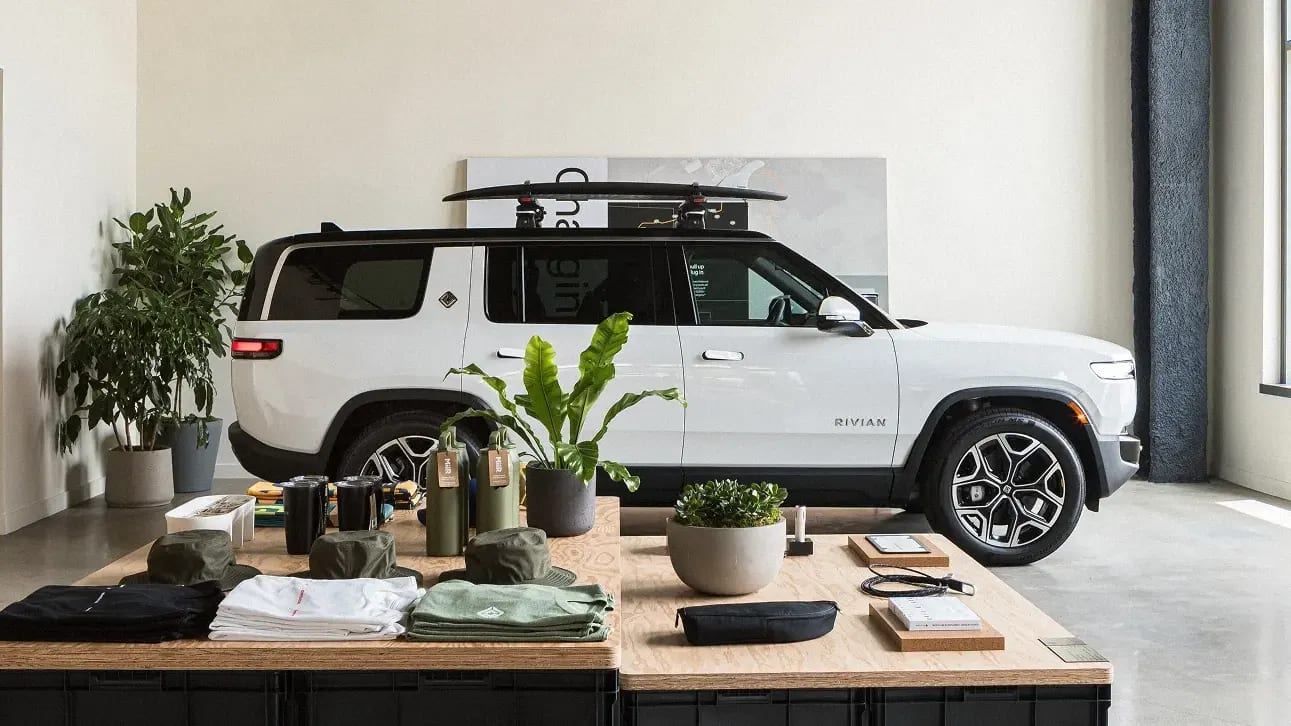

Rivian opens its fourth Massachusetts location this weekend, at the Legacy Place lifestyle centre in Dedham, about ten miles from downtown Boston — the latest addition to a consumer-facing network that is nearing 50 showrooms.
The Dedham Space will be open Monday to Saturday from 10 a.m. to 8 p.m. and Sunday from 11 a.m. to 6 p.m., with demo drives bookable through the company’s site. A free grand opening event runs from 10:30 a.m. to 2:30 p.m. on Saturday.
The location follows Spaces in Boston’s Back Bay, a service and demo centre in Canton, and a further Massachusetts site.
Spaces Jump 39%
Rivian ended the second quarter with 43 Spaces, up from 31 a year earlier — a 39% increase. Four were added in the quarter alone, and Dedham takes the count to 44.
Deliveries over the same period rose 14%, to 12,194 from 10,661.
Service centres grew 28% to 104 from 81, and the ‘Rivian Adventure Network’ reached 155 locations and 1,073 chargers, up 26% and 37% respectively.
The single largest movement was in demo drives, which more than doubled to over 57,000 from more than 28,000 a year earlier — a figure that includes marketing events and what the company calls Electric Joyrides.
Why the Ratio Matters
The build-out is running ahead of the volume, which is the point.
Rivian began R2 deliveries on June 9, moving the company below $50,000 for the first time, and raised its full-year delivery guidance by 3,000 units to between 65,000 and 70,000 vehicles. That implies 42,400 to 47,400 deliveries in the second half, weighted toward the fourth quarter — about double the first-half pace.
Founder and chief executive RJ Scaringe said conversion of reservations to orders on the $58,000 Launch Edition had been meaningfully higher than expected, with a significant number of first-time electric vehicle buyers coming from a broad range of brands.
Production rose 111% year on year to 12,613 vehicles, against the 14% delivery increase — a gap that reflects both the R2 ramp and a weak comparison quarter in 2025.
The Financial Backdrop Has Improved
The expansion comes as the underlying numbers move in the right direction. Revenue rose 27% to $1.658 billion.
Gross profit reached $179 million, the fourth consecutive positive quarter after a $206 million loss in the same period last year — a $385 million year-on-year swing.
Adjusted EBITDA remained negative at $379 million, though that is an improvement of $288 million from a year earlier and the narrowest quarterly figure in the five periods the company disclosed.
The Retail Model
Like Tesla and Lucid, Rivian does not use franchised dealers.
The brand’s Spaces are company-operated showrooms in retail and lifestyle developments rather than on dealer forecourts, a structure that has kept it in legal conflict with dealer associations in several states.
Rivian describes the format as a playground rather than a showroom, inviting visitors to climb in and on the vehicles without an appointment, alongside coffee, merchandise and community programming.
Legacy Place, which is managed by WS Development, plans to make public EV charging available at the centre in 2027.
The Adventure Network
The charging network grew faster than any other physical asset the company disclosed, and more unevenly than the annual figure suggests.
Locations rose from 123 to 155 over the five quarters shown, and chargers from 781 to 1,073 — increases of 26% and 37%.
The quarterly pattern is lumpy. The network added 8 locations and 69 chargers in the third quarter of 2025, then 10 and 87 in the fourth, then just 4 and 36 in the first quarter of 2026, before a record 10 locations and 100 chargers in the second.
The first quarter has been the slow one in both 2025 and 2026, consistent with winter construction constraints.
Sites are also getting bigger.
Average stalls per location rose from 6.35 to 6.92 across the period, meaning Rivian is densifying existing corridors rather than only extending them. The network crossed 1,000 stalls in early June.
Reliability
Rivian attributes its performance to controlling the whole stack.
“By owning the hardware, software, and localized maintenance, we’ve maintained a 98% uptime across the network in 2025 and continue the push for reliability in 2026 and beyond,” the company says, describing proprietary single-cable dispensers delivering peak power that is often 300 kW.
That claim was tested this week. J.D. Power’s 2026 public charging study found that satisfaction with DC fast chargers varies sharply by location type — highest at hotels, gas stations and restaurants, and lowest at car dealerships, which scored 570.
Rivian’s Adventure Network placed third in the same study at 755 points, behind IONNA at 807 and the Mercedes-Benz Charging Network at 797 — the first year all three were award-eligible, and the first time automaker-built networks swept the podium.
The same study found the industry’s non-charge visit rate, where drivers arrive and leave without charging, fell to 12%, its lowest recorded level.
NACS
Around 97% of Adventure Network locations are now open to vehicles from other brands, with tap-to-pay removing the need for an app. The network runs on renewable energy and sits alongside Waypoints, Rivian‘s slower Level 2 network at destinations.
The connector transition is further along than most rivals’. As of June, 166 stalls at nearly 50 locations carried NACS connectors, about 16% of the total.
By the end of the second quarter, 53 locations offered both NACS and CCS1, 88 remained CCS1-only, and 15 had gone NACS-exclusive — unusual for a non-Tesla network, and pointed at the R2, which ships with a native NACS port.
Rivian drivers can also reach more than 21,500 Tesla Superchargers, and the company has added Plug and Charge support and live availability data for Electrify America and IONNA inside its own navigation.
The Plan It Is Still Chasing
Set against Rivian‘s own target, the expansion looks slower.
The company said in 2021 that it would build more than 3,500 chargers at over 600 locations across the United States and Canada by the end of 2023.
Two and a half years past that date it has 1,073 chargers at 155 locations, and no sites in Canada at all.
At the average pace of the last four quarters — about eight locations and 73 chargers a quarter — the site target would take another fourteen years and the charger target another eight.