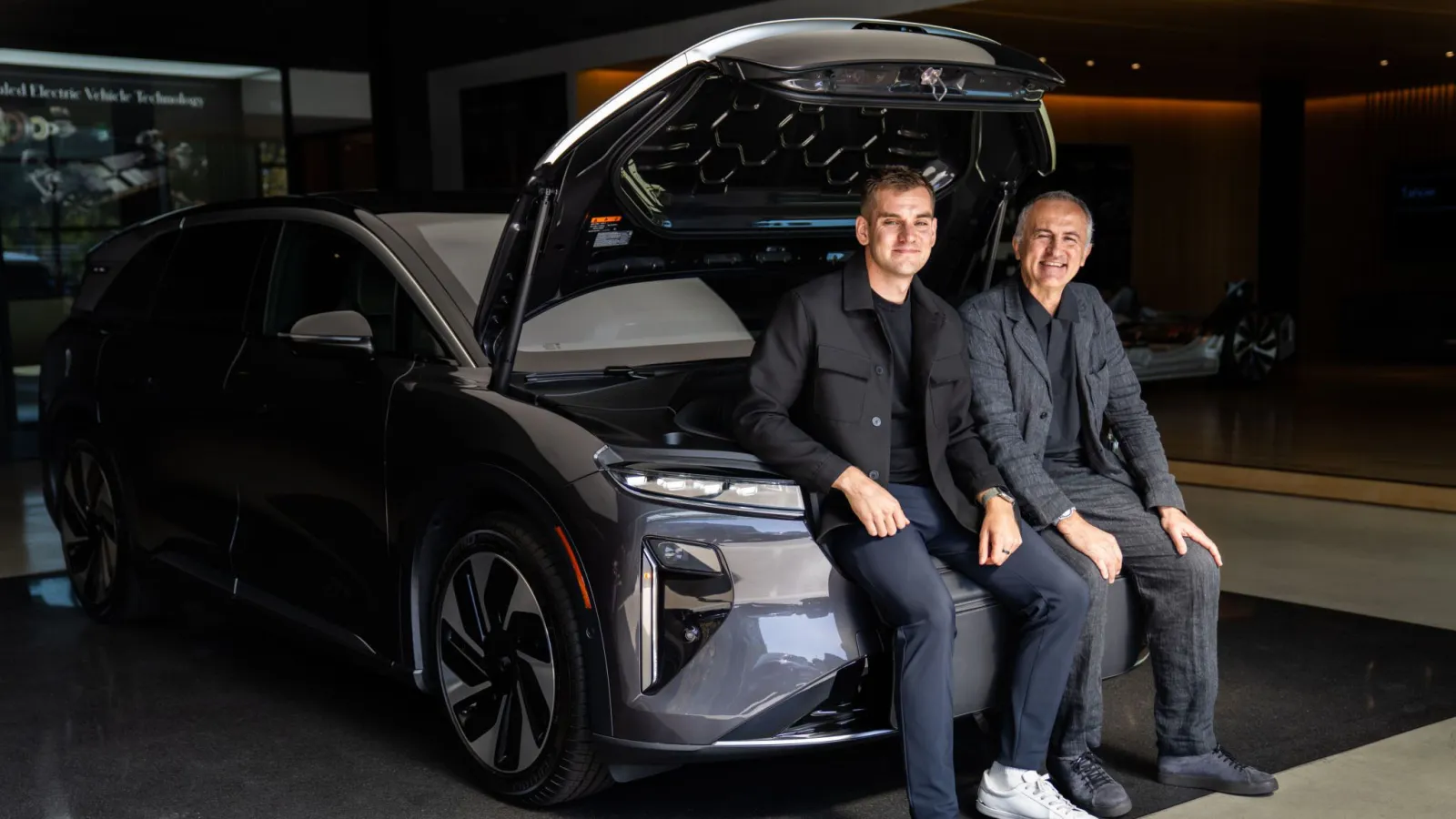
Lucid introduced a new performance version of the Gravity on Thursday, taking the model to 1,070 horsepower and claiming the title of America’s most powerful three-row SUV.
The same day, Rivian announced its 2027 R1 line — in which the Quad, the vehicle Lucid‘s claim is measured against, carried over unchanged at 1,025 horsepower.
The two announcements are not equivalent.
The Gravity GT-S is a new variant sitting above the Grand Touring, priced about $27,000 above the trim below it.
Rivian‘s was a model-year changeover in which the Dual and Tri trims were renamed Premium and Performance while the Quad carried over untouched — same 1,025 horsepower, same 1,198 lb-ft, the figures published when the second-generation R1 was revealed in June 2024.
The Quad reached buyers later than the rest of that line, with first drives in July 2025 as a 2026 model. This is its second model year on sale.
The gap between them is 45 horsepower, equivalent to 4.4%.
The Output Is Not New Either
The 1,070-horsepower figure has appeared before.
It is the output of the Gravity Dream Edition, the limited-production launch trim that started at $139,900 and which Lucidremoved from the lineup for the 2027 model year in April, four months before the GT-S was announced.
So neither company raised its ceiling on Thursday. Rivian carried its most powerful trim over untouched, and Lucid restored a peak it had withdrawn, at $12,150 less than the Dream Edition cost.
The Quicker Car Is the Less Powerful One
Rivian quotes the R1S Quad at 2.6 seconds to 60 mph and a quarter mile in 10.5 seconds, both requiring 22-inch Super Sport wheels and launch mode.
Lucid quotes 3.1 seconds for the GT-S and has not published a quarter-mile time.
Half a second separates them, in Rivian‘s favour, on 45 fewer horsepower.
The explanation is layout.
The R1S Quad uses four motors, one per wheel, allowing torque to be distributed independently — the same architecture behind its Kick Turn feature, which rotates the vehicle on loose surfaces.
The GT-S retains the dual-motor arrangement used across the Gravity range, with output raised rather than motors added.
Car and Driver measured the 828-horsepower Gravity Grand Touring at 3.1 seconds to 60 mph and 10.9 seconds over the quarter mile — the same 0-60 time Lucid now quotes for a car with 242 more horsepower.
Either the GT-S number is conservative or the additional output does little in a straight line.
What Rivian Chose Not to Do
The Quad’s engineering compromises are on the record because Rivian‘s founder and CEO RJ Scaringe has discussed them.
Scaringe told The Drive that the team considered upgrading the brakes for the Quad and decided against it on cost and complexity grounds.
The 1,025-horsepower model therefore runs the same six-piston front and four-piston rear calipers and the same rotors as the 533-horsepower Dual Motor.
He gave the same reasoning for leaving out locking differentials, saying they would add cost and complexity and that owners were unlikely to take full advantage of the capability — a judgement that rests on the four-motor system’s software doing the work instead.
Scaringe framed the trim itself in simpler terms at its Lake Tahoe launch.
“A lot of customers just want the best that we can do,” he said. “The vehicle is on-road and off-road. It can do both of those things, and it allows us to push some of the technical boundaries of what’s possible.”
He was blunter about its purpose in a roundtable interview at the same event. Asked about the Quad, Scaringe said: “It’s great for the brand, but it’s sort of an exercise in unnecessary capability.”
No comparable remark exists from Lucid, which has built the GT-S launch entirely on the claim that 1,070 horsepower makes it the most powerful three-row SUV in the country.
He has since used it as the reference point for what the cheaper R2 is not, telling CNBC in February that buyers should not expect “the more than 1,000-horsepower, go-anywhere capability of the $120,000 R1 Quad.”
The Quad’s motors are oil-cooled, which Rivian says improves efficiency and holds temperatures stable in low-speed, high-torque work such as rock-crawling. Its 400-mile Conserve mode figure is achieved by largely shutting down the rear motors.
Where the Lucid Wins
The Gravity runs a 926-volt architecture against Rivian‘s roughly 400-volt system, and the consequences are large.
Peak DC charging is 400 kW for the GT-S against 220 kW for the R1S Quad, and MotorTrend has observed a real-world Rivian peak of 204 kW.
On alternating current the gap is similar: 19.2 kW against 11.5 kW.
Efficiency follows the same pattern.
Both land at almost identical range — 373 miles projected for the GT-S, 374 miles estimated for the Quad — but the Rivian needs a 140 kWh pack to do it where the Gravity uses 123 kWh gross and 121 usable. The Gravity’s drag coefficient is 0.24.
The Lucid is also the lighter car by roughly 1,000 pounds, at about 5,900 pounds against nearly 7,000, and carries more cargo — 112 cubic feet behind the front row against 90.7 for the R1S.
Where the Rivian Wins
Towing is 7,700 pounds against 6,000.
The R1S offers five air suspension ride heights, all-terrain wheel and tyre packages, a reinforced underbody shield and ground clearance the Gravity cannot approach.
Rivian describes the Quad as a sports car that off-roads and says it is both the fastest vehicle in its lineup and the most capable off-road.
The GT-S goes the opposite way. Its standard Dynamic Handling Package brings independent rear-wheel steering and a three-chamber adaptive air suspension that lowers the vehicle at speed.
Neither Range Figure Is Certified
Both companies are quoting estimates.
Lucid‘s footnotes describe 373 miles as a manufacturer’s projection, with the official EPA estimate to follow.
Rivian‘s state that official EPA values are noted as such and that other figures are preliminary estimates based on the EPA test cycle.
The 2026 R1S Quad’s certified EPA rating is 338 miles. The 374-mile figure would be a 36-mile improvement on a carried-over powertrain.
Lucid lists the Gravity GT-S as available in late 2026. Orders can be placed now with the first units arriving months from now.
The Faster-Charging Car
Both the GT-S and the Grand Touring take 400 kW, but Lucid‘s own figures have the Grand Touring reaching 200 miles of range in under 11 minutes against 14 minutes for the GT-S.
The likely cause is wheels.
Lucid‘s range and charging figures for the Grand Touring are quoted on 20-inch front and 21-inch rear wheels; the GT-S is offered only in 21 to 23-inch sizes, on Pirelli P Zero tyres.
The move also explains the projected 373-mile range against the Grand Touring’s 450 — the GT-S’s smallest wheel is larger than the basis on which the Grand Touring is rated.
Price
The R1S Quad starts at $121,990 on Rivian‘s trim pricing, against $125,900 for the Gravity GT-S before destination, taxes, options and documentation fees. On comparable figures the gap is about $3,900.
A destination fee of $1,895 applies to the Rivian.
The company’s dedicated Quad page separately lists a starting price of $125,990 and a configured example at $124,490, figures that do not reconcile with the trim table or with each other.
The options structures differ sharply.
Almost nothing on the Quad costs money: the 22-inch Super Sport wheels required for the 2.6-second time are a no-cost option, as are 20-inch Dune Satin Graphite all-terrain wheels, with 22-inch Sport Burnished Bronze fitted as standard.
The Sound and Vision package, the Dynamic glass roof, Rivian Premium Audio, the reinforced underbody shield, plaid mats, black badging, Laguna Beach Blue calipers and Quad line badging are all included.
What does cost extra is paint, at up to $3,000, and the new second-row captain’s chairs, priced at $1,500 with the standard Black Mountain Signature interior, $4,000 with Ocean Coast Signature and $4,500 with Slate Sky Signature.
Autonomy+ is $2,500 and the Connect+ subscription $15 a month.
A Quad with the most expensive paint, the most expensive captain’s chairs and Autonomy+ reaches $131,990 before destination — above the GT-S’s base price, on a car that is already fully equipped at $121,990.
Interior and Identity
Both lean on a signature colour.
The GT-S carries blue exterior accents, blue brake calipers, a blue Lucid bear on the front right fender, blue seatbelts and blue stitching and piping through the first and second rows of a Mojave PurLuxe Premium interior.
The Quad uses Laguna Blue — exclusive calipers on 22-inch Super Sport wheels, accents on the Quad badge, and an interior Rivian calls elevated.
Its performance features were developed by an internal group of engineers, racers and rally drivers the company calls the Rivian Adventure Department.
The R1S seats seven, and for 2027 offers second-row captain’s chairs for the first time, reducing it to six. The GT-S seats up to seven.
What Neither Company Has Published
Lucid has not disclosed the GT-S’s torque, curb weight, battery capacity or efficiency rating — an unusual set of omissions for a launch built on a power claim. The 909 lb-ft figure circulating belongs to the 828-horsepower Grand Touring.
Rivian does not publish a top speed for the Quad; independent databases list 125 mph, against the 155 mph Lucid quotes for the GT-S.
Neither has released an instrumented comparison, and no independent test of the GT-S exists yet.
The Segment Is Two Cars Wide
The Tesla Model X Plaid claimed 2.5 seconds and 163 mph but is out of production.
The Cadillac Escalade IQ is heavier and less powerful. The Dodge Durango Hellcat is the accessible combustion alternative.