
Rivian‘s next over-the-air update for the R2 will restore a batch of features the midsize SUV launched without and lay the groundwork for a new in-cabin Pet Cam, the company’s software chief said in a new interview.
The 2026.24 update headlines the arrival of Pet Mode on the R2, alongside a Launch Mode, the Gear Guard security suite, garage-door pairing, an in-vehicle WiFi hotspot, and a long list of access, charging, and infotainment fixes.
Rivian had not published complete official release notes for the version as of the time of writing, with those notes expected later this month.
Chief software officer Wassym Bensaid, who also serves as co-chief executive of Rivian‘s software joint venture with Volkswagen, has trailed several of the additions on his social accounts and detailed the forthcoming Pet Cam feature in an interview with The Drive.
Closing the Launch Gap
Rivian began R2 deliveries on June 9 with a deliberately reduced software set, omitting Rivian Assistant, Climate Hold, SiriusXM, Google Casting and other features that R1 owners already had, while the Gear Guard security system shipped with limited functionality.
Bensaid framed the trimming as a quality decision, writing after launch that the company “intentionally decided to release few features later to have the best quality,” with the absent items returning through monthly updates over the summer.
The 2026.24 release is the first major step in that catch-up, and Bensaid confirmed its centerpiece directly, posting a photo of his dog in his own R2 with the caption “Pet mode coming to R2 in the next OTA. Approved by Paddington!”
What the Update Adds
Pet Mode, which Rivian markets as Pet Comfort, holds a set cabin temperature for an animal left briefly in a parked, locked vehicle, showing a reassuring message to passersby and reporting cabin status to the owner’s phone.
The feature reached the R1T and R1S via a 2022 software update and has since become a selling point among pet-owning buyers, some of whom describe the R1 as an ideal dog vehicle.
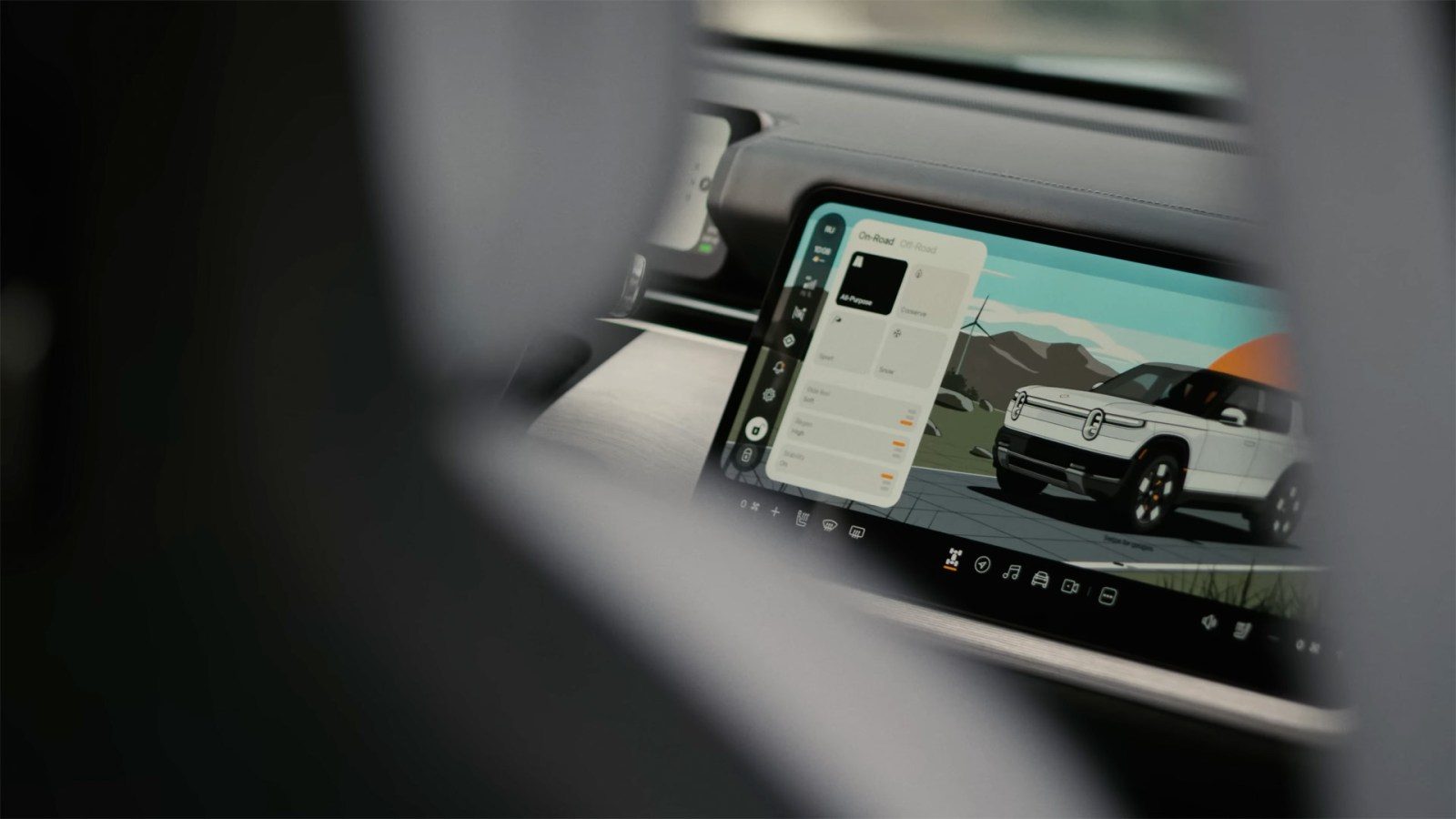
Launch Mode arrives in the same release for the R2 Performance, the dual-motor trim that is the only R2 on sale so far, sitting alongside seven other drive modes and providing maximum off-the-line acceleration, a higher top speed and recorded zero-to-60-miles-per-hour and quarter-mile times, a capability Rivian designates for closed-course use on dry surfaces.
Bensaid signaled the feature days ahead of the changelog, posting video of an R2 Performance clearing zero to 60 in 3.45 seconds, quicker than the 3.6-second figure on the company’s own website, and writing that his “team testing Launch Mode on R2” was “coming in the next OTA update.”
The Gear Guard security suite also expands, with cameras that record incidents while the vehicle is driven and capture activity around the SUV after it is locked, motion sensors that trigger an alarm, and alerts sent to the mobile app.
A new key-fob battery indicator appears in the update, and the vehicle now detects which key is closest to the driver door when it opens, loading that key’s profile and moving the seat, steering wheel and mirrors to saved positions.
The build further closes the gap with the R1 by adding garage-door pairing through HomeLink-style radio protocols, an in-vehicle WiFi hotspot whose settings persist across reboots and updates, and the ability to schedule software updates from the Rivian mobile app.
The Fixes Beneath the Features
Beyond the headline additions, the 2026.24 build carries a dense list of corrections that speak to the early state of R2 software.
The release refines hands-on-wheel detection to cut unnecessary prompts, resolves overlapping notifications and a missing Universal Hands-Free icon during turns in the Blind Spot View, and fixes an issue that prevented Adaptive High Beams from enabling on some vehicles.
That last fix addresses a complaint early R2 owners had raised, with drivers on the r/RivianR2 forum describing the matrix LED adaptive high-beam system as effectively inoperative before the company said the next update would resolve it.
Climate handling improves as well, with more consistent vent behavior after sleep and wake cycles and a fix for cases where the SUV entered sleep while a mobile-initiated seat-heat or vent request was still active.
Several mobile-app faults are addressed, among them a spurious zero-miles-per-hour charge rate shown during DC fast charging, ignored consecutive remote charge commands and an inaccurate range value sent to the app.
Access reliability receives attention through improved liftgate and drop-glass behavior after updates and steadier passive entry after the vehicle wakes, including rear-door-handle operation and digital-key detection on the wireless charger.
The infotainment and media stack draws a long set of corrections, among them a fix for Spotify hanging in a loading state, improved Apple Music streaming and login reliability, restored turn-by-turn navigation chimes and more accurate arrival estimates that account for charging stops.
Rounding out the list are smaller refinements to the Haptic Halo Wheel, a quieter turn-signal chime, a trailer icon on the driver display, and fixes for a driver seat that required recalibration each drive and a seatbelt icon that stayed lit after unbuckling.
The Marquee Feature Still to Come
The larger pet feature, Pet Cam, will not ship in this update but is due later in 2026, Bensaid told The Drive, with the executive citing the priority of getting the R2 to customers as the reason the software trailed the hardware.
Pet Cam lets owners watch their animal from the Rivian app on iOS or Android, and it depends on a new RGB camera hidden in the R2’s rearview mirror that also serves as the driver-attention monitor for the company’s Universal Hands-Free system.
The R1 will not receive Pet Cam, at least initially, because its driver-monitoring camera is infrared rather than RGB and cannot perform the same task, making the feature a matter of R2 hardware rather than software alone.
Bensaid placed unusual emphasis on the safeguards around the camera, telling The Drive the system “will only activate if there’s a pet” and that “if there’s a human, the feature will not be on.”
The executive tied that limit to a specific risk, saying it was “really super important for us to protect from cases like domestic violence” and that the company did not want to hand anyone “a tool to spy on” a partner.
Detection will draw on image recognition, weight sensors and the camera’s own scene analysis, the interior camera will be off by default and opt-in, and the display will show an indicator whenever the camera is recording, Bensaid said.
Pet Cam sits on top of Pet Mode rather than inside it, becoming available only once Pet Mode is active, and owners can toggle the camera on to check in and off again from the app to limit battery draw.
Software at the Center of the R2 Story
The additions land as software becomes the defining thread of the R2’s rollout, the model on which Rivian is staking its move toward higher volume and, eventually, profitability.
The software catch-up runs in parallel with an uneven early ramp, with some buyers reporting stalled orders and unmatched VINs as vehicles accumulated at the factory in the model’s first weeks on sale.
The R2 is the first vehicle to run RivianOS 2.0, a ground-up rewrite that unifies navigation, media, energy and quick controls, and the company has said the operating system will reach R1 vehicles later in 2026 without yet detailing which features those cars will inherit.
Whether Pet Cam can ever extend to the existing fleet remains open, given its dependence on the newer camera, and the company has not addressed the question directly.
Rivian has moved through a rapid update cadence in 2026, introducing its agentic Rivian Assistant to R1 vehicles in the spring, and the R2 sequence now follows a similar pattern of monthly feature drops layered on frequent fixes.
The same in-cabin camera serves for the driver monitoring in a hands-free system that Rivian has said will grow into point-to-point capability comparable to rival driver-assist suites by the end of the year.
Pet Cam is not the only feature Bensaid has placed on the year’s roadmap without tying it to a specific build, having also pointed to deeper integration of the third-party route-planning app A Better Route Planner “coming to your Rivian this year” in a late-June post congratulating its developers.
The camera-based pet approach also narrows the distance to Tesla, whose Pet Mode, once branded Dog Mode, has long streamed the cabin camera to the owner’s phone.