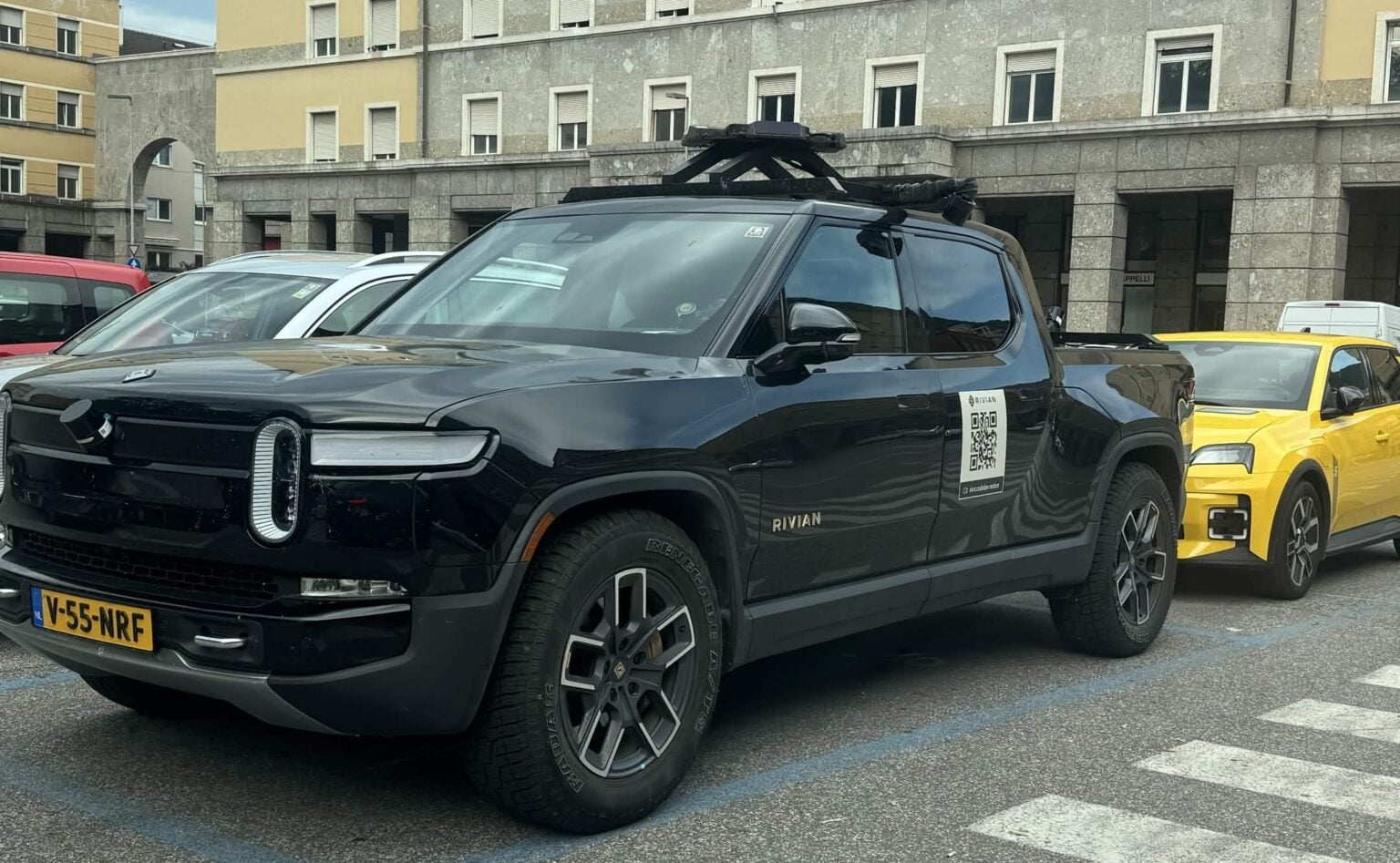

A Rivian R1T equipped with a roof-mounted sensor array was spotted on Wednesday in Italy, a test vehicle the US EV maker has been using to gather the data it needs before it can launch in Europe.
The pickup, finished in black and carrying Dutch license plates, was photographed in Bolzano by the Discord user ‘Waroen5’ and reported by RivianTrackr.
Rivian currently sells its EVs in the US and Canada, while a few hundred delivery vans co-developed with Amazon drive in Germany as part of the retail giant’s fleet.
The Dutch plates indicate that the vehicle is not locally registered, consistent with a vehicle operating out of Rivian‘s European base in Amsterdam, where it established its regional entity, Rivian Europe B.V., in 2020.
As seen with several other automakers, Rivian uses the real-world data these camera-, radar- and LiDAR-equipped trucks to collect data and train the driving model.
Groundwork Without a Date
In late May, EV reported that the company had posted a job opening for a senior development lead to build out its European commercial real-estate footprint, a role based in Amsterdam and tasked with steering the design and delivery of sales, service and parts facilities across the region.
The posting cast the successful candidate as the person who would “steward the physical foundation” of the company’s European market entry, working across multiple markets and regulatory regimes.
Both the hire and the mapping truck advance Rivian‘s European preparations even as the launch itself remains without a firm date.
Earlier this year the company quietly removed its previously stated 2027 European launch year from its website, replacing it with a message inviting prospective buyers to register for updates.
Rivian‘s site now hosts dedicated pages for 18 European countries, among them the UK, Germany, France, Spain, Italy, Sweden and Austria, none carrying a launch date.
Chief Financial Officer Claire McDonough has said Rivian will take a measured, phased approach to Europe rather than entering every market at once, exporting first from its Illinois plant and expanding export volume as its planned Georgia factory adds capacity.
The R2 as the Entry Car
The vehicle Rivian has long positioned as its European entry model is the R2, the mid-size SUV that reached its first US customers this year.
McDonough has described the R2 as the company’s “primary global scaling product,” and the model was engineered from the outset for markets beyond the US, developed with European dimensions and repairability standards in mind and confirmed in March as one of the first vehicles to adopt the new GSMA eSIM automotive standard.
He has also described European production as a long-term objective, even though Rivian‘s near-term plan is to serve the region by exporting from its US plants.
The company is targeting 20,000 to 25,000 R2 deliveries in 2026, within total guidance of 62,000 to 67,000 vehicles across its lineup.
On how it will sell the car, founder and Chief Executive RJ Scaringe said last September that direct-to-consumer “is still the plan for Europe,” while acknowledging the continent leans toward a more omnichannel approach than the US, and McDonough has since hinted the company could adopt a hybrid dealership model in some markets.
A Foothold Already in Place
Through its commercial partnership with Amazon, the company has run more than 300 electric delivery vans on the continent since 2023, and it has kept open listings for mobile service technicians in Munich to support that fleet.
Rivian‘s office in Belgrade, Serbia, its biggest outside the US, grew from 15 employees at the end of 2022 to 383 at the end of 2025, focused on vehicle software and driver-assistance development.
The company opened an AI and autonomous-driving hub in London in July 2025, its first UK facility, and maintains a team in Lund, Sweden, inherited through its 2023 acquisition of the startup behind the A Better Routeplanner app.
The Lund office is co-located with the Rivian and Volkswagen Group Technologies joint venture, which by late last year operated across the US, Canada, Sweden, Serbia and Germany with more than 1,500 employees.